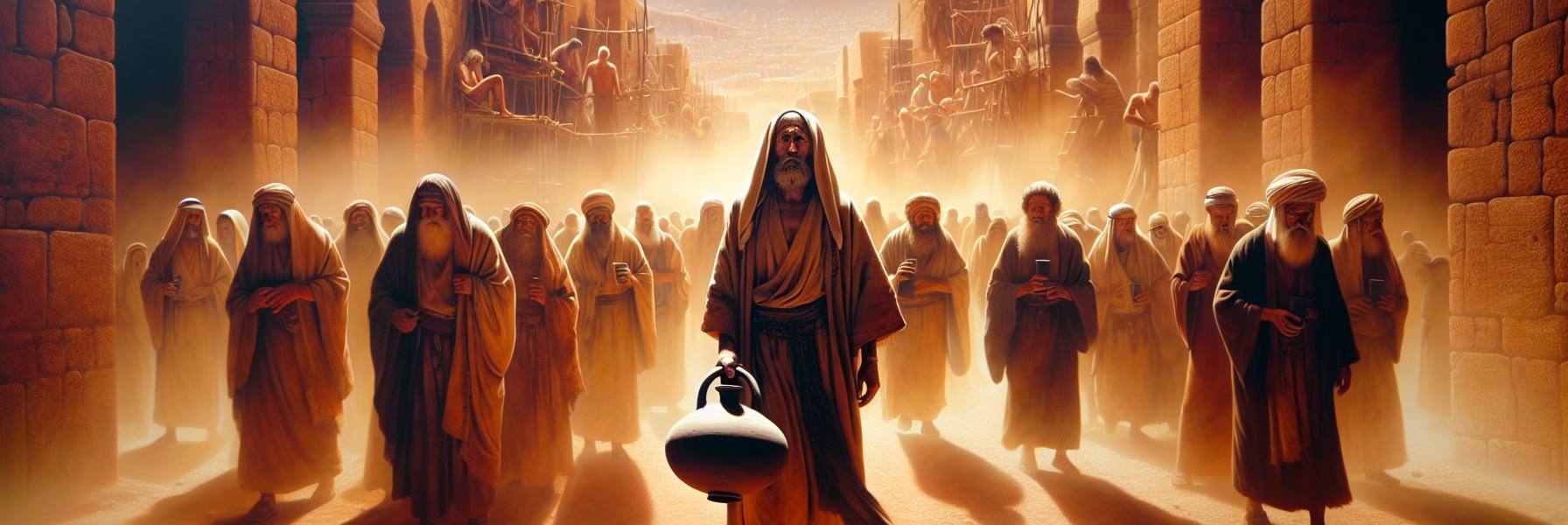

The heat in the Harsith Gate district was a physical thing. It rose in visible shimmers from the packed-earth path, carrying the fine, choking dust of the Valley of the Son of Hinnom. Jeremiah felt its weight on his shoulders as he walked, the clay flask in his hand still cool from the potter’s wheel. It was an ordinary vessel, round-bellied with a narrow neck, the kind used for water or cheap wine. Today, it would hold nothing but the word of the Lord.
He was not alone. Following him were elders of the people and senior priests, their faces set in lines of wary obligation. They had agreed to witness this “sign-act,” as the prophet called it, but their presence was a tense, silent thing. The air smelled of dust and, faintly, of smoke—a scent that never fully left this place.
Topheth. The name itself felt foul in the mouth. It was here, in this valley skirting Jerusalem’s southern flank, that the unthinkable had taken root. Under the shadow of the city dedicated to Yahweh, other fires had burned. Not for refuse, though garbage was dumped here too, smoldering in perpetuity. These fires had been lit for Molech. The memory was a stain on the land. Children—the sons and daughters of Judah—had been passed through the fire here. The theology of desperation, the dark bargain with a silent, bronze idol, whispered that such an offering might bring security, favor. It had brought only a deafening silence from heaven and a festering guilt in the soul of the nation.
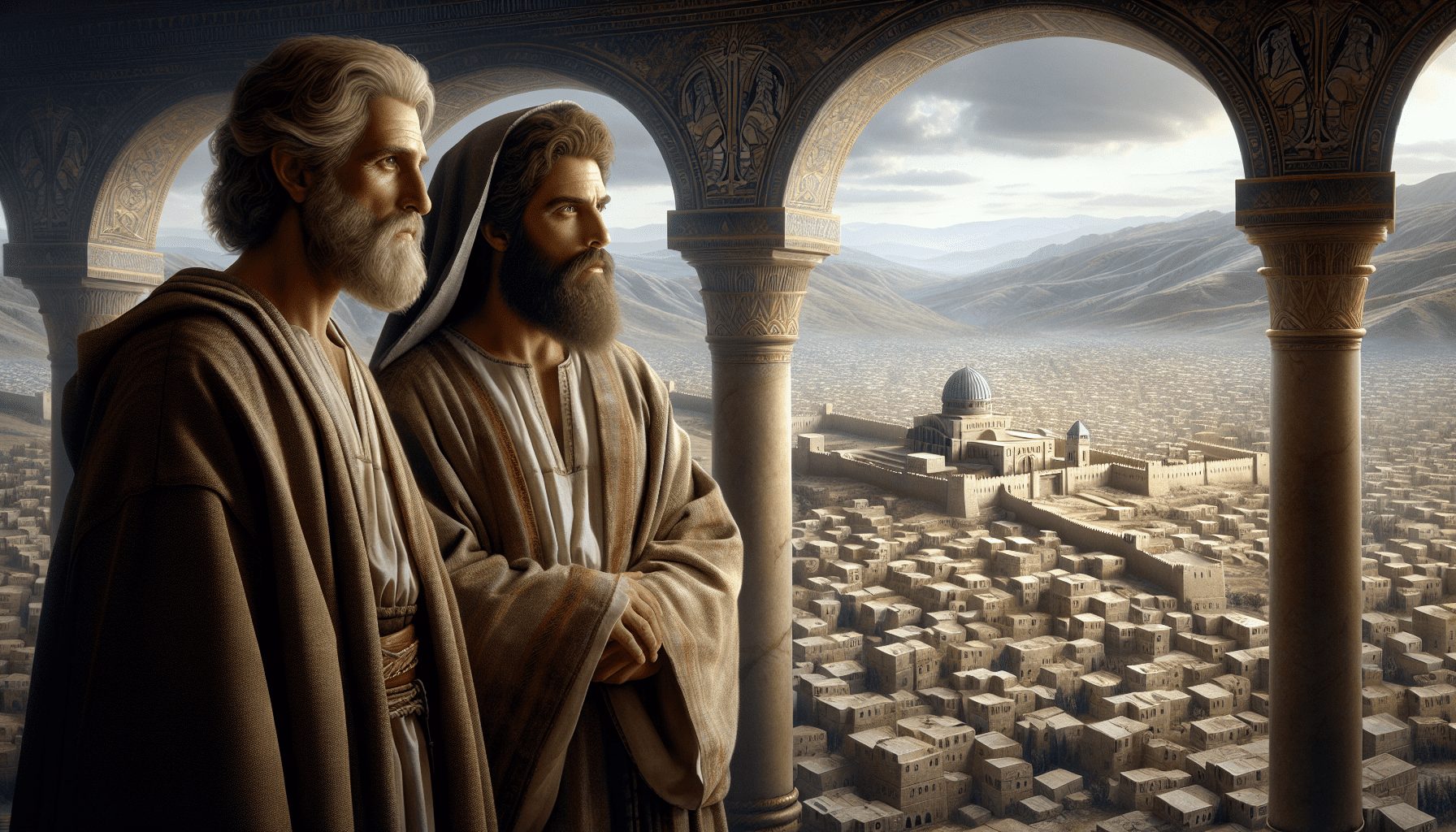
Jeremiah stopped at a place where the view of the city walls was clear. He turned to face the men, their fine linen robes already grayed with the valley’s grime. He lifted the flask, his voice not thundering, but low and graveled, carrying over the empty expanse.
“Hear the word of the Lord, O kings of Judah and inhabitants of Jerusalem. Thus says the Lord of hosts, the God of Israel.”
He spoke of the disaster about to be poured out. The language was not metaphorical. It was the language of a pot about to be smashed. “Because they have forsaken me and have profaned this place by making offerings in it to other gods… and because they have filled this place with the blood of the innocent, and have built the high places of Baal to burn their sons in the fire as burnt offerings to Baal, which I did not command or decree, nor did it come into my mind—”
That last phrase hung in the hot air. *Nor did it come into my mind.* The horror was so profound, so alien to the character of the God who had brought them out of Egypt with a father’s hand, that it existed outside the realm of His thought. It was a pure, human invention of despair.
“Therefore, behold, days are coming, declares the Lord, when this place shall no more be called Topheth, or the Valley of the Son of Hinnom, but the Valley of Slaughter.”
He painted the siege with brutal, vivid strokes. The siegeworks tightening like a vise. The desperation that would break the bonds of kinship. Parents would eat the flesh of their children, and children the flesh of their parents. It was a curse that turned the most sacred human bonds into a grotesque struggle for survival, a final, ironic judgment on those who had violated those bonds in this very valley.
The elders shifted on their feet. One of the priests, Pashhur perhaps, looked away toward the walls, as if calculating the distance back to sanity, to the temple courts where God was manageable, where prophecy could be debated and contained.
Jeremiah’s arm was growing tired, but he held the flask aloft. “And I will make this city a horror, a thing to be hissed at. Everyone who passes by it will be horrified and will hiss because of all its wounds. And I will make them eat the flesh of their sons and their daughters, and everyone shall eat the flesh of his neighbor in the siege and in the distress with which their enemies and those who seek their life afflict them.”
Then he raised the flask higher, his voice shifting from proclamation to a direct, performative declaration. “Thus says the Lord of hosts: So will I break this people and this city, as one breaks a potter’s vessel, so that it can never be mended.”
And he threw it.
It was not a dramatic, overhead pitch. It was a hard, downward thrust, as if driving a stake into the heart of the ground. The clay flask struck a prominent, jagged rock with a dry, sharp *crack*. It did not simply break; it shattered. Fragments skittered across the hard ground—the rounded belly now shards, the neck sheared clean off. A few smaller pieces danced and settled in the dust. It was utterly destroyed. No glue, no careful hand, could ever reassemble it for its intended purpose. It was fit only for the garbage pit it now lay beside.
The sound echoed briefly in the stillness. The men stared at the fragments. The object lesson was complete. Judah was not a metal tool to be reforged in this moment. It was brittle, fired clay that had rejected the potter’s hand. Its fate was to be broken beyond repair.
Jeremiah looked from the shattered pottery to the ashen faces of the leaders. His final words were not for the valley, but for them, and for the city whose walls seemed suddenly less imposing.
“And I will make void the counsel of Judah and Jerusalem in this place, and will cause them to fall by the sword before their enemies… And I will give this city into the hand of their enemies, for they have returned to the evil of their forefathers.”
He turned then, and began the walk back up the path toward the city gate, leaving the elders among the shards and the lingering, accusatory smell of smoke. He did not look back. The message was no longer in his mouth, but lying in pieces on the ground, a silent, permanent testament in the Valley of Slaughter. The only thing left was to wait for the hands that would pick up the pieces, not to mend, but to discard.