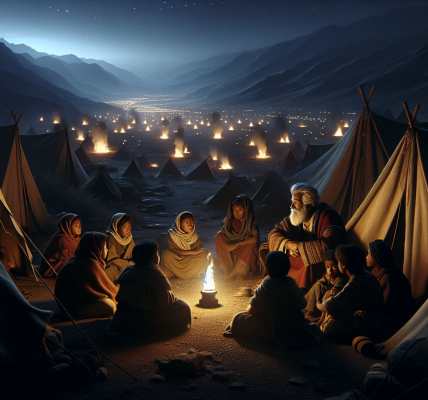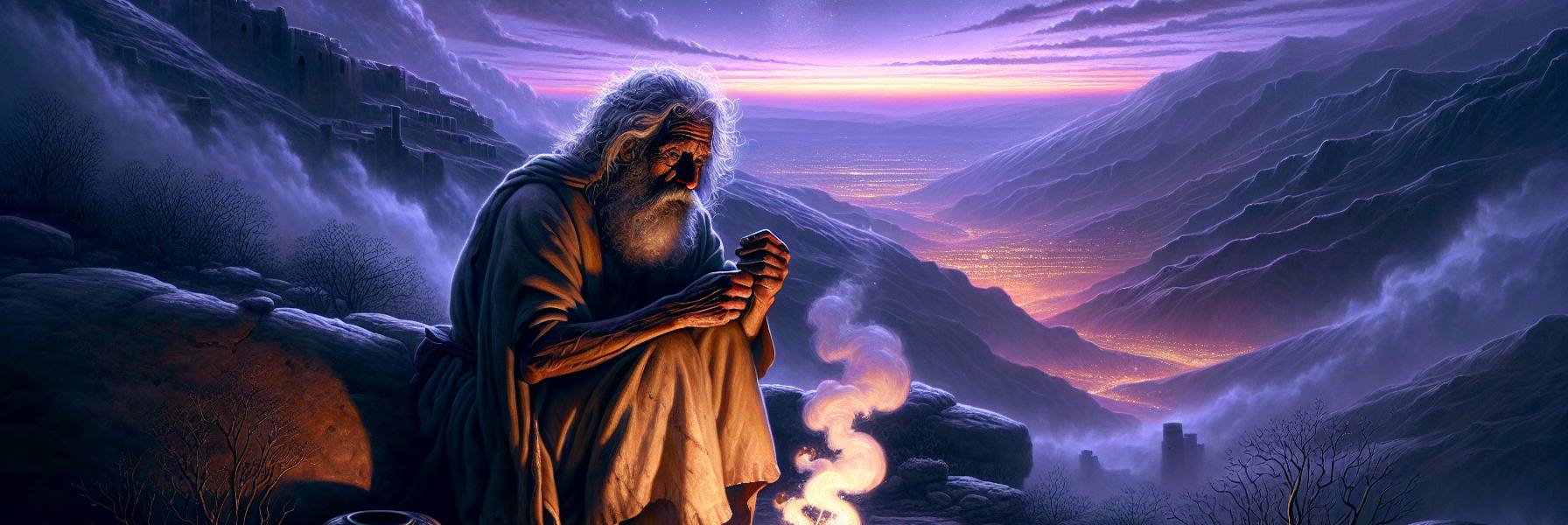

The old shepherd’s bones ached with the deep cold that settled in the Judean hills before dawn. He stirred the embers of a meagre fire, his breath pluming in the air like a silent prayer. Above him, the black vault of the sky was fading to a deep, bruised purple at the edges. The stars, those ancient, cold points of light, were beginning to wash out. He’d watched this ritual his whole life: the relentless retreat of darkness, the silent, inevitable victory of the light. It was a comfort, a daily promise. But as he rubbed his knotted hands, a thought, unbidden and strange, came to him. What if the light wasn’t just a thing that happened, but a *Someone*? What if the first dawn, the one that split the primal chaos, had a voice?
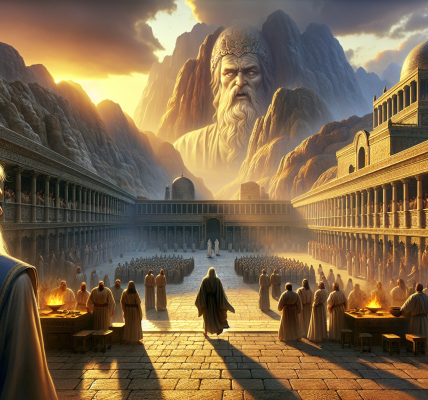
Far to the east, in the gilded silence of the Temple where the air hung thick with the smell of incense and old blood, an elderly priest named Elihu was unrolling a scroll. His eyes, clouded but keen, traced the familiar words. *“Bereishit bara Elohim…”* In the beginning, God created. But his study had lately turned to the Greek translations, and a different word echoed in his mind. *Logos*. The Word. It was a philosopher’s term, a poet’s term. It meant the underlying reason, the ordering principle of everything. He murmured it aloud. “The Word.” It felt heavy, purposeful. He imagined not a sound, but a personified Intent, a divine Mind so potent that to speak was to create. Was God’s first utterance still echoing, he wondered, holding the atoms of the world together even now?
And by the muddy banks of the Jordan, a man clothed in camel’s hair, his skin leathered by sun and austerity, was drawing a crowd. His name was John, and his voice was a river-stone, worn smooth and hard. He spoke of repentance, of a crooked world needing straight paths. They called him a prophet, and he didn’t deny it. But in his heart, he carried a secret knowledge, a memory from the womb—a leap of joy at a presence not yet seen. He pointed away from himself, his arm a stark line against the sky. “I am not the light,” he would growl, his eyes scanning the faces, looking for one in particular. “I am here to point to the light.” People scratched their heads. They understood lambs and thresholds, sin and sacrifice. They didn’t understand a man pointing at the empty air and talking about a light that could walk.
Then He came.
It wasn’t with fanfare that John first saw Him. Just another figure in the line of penitents, waiting to be immersed in the brown, chilly water. But when their eyes met, John felt it—the strange, silent pull of fulfillment. The air seemed to sharpen. As this man stepped into the river, John’s protest died on his lips. He knew. This was the point of all his pointing. Later, he would tell his disciples, his voice dropping to a whisper of awe, “I saw the Spirit come down from heaven like a dove and rest on Him. This is the one.”
The story began to spread, in fragments and whispers. Two of John’s own men, curious, followed this man. He turned and asked them a simple, devastating question: “What are you looking for?” They fumbled, asking where He was staying. “Come and see,” He said. It was an invitation not to a house, but to a new kind of existence. One of them, Andrew, ran to find his brother Simon, breathless. “We’ve found the Messiah,” he panted, using the word they’d longed for for centuries. He brought Simon to Him. Jesus looked at Simon, really looked, seeing not just the fisherman but the man he would become. “You are Simon,” He said. “You will be called Cephas.” The Rock. A new name, for a new creation.
The next day, He found Philip. Just found him. “Follow me,” He said. And Philip, in a moment of clarity he could never fully explain, did. Then Philip found Nathanael, who was skeptical, cynical under his fig tree. “Can anything good come from Nazareth?” Nathanael scoffed. Philip, with the wisdom of one who had just begun to understand, simply repeated the invitation: “Come and see.”
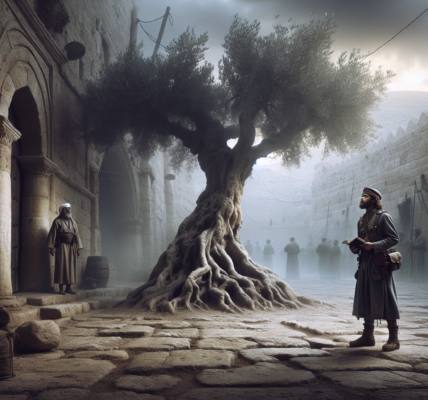
When Nathanael approached, Jesus spoke of him. “Here is a true Israelite, in whom there is no deceit.” Nathanael was stunned. “How do you know me?” Jesus’s reply held a smile, and a mystery that stretched back to the shepherd’s hillside and the priest’s scroll. “I saw you under the fig tree before Philip called you.” It was more than preternatural knowledge. It was the Word, the organizing principle of all things, seeing and knowing a single man under a specific tree at a specific hour. Nathanael’s doubt shattered. “Rabbi,” he breathed, “you are the Son of God; you are the King of Israel.”
Jesus looked at him, and then beyond him, as if seeing all the days to come. “You believe because I told you I saw you under the fig tree? You will see greater things than that.” He gestured upwards, where the last of the stars had vanished, and the full, clear light of day now reigned. “You will see heaven open, and the angels of God ascending and descending on the Son of Man.”
The shepherd felt the new sun warm his face. The priest, Elihu, felt a strange shiver, a sense of a page turning in a story he’d only partly understood. And the light, which had spoken galaxies into being and sustained the slow turn of the seasons, which had been with God and was God, had now pitched its tent among them. It walked, and talked, and called them by name. The true light, which gives light to everyone, was finally, quietly, coming into the world. The darkness had not, and would not, overcome it.