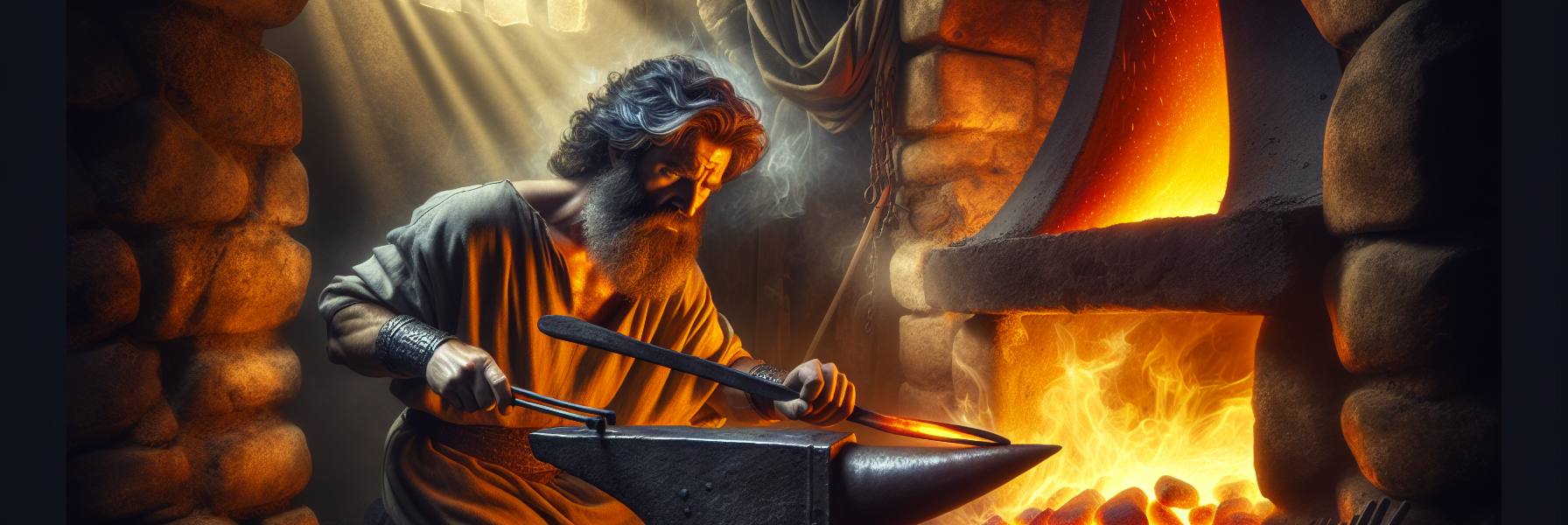

The heat in the forge was a living thing. It pressed against Eliazar’s skin, a heavy, shimmering blanket that smelled of coal and scorched iron. He worked the bellows, the leather groaning, until the heart of the fire glowed a vicious, weeping yellow. A ploughshare lay within, waiting for its final shaping. His mind, however, was not on the ploughshare. It was fixed on Reuben the miller, and the two silver pieces Reuben now refused to pay.
“A disagreement over the temper,” Eliazar had grumbled to his wife that morning. “He says the edge chips. I say he strikes stones. My work is sound. His word is false.”
Now, as the metal reached its critical peak, his anger reached its own. He snatched the ploughshare from the coals with long tongs, the brilliant orange of it lighting the soot-stained walls of his workshop. The rhythmic, punishing clang of his hammer began, each strike a physical echo of his thoughts: *Unjust. Cheated. Defamed.*
He did not see young Tobias, the shepherd’s boy, hovering at the wide doorway, a broken hinge in his small hands. The boy cleared his throat twice. The hammer did not cease.
“Master Eliazar?” Tobias’s voice was thin against the metallic thunder.
“Not now!” Eliazar barked, not turning, bringing the hammer down with a final, conclusive *clang* that sent a shower of sparks skittering across the dirt floor. He plunged the metal into the quenching bucket. The water hissed and screamed, and a great plume of acrid steam swallowed him for a moment. When it cleared, his face was set like the stone Reuben had allegedly hit. “A man is at his work. Can a man not work in peace?”
The boy retreated, the hinge forgotten. Eliazar felt a grim satisfaction. His workshop was his fortress, his anvil his throne. Here, his will was manifest in iron. Let Reuben whisper in the market. Let others judge. He knew his own worth. He needed no one’s counsel, especially not the placating words of those who would tell him to seek peace. To yield was to admit fault, and he had none. His spirit, in that moment, was like a city with its gates barred high, and he, the solitary defender, saw only enemies on the plains.
Across the village, by the chuckling stream that turned the great oak wheel, Reuben the miller sat in the cool, flour-dusted dimness of his mill. The air here was different—filled with the soothing, endless rumble of stone on stone, the gentle creak of timber, and the sweet, earthy smell of crushed grain. A fine, soft powder settled on everything, including Reuben’s beard, giving him the look of a man touched by early frost.
He was not alone. Old Nathan, who had once been a scribe in Jerusalem, sat on a sack of barley, his gnarled hands resting on his knees. Nathan had come to buy meal, but had stayed to talk of the unseasonable rains.
“It will make the late harvest difficult,” Nathan said, his voice a dry rustle. “The clay soils down by the river will hold the water like a cup.”
Reuben listened, nodding slowly. He was a man who listened more than he spoke. The words of others, to him, were like the grain he ground—to be sifted, considered, the good retained, the chaff discarded. He had learned that the first answer that rose to the lips was often not the best one, merely the loudest.
“Eliazar is troubled,” Nathan ventured after a pause, his eyes keen. “His voice carries from the smithy like the bellow of a wounded ox. It is about you?”
Reuben sighed, brushing flour from his tunic. “The new ploughshare. It chipped. I said it was too brittle. He said it was my fault. I withheld the final payment until he would see to it. Now he speaks as if I have stolen his firstborn.”
Nathan nodded slowly. “A fool’s mouth is his destruction. His lips are the snare of his soul.”
“Perhaps,” Reuben said quietly. “But my own spirit feels troubled in this. I desire no lasting strife. A brother offended is harder to be won than a strong city.”
“And contentions are like the bars of a castle,” Nathan replied, finishing the unspoken thought. They sat in the companionable rumble of the mill. Reuben was not barring his gates. He was waiting, listening, weighing. The words of a wise man, he knew, were like deep waters, and the wellspring of wisdom a flowing brook. He did not need to shout to be heard; he needed to understand.
The confrontation, when it came, was not in the market square, but on the narrow path between the olive groves. Eliazar, his temper still hot from the forge, was striding towards Reuben’s house, intent on a final, conclusive reckoning. Reuben was returning from inspecting a field, his mind on the waterlogged earth.
They met where the path was too narrow for two to pass without courtesy. Eliazar stopped, his broad chest heaving, his hands clenched at his sides. “You,” he said, the word itself an accusation.
Reuben halted. He did not speak. He simply waited, his expression unreadable.
“You have sown discord against my name,” Eliazar began, the words rushing out like a flood. “You call my work faulty. You withhold what is mine. You make my craft a joke among the men at the gate. Is this how a neighbor acts?”
He spoke for a long time. He laid out his case, his grievance, his impeccable logic. He was, he felt, presenting an unassailable argument. The one who first states a case seems right, until his neighbor comes to examine him. And Reuben examined. He listened to every word, every inflection of wounded pride. He did not interrupt.
When Eliazar finally fell silent, spent, the only sounds were the whisper of the olive leaves and the distant bleat of a goat. Reuben looked at the ground for a moment, then back at the blacksmith’s fiery eyes.
“The ploughshare,” Reuben said, his voice low and even. “It is not in my shed. It is there.” He pointed to the edge of his field, where a large, grey stone, half-buried, broke the soil. “I did not see it. The oxen drove the plough straight into it. The shock was great. Any share might have chipped. I spoke in haste, angry at the stone, at the ox, at myself. I poured my frustration onto you.”
Eliazar blinked. The rehearsed arguments, the defensive citadel of his anger, found no target. The accusation had evaporated, leaving only the simple, stupid presence of a stone.
“I… I could have made it stronger,” Eliazar muttered, the fight gone from his voice.
“And I could have looked where I was going,” Reuben said. A faint, weary smile touched his lips. “A gift, the proverb says, opens a way for the giver. It need not be silver. Can it be an apology?”
He extended his hand, not with coins, but open, empty.
Eliazar looked at the hand, then at the stone in the field, then back at Reuben’s flour-dusted face. The bars of his castle gate, which had felt so strong, now felt like a prison. He had isolated himself, sought his own desire, and quarreled against all sound wisdom. He had almost let his pride destroy a friendship of twenty years over two pieces of silver and a buried stone.
He took Reuben’s hand. The grip was firm. “The share can be repaired. Better than new. I will draw out the temper slower this time.”
“And I,” Reuben said, “will pay the boy to dig out that stone.”
They walked back towards the village together, the path somehow wider now. The matter was not ended with grand speeches or legal rulings at the gate. It was ended in the quiet admission of fault, in the listening that preceded speaking, in the understanding that a man’s spirit will sustain him in sickness, but who can bear a crushed spirit?
That evening, in the soft blue twilight, the sound from Eliazar’s smithy was different. It was not the furious, isolated clanging of before, but a slower, steadier, more purposeful beat. And if you had peered inside, you would have seen not one figure, but two, silhouetted against the forge’s glow: a blacksmith and a miller, talking quietly, the water jar between them, sharing the drink from a single cup.