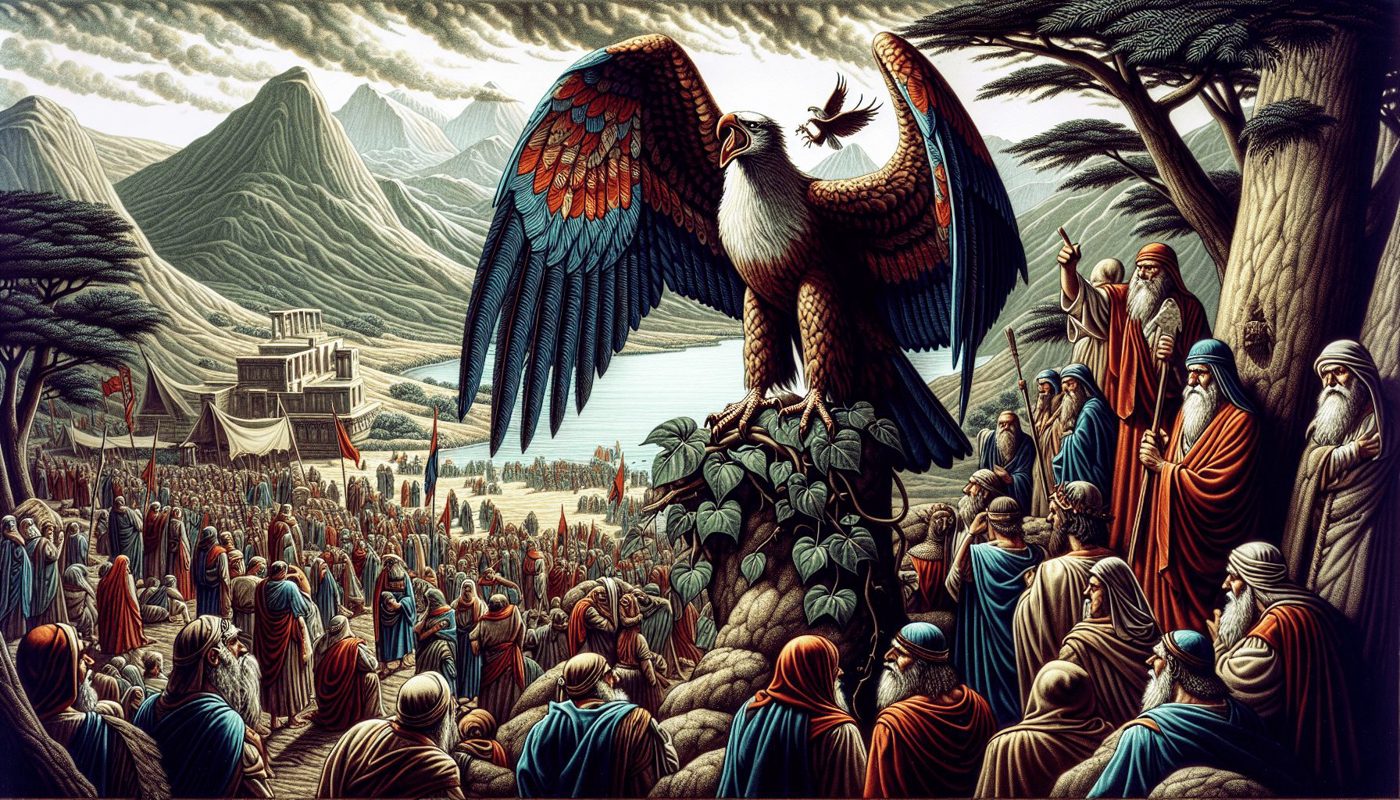
The word of the Lord came to Ezekiel with a riddle and a parable for the house of Israel. The prophet was told to speak of a great eagle—broad wings, long pinions, full of feathers, many colors—that came to Lebanon and took the top of a cedar. It cropped off the topmost young twig, carried it to a land of traffic, and set it in a city of merchants.
That same eagle also took seed from the land and planted it in fertile soil beside many waters, setting it like a willow tree. The seed grew into a spreading vine of low stature. Its branches turned toward the eagle, its roots were under him. It became a vine that brought forth branches and shot forth sprigs.
Then another great eagle appeared—large, with many feathers. And this vine bent its roots toward the second eagle, shooting out its branches toward him from the beds where it had been planted, as if asking to be watered by him. Yet the vine had already been planted in good soil by abundant waters, with everything it needed to bear fruit and become a goodly vine.
The Lord asked through Ezekiel: Shall it prosper? Will the eagle not pull up its roots and cut off its fruit so that it withers? All its fresh leaves will wither, and not by a strong arm or a great army can it be raised from its roots. Even planted as it is, shall it prosper? When the east wind touches it, it will wither completely in the beds where it grew.
The Lord then told Ezekiel to explain the riddle to the rebellious house. The first eagle was the king of Babylon. He came to Jerusalem, took its king and its princes, and brought them to Babylon. He took a member of the royal family, made a covenant with him, and brought him under oath. He also removed the mighty men of the land so that the kingdom would be lowly and not lift itself up—dependent on keeping the covenant to stand.
But that appointed king rebelled. He sent ambassadors to Egypt to ask for horses and a great army. The Lord asked: Shall he prosper? Shall he who does such things escape? Shall he break the covenant and still escape? The Lord swore by his own life that the king would die in Babylon, in the place of the king who made him king, whose oath he despised and whose covenant he broke.
Pharaoh with his mighty army and great company would not help him in the war, even when siege mounds were cast up and forts built to cut off many lives. Because he despised the oath and broke the covenant—he had given his hand in pledge and still did all these things—he would not escape. The Lord swore to bring the broken oath and covenant upon his own head.
The Lord would spread his net upon this king, and he would be caught in the snare. He would be brought to Babylon, and there the Lord would enter into judgment with him for the trespass he had committed against the Lord. All his fugitives and all his bands would fall by the sword. Those who remained would be scattered to every wind. Then they would know that the Lord had spoken it.
But the chapter does not end with judgment. The Lord himself declared what he would do. He would take of the lofty top of the cedar and set it. He would crop off from the topmost of its young twigs a tender one, and plant it upon a high and lofty mountain—on the mountain of the height of Israel. There it would bring forth boughs, bear fruit, and become a goodly cedar. Under it all birds of every wing would dwell; in the shade of its branches they would find shelter.
Then all the trees of the field would know that the Lord brings down the high tree and exalts the low tree. He dries up the green tree and makes the dry tree flourish. The Lord has spoken, and he has done it.
Comments
Comments 0
Read the discussion and add your voice.
Members only
Sign in to join the conversation
We keep comments tied to real accounts so the discussion stays clean and trustworthy.
No comments yet. Be the first to add one.