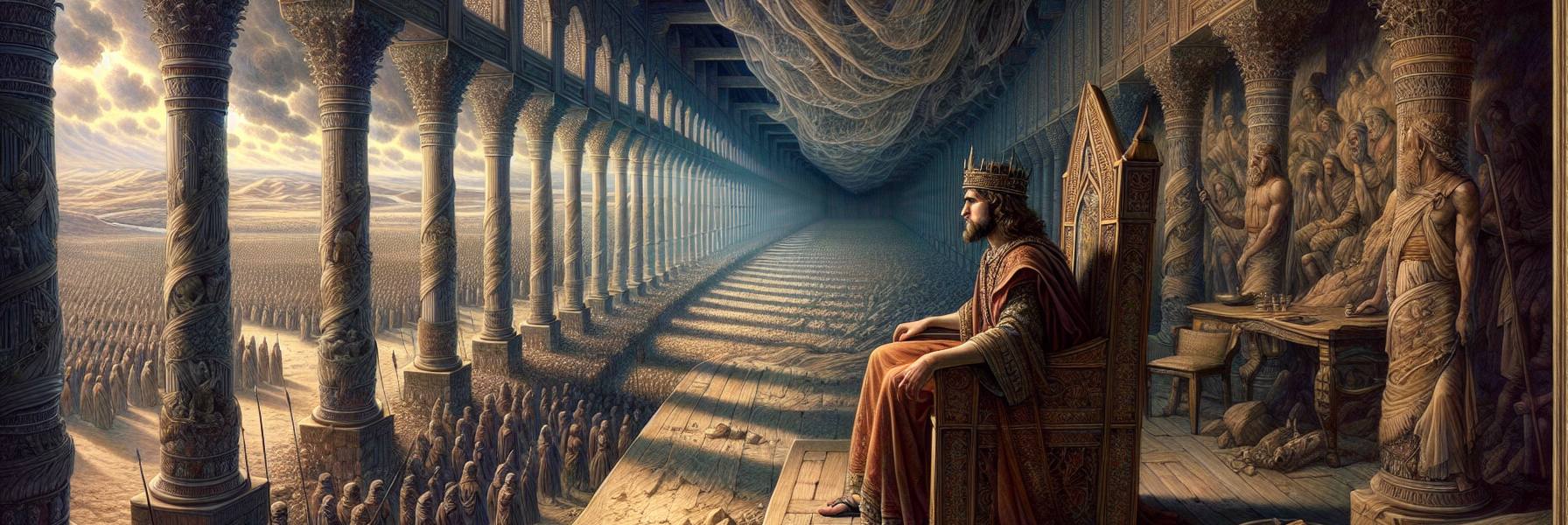

The air in the chamber was still and heavy, thick with the scent of cedar and myrrh. Solomon, son of David, felt the weight of the crown not as gold upon his brow, but as a stone upon his chest. He was young—how young he felt in these early days—and the kingdom stretched out from Jerusalem like a vast, sleeping beast, its breath the wind in the hills, its heartbeat the murmur of a thousand disputes. He had silenced his adversaries, secured his throne, married for alliance, and built a palace. Yet in the quiet hours, when the lamps guttered and the palace slept, a cold fear settled in him. It was the fear of the unqualified, the profound understanding that to rule this people, God’s people, was a task for which he possessed no native skill.
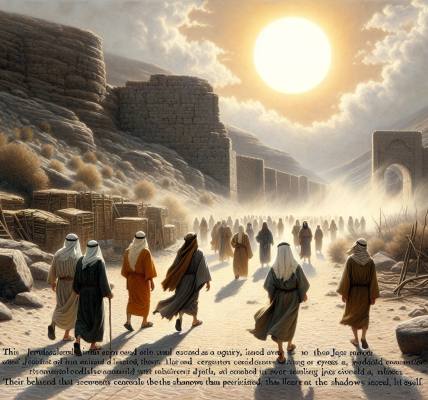
It was this hollow feeling that drove him to Gibeon. The great high place there, with its bronze altar fashioned in the days of Moses, drew him. He went not as a king in full procession, but as a pilgrim with a heavy guard, the dust of the road clinging to his robes. The sacrifice was immense—a thousand burnt offerings upon the altar. The smoke climbed in a greasy column, blotting out the stars, the smell of searing meat a sharp sacrament on the night air. He worked alongside the priests, his hands stained with ash and oil, the physical labor a relief from the torment of thought.
Exhaustion finally took him. They prepared a rudimentary shelter for him near the holy place, and he slept the sleep of the spent. And then, the dream.
It was not a dream of spectacle, but of startling clarity. The Lord appeared to him in a space that felt both infinite and intimate. There was no thunder, no whirlwind, only a presence that asked, as simply as one might ask a child, “Ask. What shall I give you?”
The words formed in Solomon’s dreaming mind, born from the honest fatigue of the preceding days. He began with remembrance. “You have shown great and steadfast love to your servant David, my father, because he walked before you in faithfulness, in righteousness, and in uprightness of heart. And you have kept for him this great and steadfast love and have given him a son to sit on his throne this day.” The gratitude was genuine, a filial piety that anchored his plea.
Then, the confession. “And now, O Lord my God, you have made your servant king in place of my father David, although I am but a little child. I do not know how to go out or come in.” The phrase *a little child* was not a statement of age, but of bewildered incapacity. He felt like a boy handed the reins of a storm.
“And your servant is in the midst of your people whom you have chosen, a great people, too many to be numbered or counted for multitude.” The burden was the sheer, uncountable weight of lives, each with its own sorrow, its own claim, its own need for justice.
Then, the ask. It rose not as ambition, but as desperation. “Give your servant therefore an understanding mind to govern your people, that I may discern between good and evil. For who is able to govern this, your great people?”
The silence in the dream was a palpable thing. Then, the voice, pleased. “Because you have asked this, and have not asked for yourself long life or riches or the life of your enemies, but have asked for understanding to discern what is right, behold, I now do according to your word. Behold, I give you a wise and discerning mind, so that none like you has been before you and none like you shall arise after you.”
And more, a promise of the unasked-for: riches and honor all his days. And a condition, a echo of the covenant with his father: “If you will walk in my ways, keeping my statutes and my commandments, as your father David walked, then I will lengthen your days.”
He awoke. The dawn was a pale streak over the hills of Gibeon. The air was cool, smelling of dew and dead ashes. For a moment, he lay still, the fullness of the dream pressing upon him. It had been so real. A strange, settled quiet had replaced the fear in his chest. He rose, offered a morning sacrifice of thanks, and returned to Jerusalem. He stood before the ark of the covenant and offered more sacrifices, feasting with all his servants. The celebration, however, was internal. The people saw a king returned from worship. They did not see the silent transaction that had taken place in the night.
The test came soon enough, and from the last place one would expect wisdom to be required.
Two women, harlots from the same cramped, sour-smelling house, were brought before him. They stood in the court, their clothing worn, their faces sharp with poverty and rage. They lived alone, they explained, and had given birth within days of each other. No midwife, no neighbor to witness. One child had died in the night, smothered by its mother’s body. That mother, in her grieved madness, had switched the children, placing the dead boy beside the sleeping mother of the living one, and taking the living son for herself.
Now they stood, shouting over each other, tears cutting paths through the grime on their cheeks.
“The living child is mine!”
“No, the dead is yours, the living is mine!”
Back and forth, a bitter duet. The guards shifted uncomfortably. Courtiers glanced at the king. This was the sordid, messy business of the kingdom, a far cry from affairs of state.
Solomon listened. He did not merely hear their words; he watched them. He saw the wild, possessive grief in the eyes of the one, a grief that burned like a fever. He saw the colder, more desperate cunning in the eyes of the other. The facts were irreconcilable. There were no witnesses. It was a puzzle of flesh and blood.
A strange impulse came to him, clear and cool as a mountain stream. He did not reason toward it; it was simply *there*, placed fully formed in his mind. He called for a sword.
A whisper ran through the court. A sword? To execute both? To frighten a confession?
The heavy blade was brought before him, its steel glinting dully. The women fell silent, watching.
“Divide the living child in two,” Solomon said, his voice calm, almost detached. “Give half to the one and half to the other.”
For a heartbeat, there was perfect stillness. Then, one of the women cried out, a raw, animal sound that echoed off the stone walls. She fell to her knees, her hands clawing at the air before her as if to pull the words back. “Oh, my lord, give her the living child! Only do not kill him!” Her offer was one of pure, self-annihilating love. She would surrender her claim entirely to see the boy live.
The other woman’s face hardened. Her lips drew into a thin line. “He shall be neither mine nor yours,” she said, her voice like flint. “Divide him.”
Solomon looked from one face to the other. In that moment, the truth was as plain as if it had been written across their foreheads. He pointed to the woman on her knees, her body wracked with sobs. “Give the living child to her. She is his mother.”
A sigh, like the wind leaving a sail, went through the hall. The guards relaxed their grips. The kneeling woman gathered the bewildered infant from an attendant, clutching him to her breast, weeping into his swaddling clothes. The other woman was led away, her face a mask of stunned defeat.
The story did not remain in the palace. It spilled into the streets, into the market stalls, the sheepfolds, the vineyards. People told it with awe, not just for the cleverness of the judgment, but for the quality of the wisdom it revealed. It was not the wisdom of scrolls or debates. It was a wisdom that saw into the heart, that used a shocking, almost brutal, proposal to illuminate the deepest truth of love and possession. “The wisdom of God is in him,” they said, “to do justice.”
Alone again in his chamber that evening, Solomon listened to the distant sounds of the city. The fear was gone. But in its place was not pride, nor even satisfaction. It was a profound and sobering responsibility. The gift had been given. The first fruits of it had been tasted. And he understood, with a clarity that was itself part of the gift, that the true burden had only just begun. He had asked for a listening heart. Now, he must spend the rest of his life using it to sift the endless, whispering cries of a people. The silence around him was no longer empty, but alive with the weight of that calling.