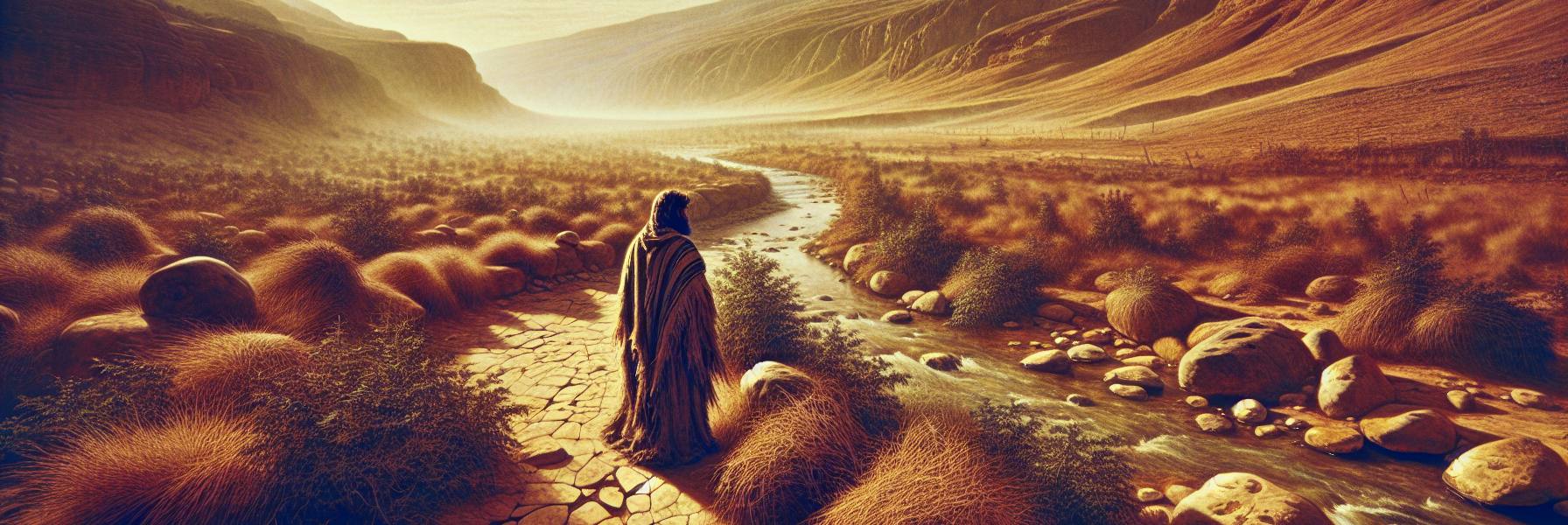

The dust of the Roman road, fine as ground chalk, hung in the air long after the caravan had passed. It settled on the dry thorns and the brittle grass of the wilderness east of the Jordan, a land of sharp stones and harder truths. In those days, a rumor began, a whisper against the wind, moving from village to village like water finding cracks in stone. They spoke of a man out in the wasteland, at the places where the river wound slow and green through the barrenness. Not a teacher from the synagogues, not a scholar with scrolls, but a voice. Just a voice, they said, clothed in camel’s hair, living on what the stark land provided—locusts and the thin, wild honey.
His name was John, son of Zechariah. He didn’t come to the people; the people, compelled by something they couldn’t name, went out to him. They left the relative safety of Jericho’s palms and Jerusalem’s walls, following goat trails down to the riverbanks. What they found was not comfort.
He stood on a gravelly bank, the Jordan flowing mud-brown at his feet. His face was burnt by sun and wind, his eyes the colour of flint. When he spoke, his voice carried over the murmur of the crowd and the river’s flow, not with practiced oratory, but with a raw, declarative force.
“Brood of vipers!” he called out, and the insult hung in the hot air. “Who warned you to flee from the wrath to come? Don’t dare to say to yourselves, ‘We have Abraham as our father.’ I tell you, God can raise up children for Abraham from these very stones.”
A scribe, his robes too fine for this place, shifted uncomfortably. A tax collector, smelling of ink and other people’s coin, looked at his feet. Soldiers, their Roman leather creaking, stared with a mix of skepticism and unease. John’s words cut through pretense like a knife through rotted cloth.
“Produce fruit,” he growled, “fruit that proves your change of heart. And don’t even begin thinking you’ve arrived. The axe is already lying at the root of the trees. Every tree that does not produce good fruit will be cut down and thrown into the fire.”
The crowd pressed in, a mixture of fear and desperate hope on their faces. “What then should we do?” a farmer called out, his hands still ingrained with soil.
John’s answer was immediate, concrete. “Anyone who has two shirts must share with the one who has none. Anyone who has food must do the same.”
The tax collectors, a class universally despised, edged forward. “Teacher, what about us?”
“Collect no more than what you are authorized to take,” John said, fixing them with that flinty gaze. “No extras. No ‘fees.’”
Even the soldiers, tools of the occupying power, asked. “And us? What should we do?”
“Don’t extort money. Don’t accuse people falsely. Be content with your pay.”
It was terrifying in its simplicity. This was no new philosophy, no complex ritual. It was a call to ordinary justice, to basic human decency, as the direct evidence of a heart turned back toward God. A baptism, a washing in the muddy Jordan, was the sign of it. They would confess the tangled mess of their lives, and he would plunge them under the water, pulling them up gasping, clean, and accountable. Hope, potent and unsettling, spread through the crowd. Could this be the one? The air itself seemed to vibrate with the question. Was this wild man from the desert the promised Messiah?
John heard the whispers. He straightened, water dripping from his beard, and silenced them with a raised, calloused hand.
“I baptize you with water,” he said, his voice dropping, becoming almost weary. “But one is coming who is more powerful than I. I am not worthy to stoop down and untie the straps of his sandals. He will baptize you with the Holy Spirit and fire. His winnowing fork is in his hand to clear his threshing floor. He will gather the wheat into his barn, but the chaff he will burn up with unquenchable fire.”
He said many other things, exhorting, warning, the words tumbling out in a cascade of prophetic urgency. They were hard words, a shaking of foundations.
It was on an ordinary day, with the crowd perhaps a little thinner, the sun a little less fierce, that he came. No fanfare. No procession. Just a man from Nazareth in Galilee, joining the line of penitents waiting in the shallows. John, looking up, saw him and stopped. A profound recognition, not of family or old acquaintance, but of essence, passed between them. John shook his head, taking a step back. “I need to be baptized by you,” he whispered, the certainty in his voice breaking for the first time. “And yet you come to me?”
The man from Nazareth replied, his voice quieter than John’s, but with a gravity that seemed to calm the very river. “Let it be so now. It is proper for us to fulfill all righteousness.”
So John consented. His hands, which had pushed so many under the water in a sign of repentance, now gently guided this one man. As Jesus came up out of the water, the heavens did not tear with a deafening crash, but seemed rather to open, to part as a curtain draws aside. And a dove, real and soft-feathered, descended in a slow, fluttering arc, coming to rest upon him. And then a voice, not from John’s throat, not from any human source, but a sound that seemed to resonate in the chest more than the ear: “You are my Son, whom I love; with you I am well pleased.”
The moment passed. The dove lifted. The crowd, perhaps, saw only a man being baptized. But John stood still, the water cooling around his legs, knowing the winnowing fork was now in hand. The one who would baptize with fire had arrived, not in judgment, but first in the quiet, willing identification with all those he had come to save.
Later, in the stone-cool halls of the fortress Machaerus, Herod Antipas would listen to reports of this preacher. He would find John’s words about his own marriage inconvenient, a prick to his conscience he would choose to silence. But out in the wilderness, by the river, the true work had already begun. The voice crying out had prepared the way. Now, the Word Himself had stepped into the water, and nothing would ever be the same.