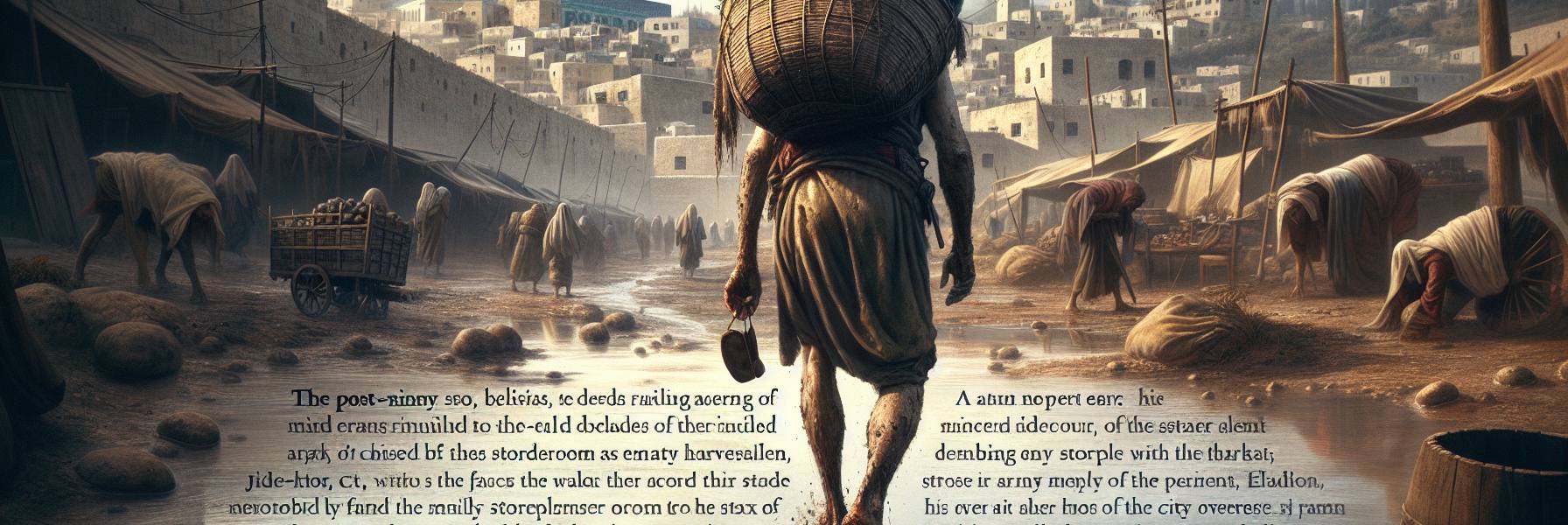

The rain had finally stopped, but the mud remained. It clung to Elior’s sandals with a weary persistence, each step a soft, sucking complaint as he made his way from the lower fields back toward the walls of Jerusalem. The smell of wet earth and bruised olives hung in the air, a scent of both life and exhaustion. His back, a permanent ache, protested the weight of the empty gathering basket. The harvest had been thin again. The tribute to the overseer had left his family’s storeroom echoing.
He entered the city through the Fish Gate, the noise of the market a dull roar that matched the thrum in his head. He didn’t linger. His feet, knowing the way better than his heart did these days, carried him through the labyrinth of streets, away from the commerce and toward the quieter districts where the shadows grew long and the faces were lean.
Passing a narrow alley, he saw old Marta, her eyes milky with years, sitting on a stone step. Her hand trembled as she tried to thread a needle, a torn cloak in her lap. Her son, he remembered, had fallen with the garrison at Megiddo. No one came to mend her clothes. Elior looked away, a hot shame flushing his neck. He had nothing to give her, not even a moment. His own children’s hunger was a sharper, more immediate cry.
Later, atop his modest roof as the sun bled into the west, he heard the commotion from the grand house of Shebna, the royal steward. Laughter, the bright ring of lyres, the clatter of dishes. The smell of roasted lamb and honey cakes drifted on the cooling air, a cruel perfume. Shebna, whose decisions from his ivory-inlaid chair dictated the price of grain, who had just purchased Elior’s neighbor’s vineyard for a pittance when the man couldn’t pay his debt. *Put not your trust in princes,* a voice, old and dusty from disuse, whispered in his mind. He wasn’t sure where it came from.
The next morning was Sabbath. The ritual felt hollow. The prayers were words, the songs just sound. He watched the priests in their fine linen, moving with solemn precision. He thought of Marta’s trembling hands, of Shebna’s laughter, of the empty storeroom. Where was the Lord in all this? Was He, too, in the employ of princes?
After the service, adrift and restless, he found himself not on the road home, but walking slowly toward the great doors of the scriptorium. A learned cousin of his wife worked there as a copyist. Perhaps it was the memory of that whisper about princes. Perhaps it was just to be somewhere cool and quiet.
His cousin, Asher, nodded a welcome, his fingers stained with ink. “You look like a man carrying the walls of the city on his shoulders, Elior.”
Elior managed a weak gesture. “Just the weight of the season, Asher.”
Asher studied him, then without a word, turned to a scroll rack. He selected one, not a grand new copy, but an older one, the leather casing worn soft. “Sit,” he said gently. “Read something old. Sometimes the oldest voices speak most clearly to a present trouble.”
Elior unrolled the scroll with care. It was a collection of songs, *tehillim*. His eyes, accustomed to scanning rows of olives for fruit, scanned the lines of script. He began to read, not aloud, but in the silence of his mind.
*Praise the Lord. Praise the Lord, O my soul. I will praise the Lord all my life; I will sing praise to my God as long as I live.*
The words felt foreign, a language of a different man. *Praise?* With this ache in his back, this fear in his gut?
He read on, skeptical, weary.
*Do not put your trust in princes, in mortal men, who cannot save. When their spirit departs, they return to the ground; on that very day their plans come to nothing.*
The whisper from the rooftop. There it was, etched in ink. A sharp, clear truth. Shebna’s laughter, the power of his office, the fear he inspired—it was all breath. A temporary arrangement of dust. It would end. The relief this thought brought was not warm, but it was solid, like finding a firm stone in a bog.
Then the song unfolded further, and Elior’s breath caught.
*Blessed is he whose help is the God of Jacob, whose hope is in the Lord his God, the Maker of heaven and earth, the sea, and everything in them—the Lord, who remains faithful forever.*
The scope of it stunned him. The God who fashioned the great bowl of the sky and the fathomless deep was named here as *his* help. Not the help of kings or legions, but of the orphaned, the forgotten. The narrative swept on, and Elior’s heart began to beat in time with its rhythm.
*He upholds the cause of the oppressed and gives food to the hungry.*
His eyes lingered. *Food to the hungry.* It was a promise, not yet a full granary, but a declaration of character. This was who the Lord was.
*The Lord sets prisoners free, the Lord gives sight to the blind, the Lord lifts up those who are bowed down…*
He saw Marta, not just the old woman with the needle, but a person seen, known, *lifted up*. He felt his own posture, the years of bending to the earth and to men like Shebna. The words spoke of a straightening, not of the spine, but of the soul.
*The Lord watches over the foreigner and sustains the fatherless and the widow…*
The song was painting a portrait of a ruler utterly unlike any prince of the earth. His court was the alleyway, the barren field, the lonely room. His policy was liberation, his economy was sustenance, his enduring project was mercy.
*…but he frustrates the ways of the wicked.*
It was a final, solemn chord. The world had an order, a moral gravity. The Shebnas of the world, with their clever, crushing plans, would find them frustrated. Their power was an illusion of the moment. The Lord’s kingdom, built on this fierce, protective love for the broken, was the everlasting one.
Elior did not know how long he sat there. The shaft of sunlight from the high window had moved. The ink on the page seemed to glow. He had not found a solution, not a miraculous bag of silver or a sudden bounty in his field. He had found something else: a true north.
He rerolled the scroll with reverence and thanked Asher. Walking home, the same mud was underfoot, the same worries waited for him. But he carried them differently. The weight was shared now. He was no longer a solitary bearer of lack, but a subject of a different kind of king.
Passing the alley, he stopped. He walked over to Marta, sat beside her on the step, and took the cloak and needle from her hands. His own hands were rough and clumsy, but they were steady. He began to stitch, a slow, uneven repair. He didn’t have food to give her today, but he had a moment. It was a small act, a tiny echo of the faithfulness described in the song. It was a start.
As he worked, the words of the psalm wove themselves into the fabric of his thoughts, no longer just ink, but a living truth: *The Lord reigns forever… your God, O Zion, for all generations. Praise the Lord.* The praise began then, not as a feeling, but as a choice—a quiet, stubborn trust planted in the mud of a difficult world, waiting for the rain of a different kind.