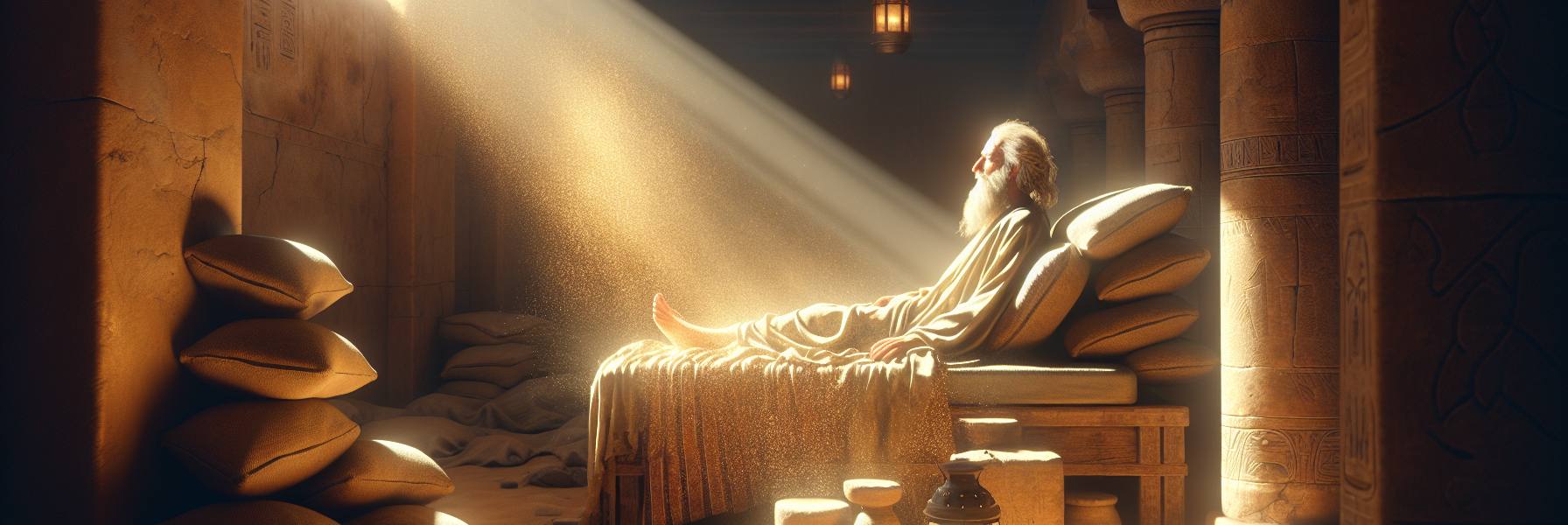

The room smelled of dust and lamp oil, and of a body that had been still for too long. The afternoon light, thick and golden, fell in a heavy slab across the foot of the bed where Jacob lay. It was a borrowed bed, in a borrowed room, in the land of Goshen, but it was the place where he would finish things. His breath came in a thin, papery rhythm. He had sent for Joseph, and now Joseph was here, standing in the shaft of light, the dust motes swirling around his fine Egyptian tunic like stars around a fixed planet.
“Come closer,” Jacob said, and his voice was the sound of two stones grinding slowly together. He pushed himself up, a laborious shifting of bone and loose skin, until he rested against the stacked cushions. Joseph obeyed, his face a careful mask of filial concern. But Jacob saw the flicker in his eyes—the administrator, the vizier, assessing the situation. He would have to set that aside.
“The God of your fathers appeared to me at Luz in the land of Canaan,” Jacob began, the words arriving slowly from a great distance. “He blessed me there. He said to me, ‘I will make you fruitful and multiply you, and I will make of you a company of peoples, and will give this land to your offspring after you for an everlasting holding.’” He paused, swallowing with some difficulty. The memory of the stairway, of the Voice, was more real to him now than the plastered walls of this Egyptian house. “Your two sons, who were born to you in the land of Egypt before I came to you here, are mine. Ephraim and Manasseh shall be mine, as Reuben and Simeon are.”
Joseph bowed his head. It was a legal pronouncement, a transaction of inheritance. He understood it. He was being given a double portion, his two sons elevated to the status of founding tribes alongside their uncles. It was an honor, but Jacob wasn’t finished. He was looking past Joseph, into the gloom of the doorway.
“Bring them to me,” Jacob said. “I want to see them.”
Joseph went out and returned, a hand on each boy’s shoulder. Manasseh, the firstborn, was tall for his age, with a serious set to his jaw that mirrored his father’s. Ephraim, the younger, had a quieter, more watchful presence. They stood before the old man, this patriarch who smelled of a different earth, and they were uncertain.
Jacob blinked slowly. His eyes were milked over with age, weak and straining. “Who are these?” he rasped.
“They are my sons, whom God has given me here,” Joseph said, guiding them forward until their knees brushed the bedding.
“Bring them to me, please, that I may bless them.” The politeness was automatic, a thread of his old formality.
Joseph brought them close. Jacob reached out his hands. They were gnarled, the knuckles swollen, the skin mapped with dark veins and brown spots. He let them hover for a moment, then laid them firmly upon the boys’ heads. But his right hand went to Ephraim’s head, the younger, and his left to Manasseh’s, the firstborn. He crossed his arms deliberately.
And then he began to speak, but not to Joseph. He was addressing the God of his fathers, Abraham and Isaac. “The God before whom my fathers Abraham and Isaac walked, the God who has been my shepherd all my life long to this day, the angel who has redeemed me from all evil…” His voice gained a thread of strength, a resonance that seemed to come from somewhere beyond his frail chest. It filled the quiet room. “Bless the boys. And in them let my name be carried on, and the name of my fathers Abraham and Isaac; and let them grow into a multitude in the midst of the earth.”
Joseph watched, and as the meaning of the crossed hands settled into his mind, a frown creased his brow. It was a mistake. The old man’s sight was gone. Gently, he reached out and took his father’s wrist. “Not so, my father,” he said softly, a touch of the vizier’s correction in his tone. “This one is the firstborn; put your right hand on his head.”
But Jacob resisted the pressure. His hand, for all its frailty, was unmovable. “I know, my son, I know,” he said, and there was a sharpness there now, the old Jacob who had wrestled with God and men. “He also shall become a people, and he also shall be great. Nevertheless, his younger brother shall be greater than he, and his offspring shall become a multitude of nations.”
And with that, he tightened his grip on their heads and spoke the blessing over them both, but the greater blessing, the blessing of the right hand, was firmly upon Ephraim. “By you Israel will pronounce blessings, saying, ‘God make you as Ephraim and as Manasseh.’” He set Ephraim before Manasseh. It was done.
He let his hands fall back to the blankets, spent. The act had taken the last of his daylight energy. He looked at Joseph, and his expression softened into something like pity for the son who understood administration but was only just beginning to understand prophecy. “I am about to die,” he said, matter-of-factly. “But God will be with you and will bring you again to the land of your fathers. Moreover, I have given to you rather than to your brothers one mountain slope that I took from the Amorites with my sword and with my bow.”
Joseph led the boys away. They were silent, the weight of the old man’s hands still palpable on their skulls. Back in the golden light of the main hall, Joseph looked at them—at Manasseh, who had received a blessing, and at Ephraim, upon whom a destiny had been pressed. He said nothing. He simply placed a hand on each of their shoulders again, a confirming weight, and sent them out to play.
In the darkened room, Jacob lay back. The scent of dust and oil was familiar. He could almost smell the grasses of Canaan, the dry wind off the hills. He had done it. He had once stolen a blessing by deceit, guided by a mother’s cunning. Today, he had bestowed one by a stubborn, deliberate act of spirit, guided by a sight deeper than eyes could provide. The patterns were repeating, but they were being redeemed, turned to a purpose he could feel but not fully see. He closed his clouded eyes. It was enough.