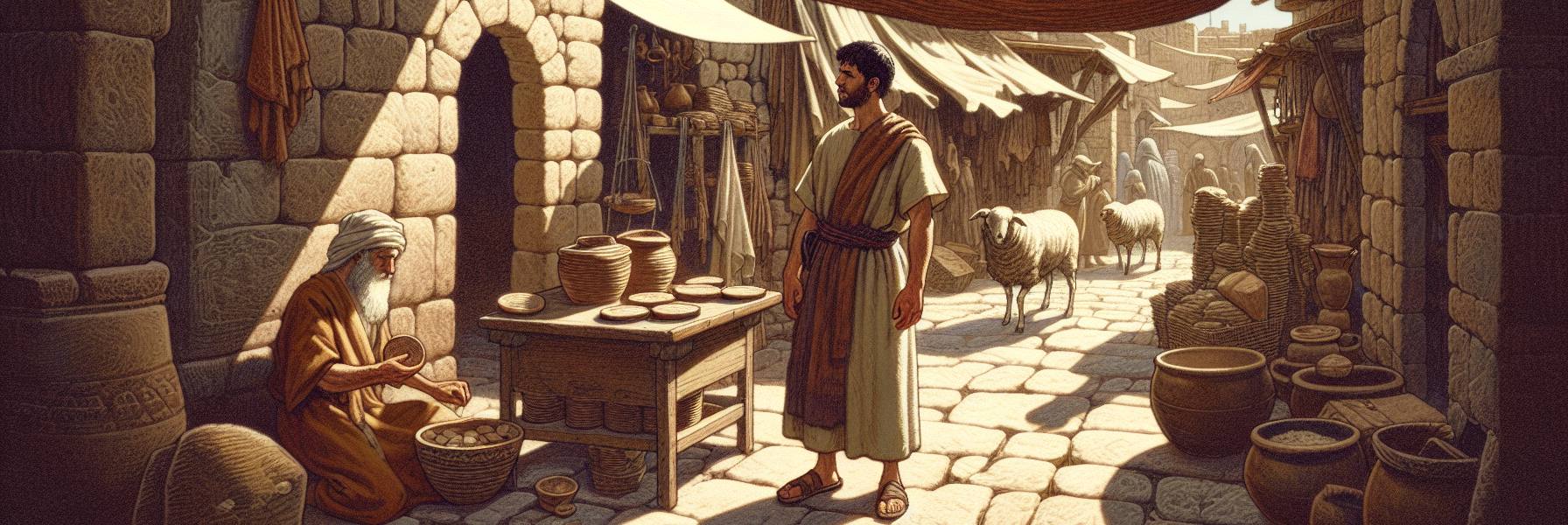

The heat in Jerusalem had a weight to it that afternoon, a kind of palpable thickness that seemed to press the dust deeper into the cracks between the stones. Ezra stood in the shadow of a merchant’s awning, not to buy, but simply to be out of the sun. The market din was a constant—the bleating of sheep, the haggling over bolts of cloth, the metallic clink of coins. But to Ezra, it was all just noise, a dry rattle against the emptiness inside him.
He jingled the few coins in his purse, not enough for the fine flour, let alone the good wine. He’d spent the last of his silver on a jug of vinegar-thin wine the night before, trying to quench a thirst it couldn’t touch. His throat was parched now, his spirit even more so. He watched a water-seller, his skin like old leather, dole out a cup for a bronze coin. *Come, buy water,* the man’s eyes seemed to say, but Ezra turned away. What was water? A temporary relief. His thirst was for something else, something he couldn’t name, a longing that ached like a forgotten melody.
He was about to retreat to his small, airless room when a voice cut through the market haze, not shouting, but clear and steady. It was an old man, seated on a low stool by the corner where the spice-sellers thinned out. He wasn’t selling anything. His hands were open on his knees, and he was speaking to no one and everyone.
“Ho!” the old man called, his voice like water over smooth stones. “Everyone who thirsts, come to the waters. And you who have no money, come, buy and eat. Come, buy wine and milk without money and without price.”
Ezra stopped. The words were absurd. A trick. Yet they settled on his parched soul like the promise of cool mist. He drifted closer, lingering at the edge of the small knot of listeners—a few bored porters, a woman with a weary face.
The old man’s eyes, milky with age, seemed to look right through the crowd and find Ezra. “Why do you spend your money for that which is not bread?” he asked, gently, almost sadly. “And your labor for that which does not satisfy? Listen carefully to me, and eat what is good, and delight yourselves in rich food.”
Ezra’s hand tightened around his coins. He thought of the cheap wine, the fleeting camaraderie it offered, the hollow morning after. He thought of all his strivings, his careful plans that came to nothing, the bread of anxiety he consumed every day.
“Incline your ear,” the man continued, his gaze lifting as if following a distant thread. “Come to me; hear, that your soul may live.” He spoke then of a covenant, an everlasting promise, steadfast, sure. He spoke of a leader, a witness to the peoples, given, but not taken by force. Words of hope, strange and deep, about nations running toward a glory they did not know.
Then the old man said something that made the hair on Ezra’s arms prickle. “For my thoughts are not your thoughts, neither are your ways my ways, declares the Lord.” He lifted a hand, gesturing to the brazen sky. “For as the heavens are higher than the earth, so are my ways higher than your ways, and my thoughts than your thoughts.”
Ezra looked up. The heavens were an immense, impossible blue, vaulted infinitely above the grimy, confined world of the market. His own thoughts were a frantic, circling swarm—worries about money, about status, about tomorrow. The idea that there was a mind whose consciousness made that sky seem near, whose purposes were as vast as that firmament… it was terrifying. And yet, it was a relief. His own small, feverish calculations suddenly seemed ridiculous.
The old man was describing rain. Not the market, not coins, but rain. “For as the rain and the snow come down from heaven and do not return there but water the earth, making it bring forth and sprout, giving seed to the sower and bread to the eater, so shall my word be that goes out from my mouth; it shall not return to me empty, but it shall accomplish that which I purpose, and shall succeed in the thing for which I sent it.”
Ezra saw it. He saw the winter rains, stubborn and cold, soaking into the hard-baked hills around the city. He saw the miracle weeks later—a faint green fuzz, then shoots, then barley swaying golden in the spring wind. It happened without anyone’s effort. The sky gave, the earth received, life sprang up. That was the word of this God. Not a theory, not a rule, but a generative force, like rain. It had a purpose of its own, and it *would* fulfill it.
A profound quiet settled in Ezra’s chest. The market noise receded to a murmur. The old man was speaking of a joy, a peace so tangible the very mountains and hills would break into song, and the trees would clap their hands. Thorns would give way to cypress, briers to myrtle. A name, a sign, never cut off.
The speech ended as quietly as it began. The old man simply closed his eyes, his lips moving in silent prayer. The small crowd dispersed, the porters back to their loads, the woman back to her worries. But Ezra stood rooted.
He looked at his hand, still clenched around his coins. Slowly, he opened his fingers. The silver gleamed, dully. He thought of the water-seller, the wine merchant. Then he slipped the coins back into his purse, untied it, and walked over to a beggar sitting by the gate, a man with eyes as empty as his own had been an hour before. Without a word, he placed the entire purse into the man’s dusty palm.
He walked away, towards the city gate and the hills beyond. His throat was still dry, his stomach empty. But the aching, nameless thirst was gone. In its place was a different kind of hunger, a clean, sharp anticipation, as if he had just smelled rain on the wind of a dry land. He didn’t have a plan. He didn’t have a coin. But for the first time in years, he felt rich. The word was like rain, already falling, and he was just ground waiting to be soaked, waiting to bring forth whatever it was meant to grow. He walked out into the afternoon, and the sunlight felt like a promise.