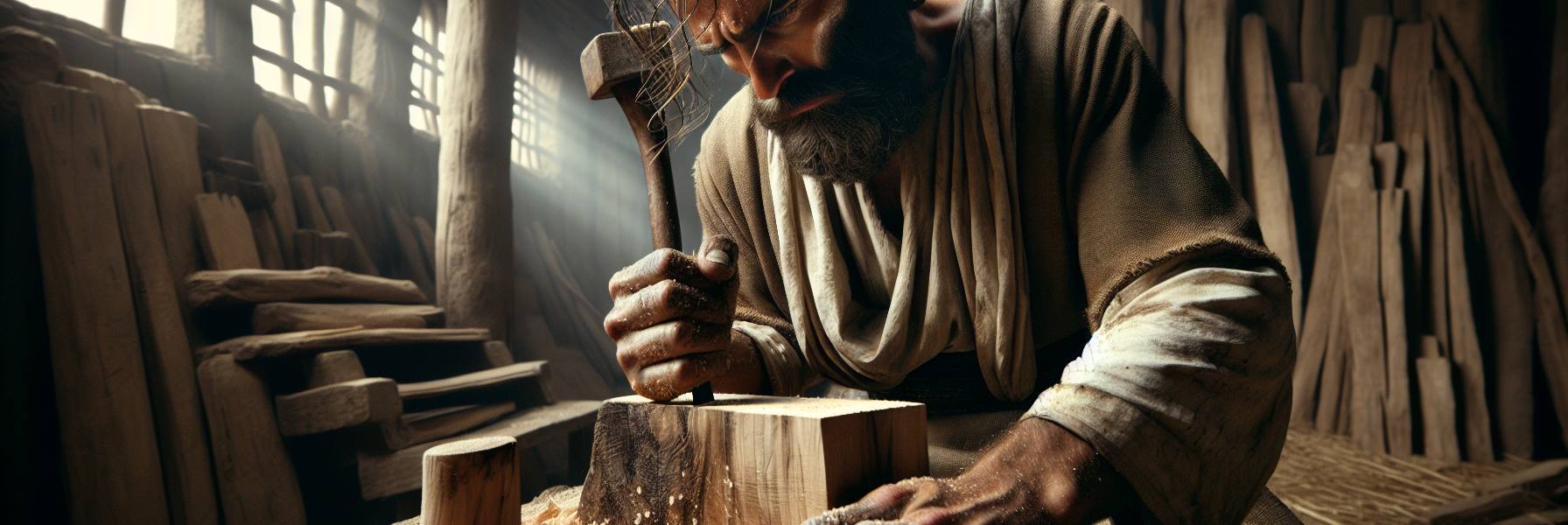

The heat in the workshop was a solid, shimmering thing. It clung to Eben’s tunic and drew lines of salt down his temples, mixing with the fine, gritty dust of cedar. He wiped his brow with a forearm already streaked with grime, his eyes fixed on the block before him. It was good wood—expensive, brought from the Phoenician traders at the harbor. His client, a wealthy merchant named Shallum, wanted a household god, something to stand in the niche of his new home, something to bring fortune.
Eben’s hands, calloused and knowing, moved with a rhythm born of decades. The adze bit into the wood, the *thwock-thwock* a familiar song. Curls of aromatic cedar fell to the packed-earth floor. He was shaping the torso now, the rough form of a man emerging from the grain. In the corner of the single room, a smaller, half-formed figure of a woman, commissioned by a baker’s wife, watched with blank, eyeless sockets. The air smelled of resin, sweat, and the faint, sour tang of the cheap beer in a clay cup by his foot.
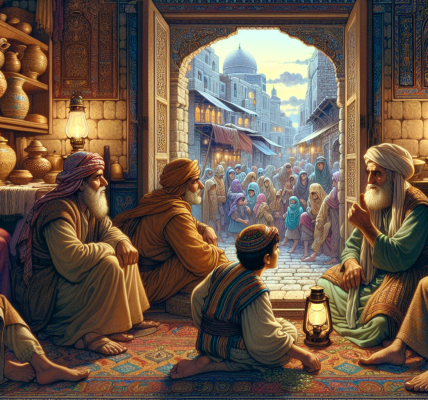
His son, Jotham, a boy of ten with serious eyes, swept the shavings into a pile. “Abba, will it see?”
Eben paused, blowing dust from the emerging chin of the idol. “See? It will have eyes, yes. I’ll inlay them with chips of obsidian. Very fine.”
“No, I mean… will it *see*? Like the stories of the LORD at the temple?”
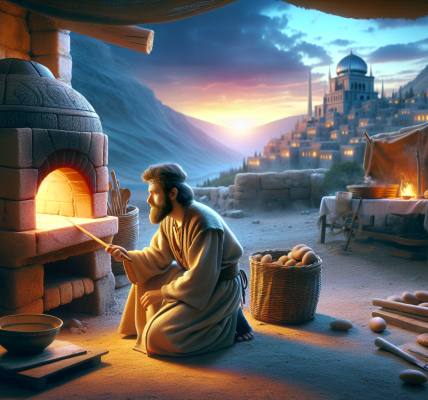
A shadow passed over Eben’s heart, quick and cold despite the heat. He’d heard the prophets in the square, their voices cutting through the market din like a cold wind. One, a wild-eyed man with a threadbare robe, had shouted just yesterday about the foolishness of the craftsman, how a man plants a cedar, the rain from heaven makes it grow, and then he takes part of it to warm himself and bake bread, and from the rest he makes a god. Eben had hurried past, the words nipping at his heels.
“This is work, Jotham,” he said, his voice tighter than he intended. “It is skill. It puts bread in our mouths. We do not ask what it sees; we ask if the coin is good.”
He returned to his labor, the rhythm less sure. As the day wore on, the idol took clearer shape. He worked until his arms ached and the light through the door slanted long and golden. He ate his evening meal of lentils and flatbread in silence, the half-formed gods standing sentinel in the gloom. That night, he dreamed not of wood, but of water—clear, cold water bubbling up from dry ground, and a voice speaking names he didn’t know.
The next day was for the finer work. With chisel and fine-grit stone, Eben carved the folds of the robe, the lines of a benign smile. Jotham brought him the obsidian chips and a pot of strong glue made from fish bones. As Eben leaned close to set the first dark stone into the socket, his own weary reflection stared back from its shiny surface—a man made of dust, giving eyes to wood.
Later, the merchant Shallum arrived to inspect the work. He was a large man, his fingers ringed with silver. He circled the now-complete idol, nodding appreciatively. “Fine, very fine. He has a prosperous look.” Shallum patted the wooden head. “You will make us rich, eh, little one?” He laughed, a hearty, uncomplicated sound. Then he turned to Eben. “The smith, Haza-el, has the plates of silver ready for the overlay. Have your boy bring it to him.”
So Jotham, with careful hands, carried the heavy wooden form through the bustling streets to the street of the metalworkers. The din here was different—the clang of hammers, the roar of bellows, the acrid smell of hot metal and coal. Haza-el, his leather apron singed with old burns, took the idol without ceremony. He had Shallum’s silver ready, beaten into thin, pliable sheets. With expert, brutal taps, he began to nail the silver onto the wood, covering the carved robe, the chest, the face. The benign cedar smile disappeared under a rigid, gleaming mask.
Jotham watched, fascinated. The final act was the chain. From a smaller ingot, Haza-el fashioned a delicate silver loop, fixing it to the back of the idol’s head. “So the great merchant can hang his god from a peg on the wall,” the smith muttered to his apprentice, not seeing the boy listening. “Or take it with him on a journey. Convenient.”
That evening, Shallum returned, beaming. He placed the remaining balance in Eben’s hand—heavy, jangling coins. Then he took his newly minted god. He cradled it like a child, then slung it over his shoulder by the chain as if it were a sack of grain. “Fine work, craftsman! May your hands never tire!”
Eben watched him go, the silver god flashing in the sunset as it bounced against Shallum’s broad back. The coins in his own hand felt cold. He thought of the tree this wood came from, a tree that had drunk deep from mountain rains, that had stretched its branches under the sun. He had warmed himself with its offcuts in the winter. And now this.
He walked out into the cooling street, needing air. He wandered without aim, past the crowded lower city, up towards the quieter heights where the old terraces overlooked the valley. The sky was a deep, endless blue, the first stars pricking through like pinpricks in a vast, dark canvas. He found himself on a barren outcrop, the city’s noises a distant murmur below.
And there, under that immense, silent sky, the words of the wild-eyed prophet returned to him, not as a shout, but as a quiet, terrible truth echoing in the hollow of his soul. The folly of it all rose before him: the man who, hungry, cuts down a tree for fuel to cook his food, and with the leftover scrap, falls down before it and prays, “Save me, for you are my god.” He saw Shallum, a shrewd man in all commerce, bowing before a piece of his own household wealth, begging a silver-plated log for prosperity.
A dry sob, more of exhaustion than grief, escaped him. He looked up at the stars, countless, fixed, beyond any human hand’s creation. He remembered the dream of water in the desert. And a different kind of knowing, slow and deep as a root finding a spring, settled upon him. It was not a vision, not a voice. It was the absence of a thing—the staggering absence of any need for him to sustain the one who had sustained the tree, the rain, the very breath in his own tired lungs.
He, Eben the craftsman, had spent his life giving form to formlessness. But here, in the quiet, was a presence that needed no form from him. A maker who was not made. A voice that had called the stars by name long before the first chisel touched wood, and who, the prophet said, called *him* by name. Not “craftsman,” but “my servant.” Not “worshipper of a thing,” but “witness.”
The wind picked up, cool from the east, carrying the scent of wild thyme. It felt like a forgiveness he hadn’t known to ask for. He didn’t know what he would do tomorrow. The workshop, the debts, the need for bread—they were all still there. But the center of the world had shifted. It was no longer in the heat of his shop, in the anxious rhythm of tool on wood, in the weight of silver coins. It was out here, in this vast, un-owned darkness that spoke of a creator. And somehow, that made him feel more solid, more real, than any idol he had ever made.
He stood there a long time, until the city’s lamps below seemed like fallen stars, and the true stars above wheeled in their silent, un-anxious courses. Then he turned, and with a step both heavier and lighter than before, began the walk back home.