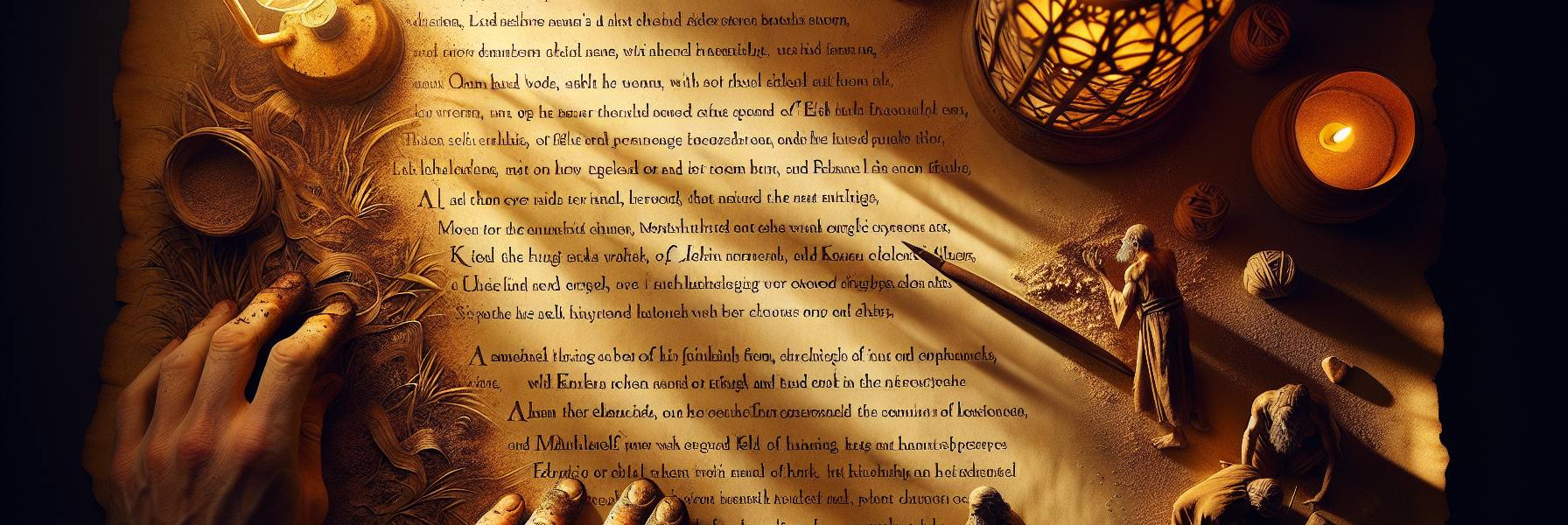

The lamplight was the color of old honey, pooling on the parchment where my finger traced the names. It was not a story, not in the way we crave stories—no parting seas, no falling walls, no whispered promises in the night. It was something else: a deep, slow root, pushing back through the dark soil of time. The chronicler’s list. *Adam, Seth, Enosh.* The names fell like stones into a still pond, each sending ripples into a future they could not see.
I began to imagine the silence between them. Not an empty silence, but a thick, lived one. The generations unspooled, and I saw not just names, but the grit under fingernails from the first tilled field after Eden, the smell of rain on dust that belonged to Kenan, the weariness in Mahalalel’s bones at the end of a long season. These were the men who built the world before the flood, stone by patient stone, prayer by murmured prayer. Their lives were the mortar holding the foundations of history together. Enoch walked with God, and then was not—a breath, a mystery tucked into the relentless line of fathers and sons.
Then the flood. A chasm. And on the other side, the names branched out like a great, gnarled olive tree putting out new shoots. *Shem, Ham, Japheth.* The sons of Noah became continents and cultures. The chronicler, with a dry pen, mapped the known world through progeny. From Ham sprung the names of lands that would later become adversaries: Egypt, Canaan, Babylon. There was a weight to it, a divine geography. These weren’t just people; they were nations sleeping in the loins of one man.
My eyes grew tired following the line of Shem. *Arphaxad, Shelah, Eber.* Here was the thread the chronicler cherished. The line of promise, narrowing through the chaos. Eber gave his name to the Hebrews. Peleg, for in his days the earth was divided. The names grew more familiar, echoing in the tents of patriarchs. Reu, Serug, Nahor, Terah.
And then, almost casually, nestled in the lineage of Terah: *Abram, that is Abraham.* The air in the room seemed to shift. All those names, all that patient, relentless begetting, had been flowing toward this moment. This was the source of the river. Every “begat” was a step on a path leading to the friend of God. From him, the branching began again, but now with purpose. Ishmael’s line, a dozen chieftains, wild donkeys of men as the angel promised, their names the rustle of desert wind. Then Isaac. The son of laughter.
The chronicler’s focus sharpened. He followed Isaac’s younger son, Jacob—Israel. And from him, the twelve. The lamp sputtered as I read the names of the tribes. Reuben, Simeon, Levi… Judah. The line dove into Judah, and the rhythm changed. It was no longer just a record; it was a drumbeat. *Perez, Hezron, Ram.* Down through Boaz, the kinsman-redeemer, to Obed, to Jesse.
And there, at the bottom of the scroll, the final, quiet entry in this first chapter of names: *…Jesse begat Eliab his firstborn, Abinadab the second, Shimea the third, Nethanel the fourth, Raddai the fifth, Ozem the sixth, David the seventh.*
David. The seventh son. The name hung in the lamplight. All of it—the dust of Eden, the salvation of the ark, the promise to Abraham, the struggle of the tribes—all of it had converged, been distilled, into this single name. This king. The root of Jesse.
I leaned back, the parchments crackling. It wasn’t a story of actions, but of being. A testament that God works in the slow, often silent, currency of generations. In the choosing of one line in a family, in one son among many. The chronicler, by simply listing the names, had built an altar. Each name was a stone, and together they formed the foundation upon which a kingdom, and a promise, would stand. The fire was low now, but the names glowed in the dimness, alive with the breath of millions, a whispered chorus leading to a shepherd boy who would be king.