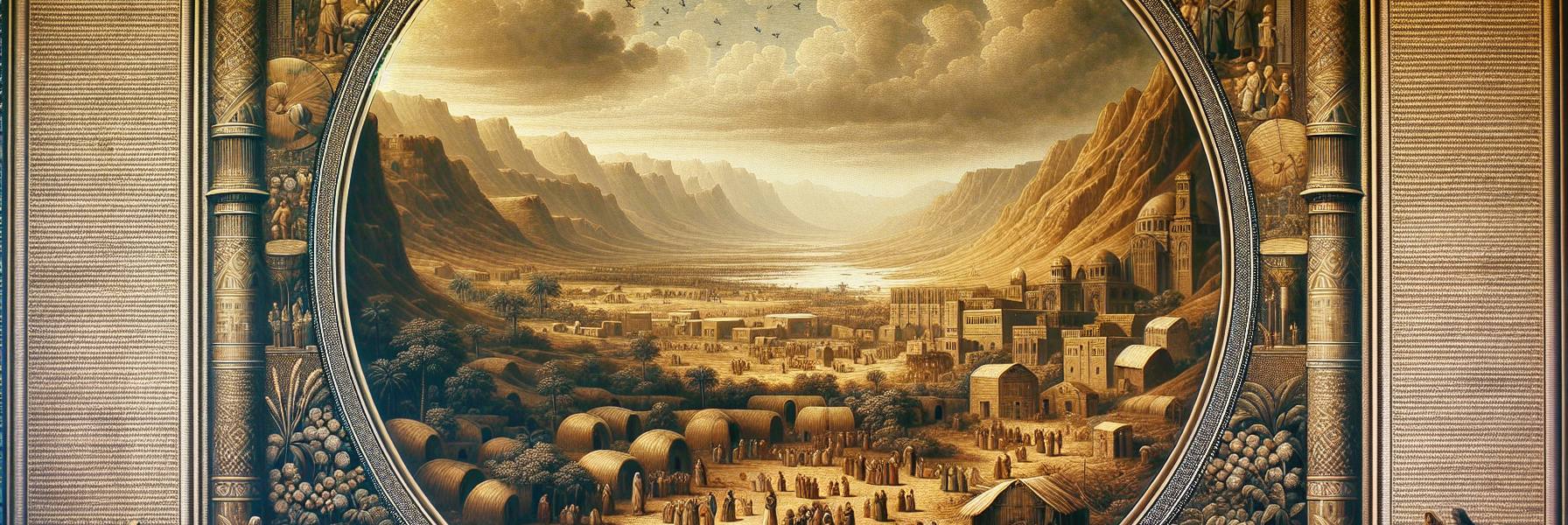

The memory of Joseph had grown thin in the land of Egypt, like the last fading stain of dye on old linen. The man who had once been the kingdom’s salvation, the interpreter of dreams who shepherded them through seven lean years, was now just a whisper in the dust of forgotten archives. His people, however, were not forgotten. They were everywhere.
They had come in as seventy souls, a clan of shepherds welcomed into the lush pasture of Goshen. Now, generations later, they were a nation within a nation. The fields and workshops of Goshen teemed with them—a restless, fruitful, multiplying people. Their language was a familiar murmur in the marketplaces; their children seemed to spring from the very black soil of the Delta. They were strong, a people whose hands were calloused from brick-making and building, whose backs were unbent by the labour that Egypt increasingly heaped upon them.
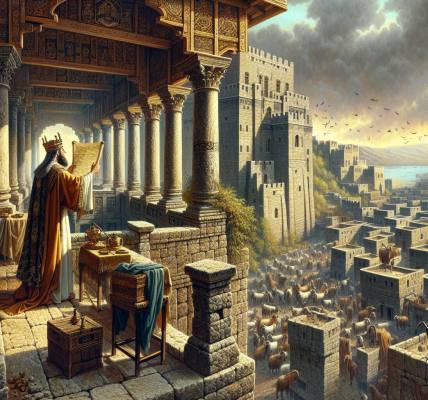
In the great limestone halls of the royal palace at Pi-Ramesses, a new king brooded. He did not know Joseph. To him, the tales were antiquated court poetry, irrelevant to the pressing geometry of power. He saw only the unsettling arithmetic: the Israelites were many, and they were still increasing. They clustered thickly in the northeast, that vulnerable flank of the kingdom where foreign armies might one day sweep in from the desert. A chilling calculation formed in his mind: what if, when the sword fell, they joined the enemy? Their strength would tip the balance. They would rise, and Egypt would fall.
He summoned his advisors, his military commanders, the overseers of the great state projects. His voice, cool and measured, laid out the problem not as a fear, but as a fact. “Look,” he said, gesturing vaguely towards the north, as if the Israelite swarm was visible from the chamber. “The people of the children of Israel are more and mightier than we. We must deal wisely with them.”
The policy that emerged was not one of immediate slaughter, but of a slow, grinding subjugation. It was presented as a matter of national utility. The great ambitions of the crown—new store-cities, granaries, monuments to the glory of the gods and Pharaoh—required vast labour. Who better than this vigorous, landless population? Taskmasters were appointed over them, hard men with whips of papyrus and quotas written on flaky ostraca. The aim was two-fold: to harness this human river for the glory of Egypt, and to break its spirit with the weight of the work.
Pithom and Raamses became bywords for misery. The sun beat down on endless mud pits where men and women stooped, mixing straw-laced clay with their feet. Others hauled water, chopped straw, carried the heavy, unfired bricks on wooden yokes that gouged their shoulders. The air was thick with the smell of sweat, mud, and despair. Overseers’ shouts punctuated the groan of labour. The quota was relentless; if the brick count fell short, the blows fell hard.
But a strange thing happened. The more they were afflicted, the more they multiplied and spread. It was as if life, confronted with the sheer, crushing intention of death, pushed back with greater force. Children were born in the shadows of the brick kilns. Families clung tighter. Their God, the God of their fathers Abraham, Isaac, and Jacob, seemed to breathe a stubborn vitality into them that the lash could not extinguish. A kind of dread now mixed with the Pharaoh’s political calculus—a superstitious unease at this inexplicable fertility.
His next move was quieter, more insidious. He sent for two women. Their names were Shiphrah and Puah. They were Hebrew midwives, the ones who knelt in the dim, blood-warm hours before dawn to catch life as it entered the world. They stood before his majesty, their hands still smelling of mint and myrtha used to cleanse, their simple woolen garments stark against the glittering court.
His command was chilling in its simplicity. “When you attend the Hebrew women on the birthstool,” he instructed, his eyes devoid of any recognition of their humanity or skill, “if it is a son, you are to kill him. But if it is a daughter, she may live.”
He expected obedience. He expected fear. What he did not expect was the quiet, immovable fabric of their faith. Shiphrah and Puah left the palace, but the king’s order did not enter their hearts. They went back to their work, to the cries of labouring women, to the sacred, messy struggle of birth. They feared the God of life more than they feared the king of death.
When questioned later by an angry Pharaoh—”Why have you done this, and let the male children live?”—they had an answer ready, born of sharp observation and a grain of truth. “Because the Hebrew women are not like the Egyptian women,” they said, their voices perhaps even carrying a hint of weary professionalism. “They are vigorous. Before the midwife can even get to them, they have already given birth.”
It was a story that played on Egyptian stereotypes of these robust, uncultured slaves. It was just plausible enough. And behind it was a divine approval, a quiet reward for their courage: God dealt well with the midwives, and He gave them families of their own, a bitter irony not lost on a king who sought to strangle Israelite families in the crib.
Frustrated, Pharaoh abandoned subtlety. The order went out to all his people, a monstrous democratization of violence. “Every son that is born to the Hebrews,” he commanded, “you shall cast into the river Nile. But every daughter you shall let live.”
The decree hung over the land like a miasma. The great, life-giving Nile, the artery of Egypt, was now to become a grave. It was a final, desperate attempt to drown the future of a people in the very waters that sustained the kingdom. The air in Goshen grew heavier, pregnant now with a terrible listening—for the cry of a newborn boy, for the footsteps of soldiers, for the final, chilling splash in the reeds.
And in one house, among the many, a man and a woman of the tribe of Levi looked at each other across the stillness of their home. A new life stirred within the woman, a secret hope. The king’s edict echoed in their minds, but so did another, older promise, whispered from generation to generation. They would have to wait. They would have to hide. They would have to trust in a deliverance they could not yet see, while the broad, indifferent waters of the Nile flowed on.