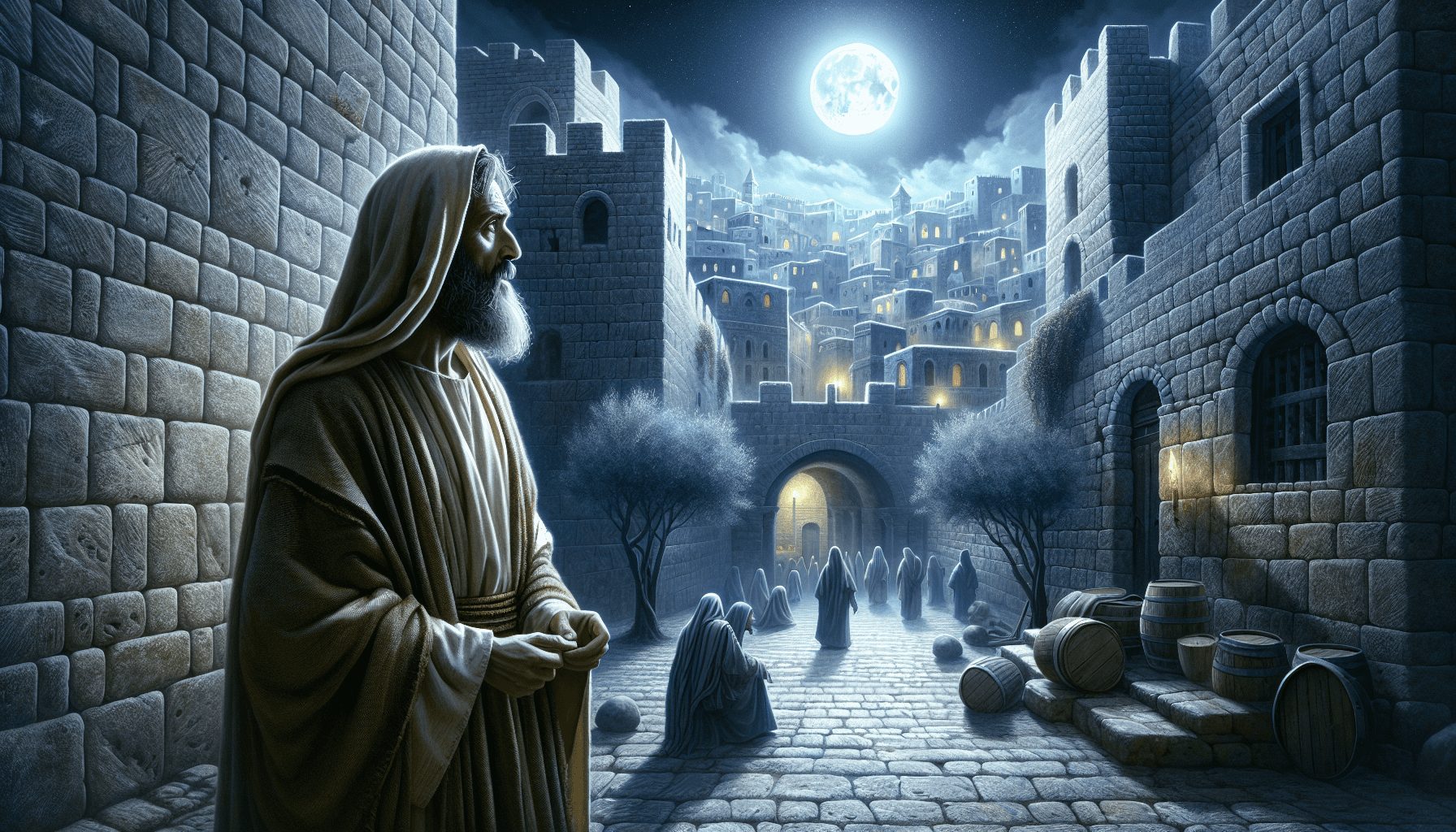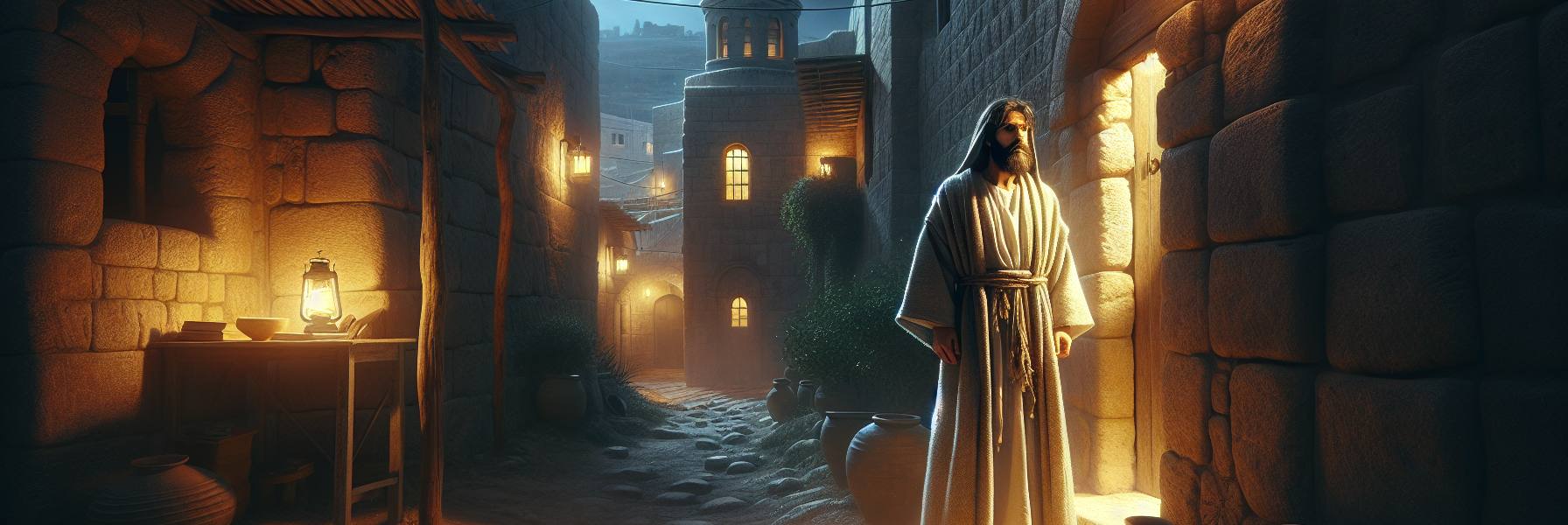

The heat of the day had bled away into a Jerusalem evening, leaving behind the cool, dusty scent of stone and earth. Nicodemus stood before a modest dwelling in a quieter quarter of the city, his fine linen robe feeling suddenly conspicuous. He had waited for full dark, the last saffron streaks of sunset swallowed by the indigo sky. A servant had delivered the message, a request for a private audience. The reply had been simple: *Come.*
He knocked, a soft, tentative sound. The door opened, not by a servant, but by the man himself. Jesus of Nazareth. In the low light of a single oil lamp, his face was all planes and shadows, eyes holding a calm, unnerving depth. No greeting was offered, but a slight nod, an invitation to enter.
The room was spare. A low table, some rolled mats, the smell of cured olives and lamp oil. Nicodemus cleared his throat, the formal phrases rehearsed on the walk over now sticking to his tongue. “Rabbi,” he began, his voice sounding too loud in the quiet. “We know that you are a teacher who has come from God. For no one could perform the signs you are doing if God were not with him.”
He meant it. He had seen the things, heard the reports from credible men. But the words hung there, a diplomat’s opening, careful and safe.
Jesus looked at him, not at his robes or his posture of learned authority, but directly into the unease he carried. His reply was not an acknowledgement of the compliment, nor a dismissal. It cut straight through the polite veneer to the heart of the matter, spoken with a quiet certainty that filled the small space.
“Very truly I tell you, no one can see the kingdom of God unless they are born again.”
Nicodemus blinked. The non sequitur was jarring. Born *again*? The phrase rattled against everything he knew—the covenant of Abraham, the Law of Moses, the meticulous study of a lifetime. His mind, trained in linear argument, seized on the literal impossibility. A flicker of the old Pharisee, the debater, rose within him.
“How can someone be born when they are old?” he asked, a trace of bewildered frustration in his whisper. “Surely they cannot enter a second time into their mother’s womb to be born!”
Jesus didn’t smile at the literalism. His voice remained steady, patient, but it deepened, like water finding a hidden channel. “Very truly I tell you, no one can enter the kingdom of God unless they are born of water and the Spirit. Flesh gives birth to flesh, but the Spirit gives birth to spirit. You should not be surprised at my saying, ‘You must be born again.’”
He paused, letting the distinction settle. The lamp flame guttered, casting long, dancing shadows. Outside, a night wind stirred, a soft sigh against the door.
“The wind blows wherever it pleases. You hear its sound, but you cannot tell where it comes from or where it is going. So it is with everyone born of the Spirit.”
Nicodemus sat back on his heels. He was a master of Israel, a teacher who could parse the finest point of legal code. Yet here, in this bare room, he felt like a student gazing at a text in a language he only half-understood. The analogy was maddening and beautiful. The wind—*ruach*—the same word for Spirit. Unseen, sovereign, undeniable in its effect. You couldn’t command it, cage it, or fully comprehend its path. You could only feel it, and be changed by it.
“How can this be?” The question this time was not argumentative, but plaintive, a genuine cry from the depths of his confusion. It was the admission of a wise man who had run into the limits of his own wisdom.
“You are Israel’s teacher,” Jesus said, and there was no mockery in it, only a profound gravity, “and do you not understand these things? Very truly I tell you, we speak of what we know, and we testify to what we have seen, but still you people do not accept our testimony. I have spoken to you of earthly things and you do not believe; how then will you believe if I speak of heavenly things?”
The words were a gentle rebuke, but they also held a door open. *We speak of what we know.* It was an invitation into a different kind of knowing, one based not on scholarly citation but on firsthand witness. Nicodemus fell silent. The only sound was the distant bark of a dog and that ceaseless, whispering wind.
Then Jesus began to speak again, his gaze seeming to look through the clay walls of the house, out into the vast scripture of the night sky. He spoke of ascent and descent, of heavenly things rooted in an earthly story every Jew knew by heart.
“No one has ever gone into heaven except the one who came from heaven—the Son of Man.” His voice took on a melodic, prophetic rhythm. “Just as Moses lifted up the snake in the wilderness, so the Son of Man must be lifted up, that everyone who believes may have eternal life in him.”
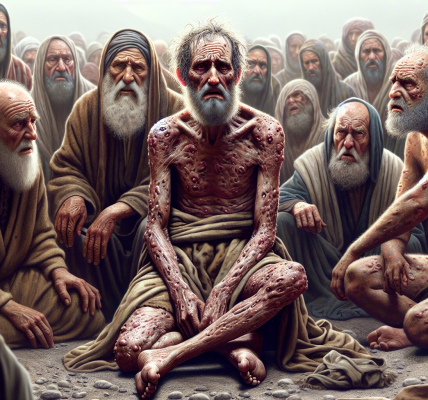
Nicodemus knew the story well—a plague of venomous snakes, the cries of the dying, and God’s strange instruction to Moses: fashion a bronze serpent, lift it high on a pole. All who looked upon it, in faith and desperation, would live. It was a story of death, a symbol of death, becoming the very source of life for those who trusted the remedy provided.
The connection was staggering. This wasn’t just more teaching. This was a profound re-telling of the story of God and his people, with himself at its center. The lifted-up one. The remedy.
And then came the words that would, in time, echo far beyond that room, beyond Jerusalem, across centuries and oceans. They came not as a shout, but as a solemn, world-altering declaration.
“For God so loved the world that he gave his one and only Son, that whoever believes in him shall not perish but have eternal life. For God did not send his Son into the world to condemn the world, but to save the world through him.”
*God so loved the world.* The emphasis wasn’t on wrath, or law, or exclusion, but on a love so vast it compelled a gift beyond calculation. The world, *kosmos*, all of it—the good, the broken, the faithful, the lost. The love was the engine; the Son was the gift; belief was the receiving hands.
“Whoever believes in him is not condemned,” Jesus continued, the lamp light now seeming to gather in his eyes. “But whoever does not believe stands condemned already because they have not believed in the name of God’s one and only Son. This is the verdict: Light has come into the world, but people loved darkness instead of light because their deeds were evil. Everyone who does evil hates the light, and will not come into the light for fear that their deeds will be exposed. But whoever lives by the truth comes into the light, so that it may be seen plainly that what they have done has been done in the sight of God.”
The discourse was over. The ideas hung in the air—birth from above, wind-like Spirit, a serpent lifted up, a Love that gave, a Light that exposed and healed. Nicodemus had no more questions. His carefully constructed world of ritual and righteousness felt both vindicated and utterly dismantled. He had come seeking a theological clarification. He had been offered a birth.
He stood to leave, his body feeling both heavy and strangely weightless. Jesus saw him to the door. No summary, no call to action, just the quiet space to carry what he had heard.
Nicodemus stepped back into the night. The wind, that same unseen *ruach*, was stronger now, cool against his face. He pulled his robe closer and began the walk home through the sleeping city. The darkness around him was no longer just an absence of light, but a condition he understood in a new way. And far behind him, through a small, lit window, the Light remained, waiting, not condemning the dark, but patiently, relentlessly offering to overcome it. He walked on, the teacher now a student, the old man pondering a new birth, the sound of the wind his only companion.