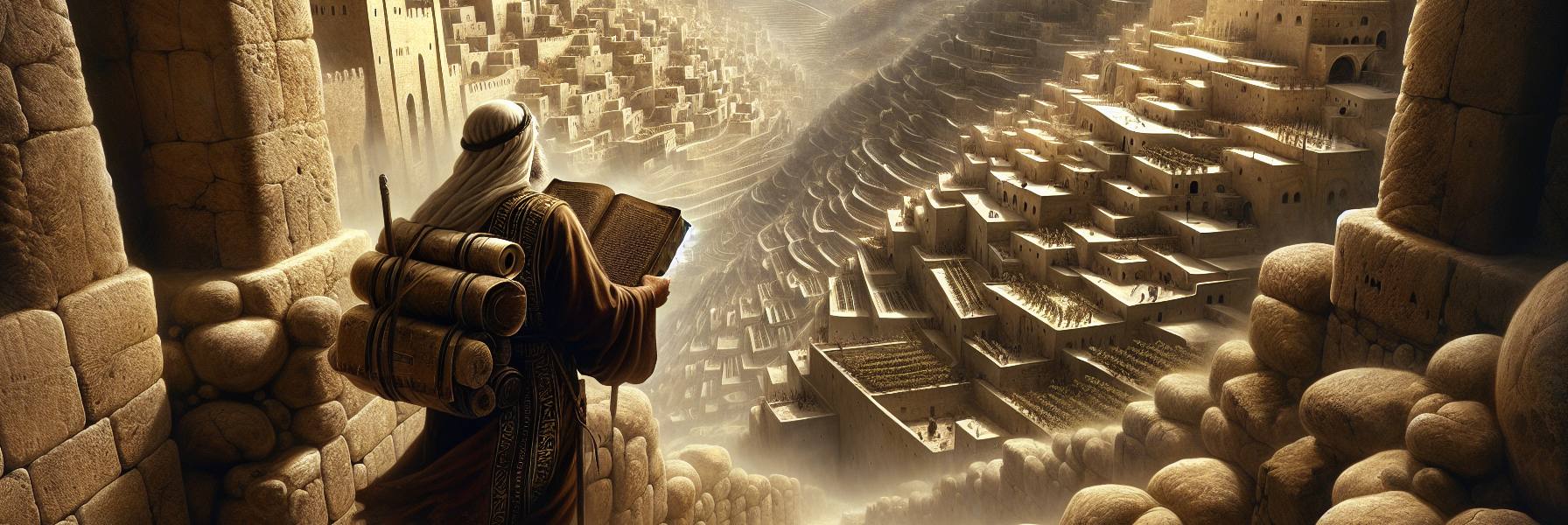

The heat in Jerusalem that summer was a thick, woolen blanket, soaked in dust and despair. It settled in the courtyards, baked the white limestone of the walls, and turned the air above the Kidron Valley into a shimmering, merciless haze. Habakkuk felt its weight as he climbed the worn steps to his post on the city’s eastern rampart, his sandals scraping against stone worn smooth by a thousand worried footsteps.
He wasn’t a king or a prince, just a watchman of a different sort. His watchtower was the cracked leather of the Law, his horizon the crumbling moral landscape of Judah. From this physical height, he could see the vineyards clinging to the hills, but his inner sight was crowded with other scenes: the swift justice of the corrupt, the hollow eyes of the cheated poor, the arrogant laughter that echoed from the houses of the powerful. The fabric of the covenant, he felt, wasn’t just fraying; it was being torn apart with deliberate, greasy fingers.
His prayers, once fluid as psalm, had become a choked, repetitive thing. He found himself rehearsing the same words, not in faith, but in a kind of anguished accusation.
“God of our fathers,” he muttered, the words scraping his dry throat. “How long? A simple question. How long must I cry for help about the violence here and you not listen? How long must I shout ‘Injustice!’ to you and you not save?”
A lizard darted over a sun-bleached stone. Below, a merchant argued loudly with a customer, their voices sharp and venomous in the still air. This was the “violence” he meant. Not just the blade in the dark, but the violence of the weighted scale, the subverted court, the sly word that ruined a reputation. Why did the Almighty tolerate it? He made the law that carved right from wrong as clearly as a valley from a mountain, yet He seemed to stand back and watch as His people smeared the lines into irrelevance.
“The Law grows paralyzed,” Habakkuk whispered to the empty sky. “True justice never breaks through. The wicked surround the righteous, and so the verdict that comes out is twisted, a mockery.”
He waited. Only the buzz of flies, the distant cry of a donkey. The silence was not peaceful; it was a presence, a heavy, listening silence that seemed to absorb his complaints without echo. He descended at dusk, his soul heavier than when he ascended. This went on for days. A week. The cycle of outrage and divine quiet became its own kind of torment.
Then, one evening, as the sun bled into the western hills and long shadows stretched across the city like grasping fingers, the answer came.
It did not come as a still, small voice. It came as a seismic shift in his understanding, a terrifying download of vision that left him breathless, gripping the parapet until his knuckles shone white. The silence shattered not with sound, but with a brutal, panoramic clarity.
“Look among the nations, Habakkuk. Watch. Be utterly astounded.”
And he saw. Not Judah, but a force from the east, a people bitter and impetuous, sweeping across the earth to seize dwellings not their own. The Lord was raising up the Chaldeans.
The vision was not of tidy armies in formation, but of a raw, terrifying essence. He saw their nature before he saw their banners. A people whose own power was their god. They moved like desert predators, with the dread glory of a sandstorm. Their horses were swifter than leopards, more wolfish than evening wolves. Their horsemen sprang from distant places, flying like vultures hungry for carcasses. They came entirely for violence. The dread of them preceded them, a wind of fear that withered resolve. They gathered captives like sand.
And they laughed. This was the worst of it. They laughed at kings, at fortresses. They would sweep past like a sirocco wind and move on, their guilt intact, their strength their divinity.
Habakkuk stood frozen as the vision etched itself into his mind. This was the answer? To the question of Judah’s internal rot, God’s solution was a scalding, external fire? A instrument more wicked than the disease?
A new, more profound horror seized him. He stumbled down to his small chamber, the after-image of laughing, pitiless faces burning behind his eyes. The silence was gone, replaced by a roaring theological dissonance.
He found his voice again, but now it was raw, embittered, arguing not from hurt but from a shattered sense of divine justice.
“Your eyes are too pure to look on evil, you cannot tolerate wrongdoing,” he argued into the gathering dark. “So why do you tolerate the treacherous? Why are you silent while the wicked swallow up those more righteous than they?”
The Chaldeans, in his vision, were fishermen who caught men in a cruel net and rejoiced. They worshipped their nets, offered sacrifices to their dragnets. Would God, the Holy One of Israel, really use such a tool? To punish a thief, you appoint a murderer?
He saw the endless cycle: the Chaldean sharpening his sword, stringing his bow, preparing to slaughter nations without mercy. They would sweep through like a wind, and because they ascribed their power to themselves, they would never be satisfied. They would keep gathering, conquering, piling up guilt like spoil.
The final, desperate question tore from him, a whisper that held the weight of a scream.
“Will they, therefore, empty their net and go on mercilessly killing nations forever?”
The chapter ended there, in his chamber, with no resolution. Only the prophet’s shattered assumptions, the terrifying vision of God’s unsettling method, and the heavy, unresolved tension hanging in the dusty air. Outside, Jerusalem slept, unaware of the storm being prepared in the east, and of the lone, troubled man who now bore the dreadful knowledge of its coming. The watchman had received his answer, and it had become a darker, more terrible burden than his original cry.