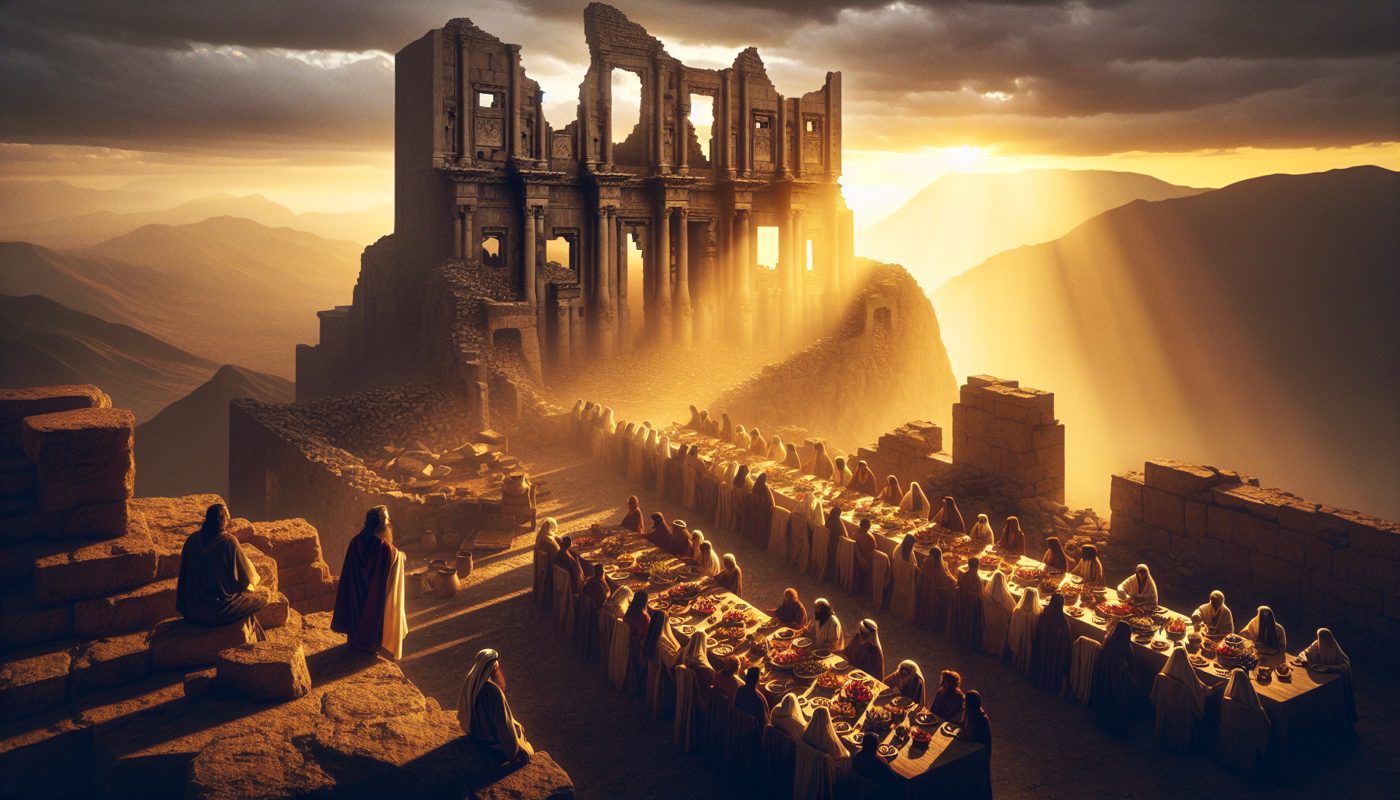
Isaiah 25 opens with a man who has seen something. He has watched a fortified city collapse into rubble, a palace of strangers reduced to a heap that will never be rebuilt. The Lord has done this, and the prophet does not flinch. He exalts the Lord by name, calling him his God, and he praises him for counsels carried out in faithfulness and truth. The ruin is not lamented. It is celebrated as a wonder.
The chapter does not name the ruined city, but it names the consequence. A strong people will glorify the Lord because of it. A city of terrible nations will fear him. The destruction of the proud fortress becomes the ground for worship among those who were not strong before. The poor and the needy, the ones who had no refuge of their own, discover that the Lord himself has been their stronghold all along.
The prophet describes that protection in physical terms. The Lord is a refuge from the storm, a shade from the heat. When the blast of the terrible ones comes like a storm against the wall, the Lord brings it down. The noise of strangers is silenced the way heat is broken by the shade of a cloud. The song of the terrible ones is brought low. The powerful are not merely defeated. They are muted.
Then the scene shifts to a mountain. On this mountain, the Lord of hosts prepares a feast for all peoples. The food is not ordinary. It is fat things full of marrow, wines on the lees well refined. The language is heavy with richness. This is not a sparse meal for the desperate. It is a banquet of abundance, and it is spread for every nation, not for Israel alone.
On the same mountain, the Lord destroys something else. He destroys the face of the covering that covers all peoples, the veil that is spread over all nations. The prophet does not explain what that covering is, but he names its removal as an act of divine power. Whatever has hidden the truth or obscured the sight of God is torn away on this mountain, in the middle of the feast.
Then the prophet declares what the Lord has done. He has swallowed up death forever. The verb is past tense, as though the act is already finished. Death is not defeated in a slow process. It is swallowed, consumed, removed. And because death is gone, the Lord wipes away tears from off all faces. The reproach of his people is taken away from all the earth. The Lord has spoken it, and that is the guarantee.
On that day, the people will say what the prophet has already said. They will declare that this is their God, the one they waited for, the one who saves. They will be glad and rejoice in his salvation. The waiting is over. The salvation has come. The mountain is the place where the hand of the Lord rests, and where his people rest with him.
But the chapter does not end with universal peace. Moab is trodden down in his place like straw in the water of a dunghill. The Lord spreads forth his hands in the midst of Moab like a swimmer spreading his arms, but the purpose is not rescue. It is to lay low Moab's pride together with the craft of his hands. The high fortress of Moab's walls is brought down to the ground, even to the dust.
The same mountain that holds the feast for all peoples also holds judgment for the proud. The poor and needy find refuge there. The terrible nations are silenced there. Death is swallowed there. And Moab, the nation that trusted in its own walls and its own pride, is ground into the dust there. The mountain does not treat everyone the same. It saves the humble and crushes the arrogant.
The prophet does not ask for a response. He does not plead or warn. He simply declares what the Lord has done and what he will do. The feast is prepared. The covering is removed. Death is ended. Tears are wiped away. The hand of the Lord rests on his mountain. And the proud are brought low. That is the whole of the chapter, and the prophet lets it stand as it is.
Comments
Comments 0
Read the discussion and add your voice.
Members only
Sign in to join the conversation
We keep comments tied to real accounts so the discussion stays clean and trustworthy.
No comments yet. Be the first to add one.