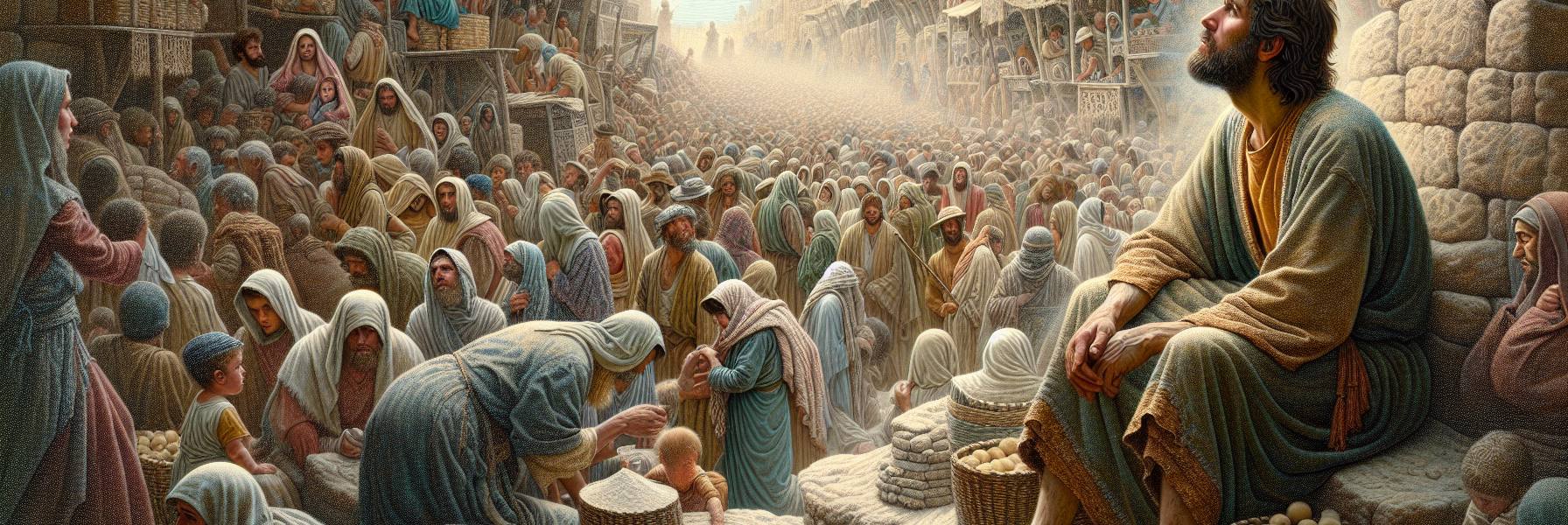

The air over the hillside was thick, not just with the dry heat of the day, but with the press of bodies and the weight of words. The dust, fine as ground flour, rose in little puffs with every shift of sandaled feet and settled on the wool of cloaks and the frayed edges of baskets. Yohan, a fisherman who’d left his nets drying in Bethsaida to follow the rabbi from Nazareth, sat with his knees drawn up, feeling a pebble dig into his thigh. He was tired. The hopes that had drawn him here felt frayed by the sheer, exhausting reality of the crowd—the crying infants, the bartering of vendors at the periphery, the muttered arguments about interpretation.
And then the teacher’s voice cut through it, not with a shout, but with a carrying clarity that stilled the rustling.
“Don’t judge,” he said, his gaze sweeping over them, pausing on a group of Pharisees whose lips were thin with disapproval, and then on a woman shushing her child, her face lined with worry. “Don’t judge, so that you won’t be judged. Because with the judgment you use, you’ll be judged, and with the measure you use, it will be measured to you.”
Yohan shifted the pebble. He thought of his brother, always so quick to point out a poorly mended net, a lazy hour at dawn. He felt the familiar heat of defensive anger. But the teacher wasn’t finished.
“Why do you look at the splinter in your brother’s eye, but don’t notice the beam of wood in your own eye?” A few men chuckled, a dry, knowing sound. The image was ridiculous, absurd—a man with a roof timber protruding from his face, squinting critically at a speck of dust in another’s eye. “How can you say to your brother, ‘Let me take the splinter out of your eye,’ and look, there’s a beam in your own eye? Hypocrite! First take the beam out of your own eye, and then you’ll see clearly to take the splinter out of your brother’s eye.”
The laughter died. The words weren’t just a joke; they were a mirror. Yohan saw not his brother, but his own heart—a ledger of grievances, a readiness to condemn. The beam was his own self-righteousness, heavy and blinding.
A man near the front, his clothes a little too fine, called out, “Rabbi, what of the holy things? The pearls of the Law?” The teacher’s expression changed, grew almost sorrowful.
“Don’t give what is holy to dogs, and don’t throw your pearls before pigs. If you do, they might trample them under their feet, then turn and tear you to pieces.”
A murmur of confusion rippled through the crowd. It seemed harsh, contrary to the message of mercy. But as Yohan listened, he began to understand. It wasn’t about withholding truth from the unworthy. It was about discernment. The pearls weren’t for display or for casting indiscriminately into the mire of mockery. They were for the seeking heart. He thought of the endless, circular debates in the synagogue, the Scriptures used as weapons to win arguments rather than to transform lives. That was the trampling.
Then the teacher’s voice softened, resuming the rhythm that was becoming familiar, a rhythm that felt like the beat of a different world. “Ask, and it will be given to you. Search, and you will find. Knock, and the door will be opened to you. For everyone who asks receives, and the one who searches finds, and to the one who knocks, the door will be opened.”
It was an astounding promise. Absolute. A woman clutching a sick child to her breast closed her eyes, her lips moving silently. A young scholar, scrolls at his side, leaned forward, his brow furrowed.
“Would any of you hand your son a stone when he asks for bread?” the teacher continued. “Or a snake when he asks for a fish? So if you, who are evil, know how to give good gifts to your children, how much more will your Father in heaven give good things to those who ask him?”
Yohan looked at his own rough hands, hands that had withheld forgiveness, that had judged swiftly. *Evil*. The word was a shock, but it rang true. Yet from that very recognition sprang the hope: if even he, in his flawed love, knew to give his son a fish and not a serpent, then the love of the Father was a reality beyond comprehension. The asking, the searching, the knocking—they were not transactions, but the posture of a child before a good parent.
The sermon turned then, towards its end, and the urgency returned. “So in everything, treat people the same way you want them to treat you. This, in fact, is what the Law and the Prophets are all about.”
It sounded so simple. It was the hardest thing in the world.
“Go in through the narrow gate,” the teacher said, his arm gesturing towards the winding, steep path that led away from the easy, well-trodden Roman road below. “Because the gate is wide and the road is broad that leads to destruction, and many go through it. But the gate is narrow and the road is difficult that leads to life, and few find it.”
Yohan felt a chill despite the sun. The broad road was the way of the beam in the eye, the way of easy judgment, popular opinion, comfortable compromise. It was crowded. The narrow road was the way of the splinter-remover, the way of seeking and knocking, the way of treating others as you wished to be treated. It looked lonely. And hard.
A final warning, stark and terrifying, filled the air. “Be on your guard against false prophets, who come to you in sheep’s clothing but inwardly are voracious wolves. You’ll recognize them by their fruit.”
Yohan’s mind went to the charismatic preachers in Jerusalem, drawing crowds with promises of political revolution and earthly glory. Their words were thrilling. But what was their fruit? Division? Hatred? Pride?
“Are grapes gathered from thorn bushes, or figs from thistles? In the same way, every good tree produces good fruit, but a rotten tree produces bad fruit. A good tree can’t produce bad fruit, and a rotten tree can’t produce good fruit.”
The logic was merciless and agricultural. You didn’t assess a tree by its leaves or its pleasing shape, but by what it yielded. You didn’t assess a teacher by his eloquence or his following, but by the character he produced in himself and his disciples. Love, joy, peace, patience? Or discord, envy, and strife?
“Every tree that doesn’t produce good fruit is cut down and thrown into the fire. So you’ll recognize them by their fruit.”
The silence that followed was profound. The teacher concluded, his voice now holding a final, sobering weight. “Not everyone who says to me, ‘Lord, Lord,’ will enter the kingdom of heaven, but only the one who does the will of my Father in heaven. On that day, many will say to me, ‘Lord, Lord, didn’t we prophesy in your name, and expel demons in your name, and do many miracles in your name?’ Then I will declare to them, ‘I never knew you. Go away from me, you who practice lawlessness!’”
The words landed like stones in a still pool. *I never knew you*. It was the ultimate rejection, not based on a lack of religious activity, but on a lack of relationship, a lack of the lived obedience that flowed from knowing him. The house built on the rock and the house built on the sand—the story he told next—was simply the illustration. The storm would come. It was coming now, in the form of Roman oppression, of religious persecution, of internal doubt. The foundation would be everything.
As the crowd began to disperse, buzzing with conversation and debate, Yohan remained seated. The pebble was still there. He picked it up, a smooth, grey stone. He thought of the wise builder digging down, past the easy sand, to find the bedrock. It was hidden, difficult work. He looked at the teacher, who was now surrounded by a few disciples, his face showing the fatigue of the day. The words weren’t just a sermon. They were an excavation manual. And Yohan knew the work had to begin in his own heart, removing the great, heavy beam, learning to ask, to seek, to knock on the narrow gate, one difficult, daily step at a time. The broad road beckoned, wide and inviting, down in the valley. He stood, turned his back on it, and began the climb.