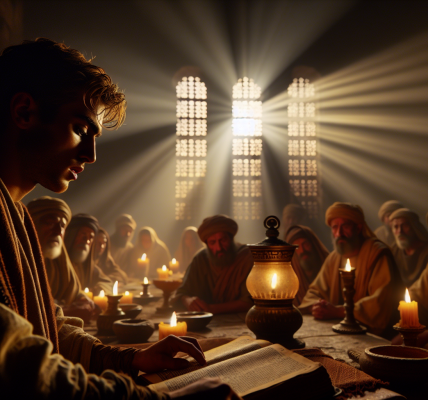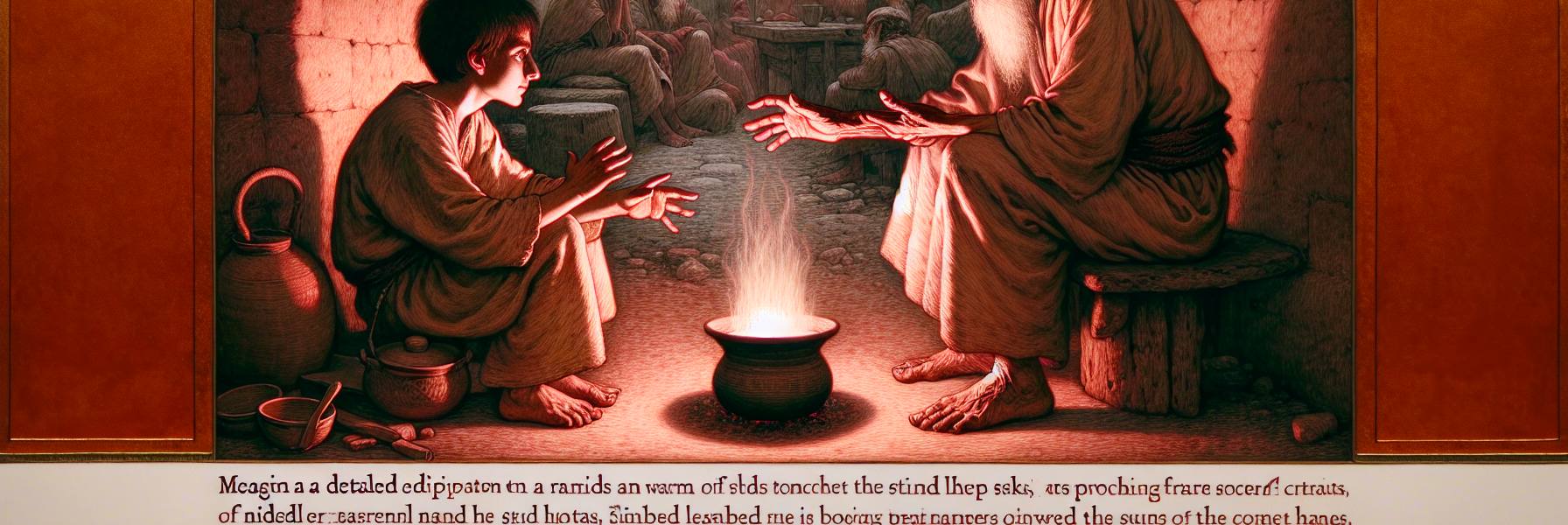

The fire had burned low, a heap of crimson embers breathing heat into the small room. Old Eliahud stretched his knotted hands toward the warmth, the parchment of his skin glowing in the dim light. From the street outside, faint and defiant, came the sound of laughter from the garden of the incense-burners, the clatter of bowls where they sat through the night invoking names that made his soul shrink.
His grandson, Micah, sat on a rough stool, eyes fixed on the old man’s face. “Tell it again, Grandfather. The word that came to you.”
Eliahud did not speak at once. He was listening to the other sound, the one beneath the laughter: the persistent, hollow tap-tap-tap of a mason’s chisel from the Hill of the Potter, where they shaped bricks for an altar to the Host of Heaven in their own courtyards. He closed his eyes.
“I sought,” he began, his voice a dry rustle like palm fronds in a desert wind, “a people who did not seek. I spread out my hands, all the day, to a rebellious house. They walked in a way that was not good, following their own devices.”
Micah leaned forward. “Our people?”
“A people who provoke me to my face, continually.” The old man’s eyes opened, sharp and dark. “They sit among the graves, and spend the night in secret places. They eat the flesh of swine, and the broth of abominable things is in their vessels. And they say, ‘Keep to yourself, do not come near me, for I am too holy for you.’”
The irony was a bitter taste in his mouth. He remembered the sharp, greasy smell from the valley, the arrogant eyes of young priests who’d built their own high places, thinking the God of Abraham confined to the ruins of Solomon’s temple. They sought ghosts and whispered to the dead, all the while holding their ritual purity like a shield against the very Lord they claimed to serve.
“What becomes of such?” Micah whispered, his young face grave.
Eliahud’s gaze returned to the fire. “They are a smoke in my nostrils,” he said, quiet and final. “A fire that burns all the day. I will not keep silence, but will repay, yes, I will repay into their bosom both their iniquities and the iniquities of their fathers together.”
A heavy silence settled, broken only by the crackle of the embers. It was a terrible sentence. Micah’s shoulders slumped. Was this all the word contained? Ashes and judgment?
But then Eliahud’s expression shifted, the deep lines around his mouth softening not into a smile, but into something more profound—a weary, unshakable certainty. He reached out and placed a hand on Micah’s knee.
“Thus says the Lord,” he continued, and now his voice gained a thread of strength, a melody woven through the dirge. “As the new wine is found in the cluster, and one says, ‘Do not destroy it, for there is a blessing in it,’ so will I do for my servants’ sake. I will not destroy them all.”
He described it then, not as a priest reciting a law, but as a farmer dreaming of a lost inheritance. A land, their land, but made new. Sharon would no longer be a place for flocks alone, but a meadow of myrtle and cypress, where shepherds would rest under the broad shade. The Valley of Achor—the valley of trouble, where Achan’s sin had once brought defeat—would become a door of hope. A place for herds to lie down, unafraid.
“My chosen shall inherit my mountains,” Eliahud murmured, his eyes seeing beyond the mud-brick wall. “They shall build houses and inhabit them. They shall plant vineyards and eat their fruit. They shall not build and another inhabit; they shall not plant and another eat.”
Micah’s breath caught. It was a reversal of every curse they had known, every fear that haunted their exile and their return. The futility was lifted.
“And the wolves and the lambs…” the young man prompted.
“They shall feed together,” Eliahud said, a true smile touching his lips now. “The lion shall eat straw like the ox. Dust shall be the serpent’s food. They shall not hurt or destroy in all my holy mountain.”
The vision unfolded between them, painted on the dark air: longevity so profound that to die at a hundred years would be to die a mere youth, an accident. People would live out the days of trees, their lives as solid and fruitful as the oaks of Bashan. They would enjoy the work of their hands, free from the consuming dread of invasion or barrenness.
Eliahud’s voice sank to a whisper, intimate and sure. “Before they call, I will answer. While they are yet speaking, I will hear. The sound of weeping, the cry of distress… it will be heard no more.”
He fell silent. The fire had settled into a steady, golden glow. The laughter from the street had ceased. Even the chisel from the hill was still. It was as if the night itself was holding its breath, caught between the two realities—the one of smoke and rebellion just outside the door, and the one of answered prayer and grazing lions in the quiet of the old man’s heart.
Micah sat for a long time, watching the peaceful rise and fall of his grandfather’s chest. The judgment had been severe, absolute. But the promise… the promise was not a general blessing sprayed upon a nation. It was specific, intimate, agricultural, *real*. It was about dirt and vines and houses and the absence of toothaches. It was about a God who heard the unspoken thought, who saw the tear not yet shed, and whose answer was already on the way, woven into the very fabric of a new heaven and a new earth.
He understood then. The fire outside—the one burning in the nostrils of God—was for those who chose the graves and the swine’s flesh, who loved their own devices. But the other fire, the one here on the hearth, speaking of answered prayers and wolves lying down with lambs… that was for the servants. For those who, like his grandfather, sought the Seeker.
The old man slept. Micah pulled a coarse blanket over his shoulders, and went to the window. The first hint of dawn, a pale smudge of silver, was touching the eastern hills. Somewhere, a real lamb bleated. A new day, ordinary and broken. But now, and forever after, he would see through it, to the mountains beyond, where the lion, full of straw, slept peacefully in the lengthening shadow of a vineyard heavy with untrampled fruit.