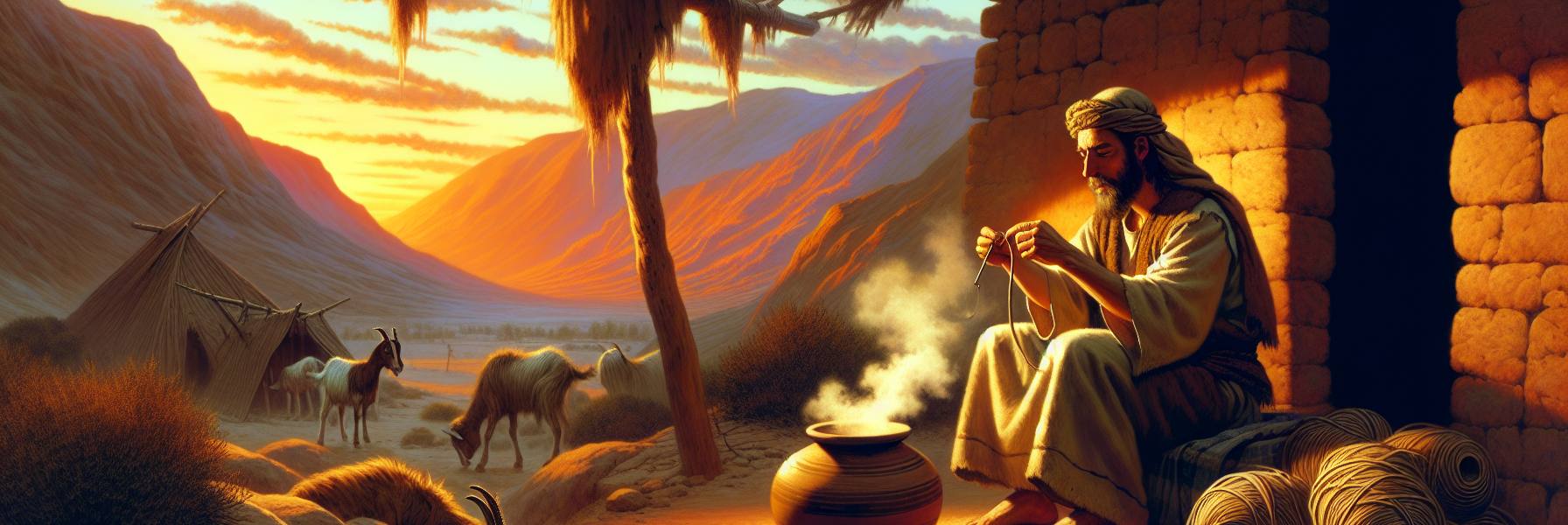

The heat of the day was finally beginning to soften, lengthening the shadows of the goat-hair tents into strange, stretched shapes across the floor of the wadi. Caleb sat just inside the entrance of his dwelling, the smell of dust and thyme heavy in the air. His fingers worked a piece of cord, the repetitive motion a comfort. His mind, however, was not on the task. It was on his neighbor, Elidad, and the empty space where a clay storage jar, broad-bellied and sealed with wax, should have been.
It had vanished three days ago. Not misplaced. Taken. Caleb knew the rhythms of his own possessions as he knew the lines on his palms. The jar had held the last of his barley from the last harvest, a meager reserve against the uncertainty of the next. Its absence was a cold stone in his gut.
He had said nothing at first, nursing a private, seething anger. But in a camp such as this, a moving city of tribes beneath the mountain, secrets were thin things. Whispers had reached him by the second evening, carried on the smoke of cooking fires. Talk of Elidad’s son, Rea, seen skulking near the edges of the camp after dark. Talk of a sudden, uncharacteristic purchase of fine oil from a trader in the Judahite section.
Caleb’s justice was a hot, simple thing. He wanted to march over, confront the boy, demand not just the grain but blood for the insult. But the words of Moses, still echoing from the foot of the smoking mountain, had woven themselves into the fabric of their new life. They were no longer just runaway slaves; they were a people under a covenant, with rules that sought to build not just order, but a sacred community.
The rule for theft was clear. It was not mere retaliation. If the stolen property was found alive in the thief’s possession—an ox, a donkey, a sheep—it was to be restored double. But for a jar of barley? The law was specific: if what was stolen was gone, consumed or sold, then the restitution was to be far greater. Four sheep for one. Five oxen for one. The principle was one of costly restoration, a burn that would make a man think twice before stretching out his hand to his neighbor’s goods.
Caleb sighed, the knot in the cord pulling tight. He was not a wealthy man. Fourfold restitution would beggar Elidad’s family. The thought brought him no pleasure, only a heavier weight. This was the hard truth of the law—it judged the thief, but it also demanded something from the wronged. It demanded a process, not a riot.
He rose, his joints stiff, and walked out into the violet twilight. He did not go to Elidad’s tent. Instead, he went to the tent of Jethro, an older man from the tribe of Reuben who was often called to settle disputes. Jethro was mending a sandal by firelight, his face a map of deep lines.
“Caleb,” he said, not looking up. “The jar.”
“Yes.”
“You have proof?”
“No proof that would satisfy a court in Egypt. Only the absence. And the talk.”
Jethro nodded, setting his awl down. “The talk is a breeze. It can blow from any direction. The law requires more. It requires witnesses, or the thing itself found in his keeping. If you accuse without this, you become the thief of his good name. The burden is a solemn one.”
This was another layer Caleb had not fully considered. The law protected the accused as much as the victim. A false, unproven accusation was a sin against the community.
“What should I do?” Caleb asked, the heat gone from his anger, replaced by a weary confusion.
“Go. Speak to Elidad. Not as an accuser, but as a neighbor who has suffered a loss. See what the Spirit stirs.”
It felt like weakness. But Caleb went.
Elidad’s fire was low. His son, Rea, a boy of fifteen with downy cheeks and shifty eyes, was stirring a pot. Elidad looked up, and in his face Caleb saw not guilt, but a deep, troubled exhaustion.
“Caleb. Come. Sit.”
Caleb sat. For a long moment, he said nothing, watching the boy Rea, who would not meet his gaze. He thought of the commandments: *You shall not steal. You shall not covet.* They were not just rules for the hands, but for the heart. What hunger, what covetousness, had festered in the boy’s heart to lead him to a neighbor’s tent?
“My storage jar is missing,” Caleb said finally, his voice flat. “The one with the chip on its rim, shaped like a crescent moon. It held my barley.”
The silence that followed was thick enough to feel. The only sound was the hiss of the fire and the distant bleat of a sheep. Rea’s stirring stopped. Elidad’s shoulders slumped, as if bearing a sudden, physical load.
“I know,” Elidad whispered.
Caleb waited.
Elidad looked at his son, and his eyes were pools of profound sorrow. “The boy was shamed. He lost a lamb he was tending—a predator took it from the flock at the edge of the camp. He knew the penalty. He knew I would have to make it good to the owner from our own flock. He thought… he thought to replace the value before I knew. He sold the barley to a trader yesterday. For a price far below its worth.”
Rea was crying now, silent tears cutting tracks through the dust on his face. It was not the cunning theft Caleb had imagined. It was a panicked, foolish child’s attempt to avoid his father’s disappointment, spiraling into a worse crime.
The law was clear. The property was gone, sold. Restitution was fourfold. Caleb looked at Elidad’s thin flock, visible in a pen nearby. Taking four sheep would leave them with almost nothing. It would satisfy the letter of the law, and break a family.
But the law also spoke of other things. In the same chapter, woven between the rules for theft, were commands about kindness. If you took your neighbor’s cloak as a pledge, you had to return it by sunset, for it was all he had to keep him warm in the desert night. You were not to curse a leader of your people. You were to be holy, because the Lord their God was holy. The law was a tapestry, and justice was only one thread; mercy was another, tightly woven alongside it.
Caleb took a deep breath, the desert air cool in his lungs. “The law says four sheep for one jar of barley, when it is gone and sold.”
Elidad closed his eyes, a man awaiting a blow.
“But,” Caleb continued, the words forming slowly, as if being given to him, “the law also says we are to be a people set apart. We were strangers in Egypt. We know the weight of oppression. Your son is not a stranger. He is of this camp. He has confessed.”
He stood up. “I will take one sheep. Not four. And your son will work for me, six days, to repay the labor of the barley that was lost. He will learn the weight of a day’s work, and the value of what he took.”
Elidad looked up, stunned. Rea stared, his tears now of confusion and a dawning, painful hope.
It was not the strict penalty. It was something else—a restoration that sought to repair not just property, but the soul. It felt riskier, more uncertain. But it felt, to Caleb in that moment, more like the spirit of the mountain, more like building the community the covenant demanded.
Jethro, who had quietly approached to observe, gave a slow, deep nod. The law was a guardian, a tutor. But sometimes, to fulfill its deepest purpose, it had to be read with the eyes of the heart, remembering that the greatest law, the one upon which all others hung, was love of God and love of neighbor. The jar was gone. But perhaps, Caleb thought as he walked back to his tent under a sky now brilliant with stars, something more valuable had been found.