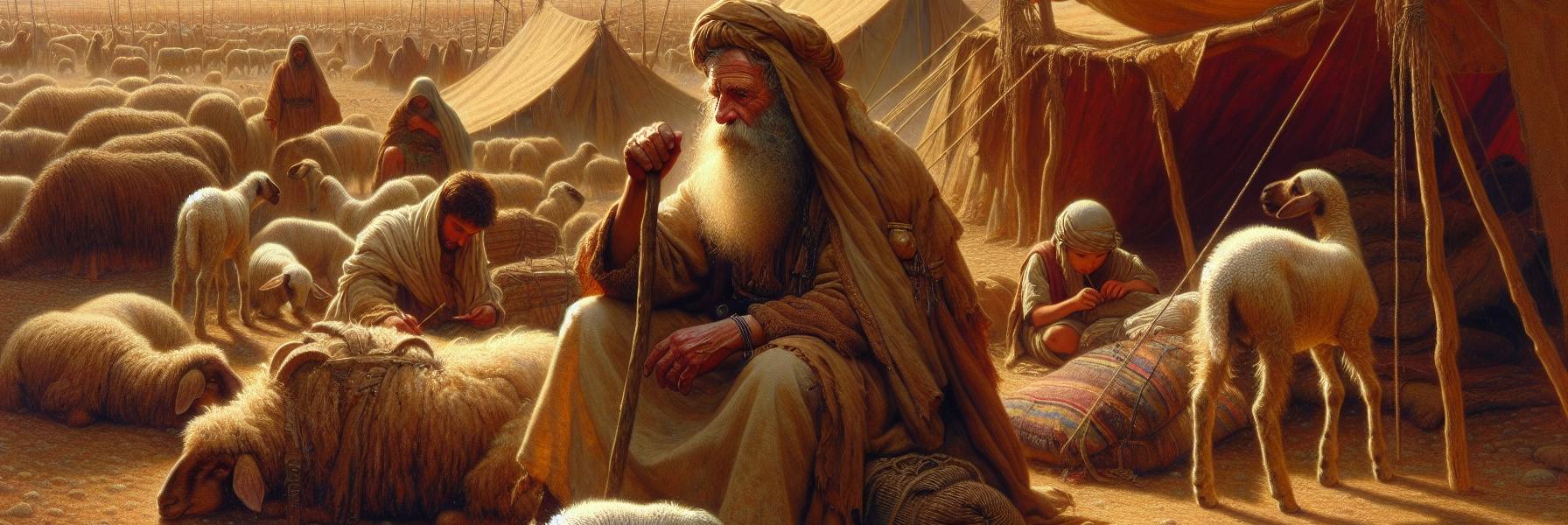

The heat in the camp was a heavy, woolen blanket. It pressed down on the shoulders of the men tending the flocks on the rocky hillsides and shimmered above the endless, tawny plain. Dust, fine as ground cinnamon, clung to everything—to the rough weave of the tents, to the beads of sweat on a child’s temple, to the leaves of the few stunted tamarisks that offered scant relief.
Eliab, his bones aching with eighty years of wilderness and memory, sat in the thin stripe of shade cast by his tent. His grandson, Joah, squirmed beside him, tracing patterns in the dust.
“Sing the mountain song, Grandfather,” Joah said, not for the first time that afternoon.
Eliab didn’t answer immediately. His eyes, milky at the edges but still sharp at the centre, were fixed on the horizon, where the world blurred into a haze of gold and blue. He was not seeing the present camp, but another one, decades gone. The memory had a different taste—of terror, of thunder, of the smell of ozone and wet stone.
“It is not a song for a single voice,” Eliab said at last, his voice a dry rustle. “It is a song for the rock itself to echo, for the congregation. A song for when we remember… and when we forget.”
He shifted, a joint popping softly. “The song begins with a noise. Not a noise of the camp—not the bleating of goats or the crackle of a fire—but a deeper sound. A sound from before the foundation of the world. It is the sound of the Maker of the sea, who cupped the churning deep in the hollow of His hands. Who formed the secret places of the earth, the dry bones of the mountains, the hidden veins of water.”
Joah had stopped drawing. He was listening now, his young face serious.
“And the song,” Eliab continued, his voice gaining a little strength, weaving the words, “is a call to come. To come with a noise of our own. To shout aloud to the Rock of our salvation. To come before His face with thanksgiving, to raise a confused, joyful noise of psalms to Him. For He is a great God. Greater than any god of Egypt, greater than the silent idols of the plains. In His hand are the deep places you cannot imagine, and the heights of the hills are His also. The sea is His—He made it. The dry land… ah, the dry land… His hands formed that, too.”
He fell silent for a long moment, the only sound the distant cry of a desert bird. The weight of the memory was upon him fully now, a physical pressure.
“But the song,” he whispered, “it turns. It becomes hard, like flint. It speaks of a day, a specific day, when the voice that made the mountains spoke and we… we covered our ears.”
Joah leaned in. “What did He say?”
“He said, ‘Harden not your heart.’” Eliab’s gaze was inward, terrible. “It was at Meribah. Massah. Places whose names mean ‘quarreling’ and ‘testing’. The water was bitter, or there was none. Our throats were lined with dust, our faith was a shriveled root. And we cried out, but not in psalms. We cried out in accusation. ‘Is the Lord among us, or not?’ We tested Him. We saw His works—the plagues, the divided sea, the pillar of fire—and yet, in our thirst, we chose to see only the dust.”
The old man’s hand, gnarled as an olive root, clenched on his knee. “For forty years,” he said, the words dragged up from a deep well of sorrow, “that generation sickened Him. They were a people who wandered in heart, who did not know His ways. And He swore in His wrath, ‘They shall not enter my rest.’ Not the rest of Canaan, with its milk and honey. No. A deeper rest. The rest of a trusting heart. The rest of ceasing from your own striving and knowing He is God. They never learned it. They died with the grit of the desert between their teeth, their hearts as hard as the stones they stumbled over.”
Eliab looked at his grandson, and his eyes cleared, focusing on the present. The boy’s face was pale under his tan.
“So the song is both,” Eliab said, his tone softening to a plea. “It is the shout of joy to the Maker of all. And it is the warning, whispered in the ear of the next generation. ‘Today, if you hear His voice…’ It is always today, Joah. The heart does not harden in a year. It hardens in a moment of thirst, in a hour of complaint, in the slow, silent choice to forget the weight of glory and see only the dust. So come. Come with a shout. But come also with a soft heart. Bow down. Kneel before the Lord our Maker. For He is our God, and we are the people of His pasture, the sheep led by a hand that shaped the mountains. Listen. Today.”
The heat had begun to lift, a cooler breath stirring the dust. From somewhere in the camp, the first notes of a lyre sounded, tentative, searching for a melody. Eliab said no more. He simply sat, a monument of memory and flesh, as the shadows lengthened and the ancient, urgent song hung in the air between them, unfinished, a call and a warning echoing down through all the days.