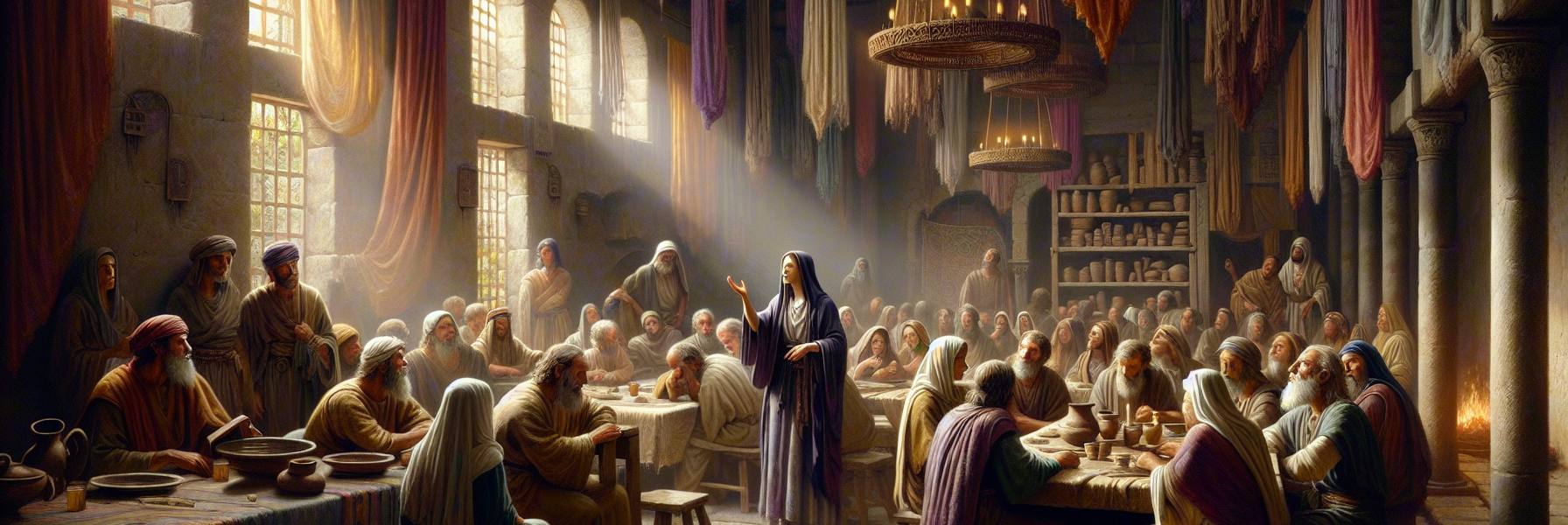

The air in Prisca’s house was thick with the scent of baked clay from the oil lamps and the lingering aroma of the evening meal. It was not a large room, and the bodies gathered there—weavers, merchants, a retired legionary with a stiff knee, slaves who belonged to notable households—made it warm. A tension hummed beneath the murmured prayers, a discordant note that had been growing for weeks.
It began, as it often did, with praise. Old Matthias, his voice like gravel tumbling from a sack, spoke of a vision he’d had while mending his fishing net—a cascade of light over the Aegean, which he took as a sign of the Lord’s favor on their voyage. Then young Chloe, her fingers still stained with purple dye from her master’s workshop, stood. She spoke with a startling, piercing clarity about a passage from the Prophet Isaiah, drawing lines of connection to their own lives in Corinth that left many nodding, a few bewildered. Her words were not elegant, but they carried weight.
Then came Ariston. He was a gifted speaker, trained in the Greek manner. When he prayed in the Spirit, it was a torrent of beautiful, incomprehensible sound. His face shone; his hands lifted. A profound silence followed, broken only by the crackle of a lamp wick. For a moment, it felt as if the veil between heaven and earth had grown thin.
But after, as cups of watered wine were passed, the fractures showed. A woman named Tryphena, who had a knack for quietly settling disputes and organizing the distribution of goods to the widows, sighed heavily. “It is a beautiful gift,” she said, not looking at anyone in particular. “But I cannot understand it. It feels… distant.” Her words hung there.
Linus, a man whose practical skill in fetching water and securing safe meeting places was invaluable but rarely noted, shifted uncomfortably. “Chloe’s teaching helped me,” he ventured. “It was plain. I could carry it with me to the docks tomorrow.”
Ariston, still radiant, spread his hands. “But the tongues, brothers and sisters! It is the language of angels! Is that not the greatest evidence of the Spirit’s power among us? Should we not all seek this above all?”
A murmur rippled. Some agreed fervently. Others, like the burly Gaius who could lift a milling stone by himself and often did for others, looked at his own rough hands, confused. What did his strength have to do with angels’ speech?
Prisca, who with her husband Aquila hosted the gathering, felt the unease like a chill. She exchanged a glance with Aquila. This was the very division they feared. The sense of one body was splintering into a hierarchy of gifts, each faction valuing their own above another’s.
A few days later, a papyrus scroll, creased from travel and sealed with simple wax, arrived. It was from Paul, their father in the faith. As they gathered again, Aquila broke the seal and read aloud. His voice filled the cramped space.
“Now concerning spiritual gifts, brothers and sisters, I do not want you to be uninformed…”
The letter was not a rebuke, but a reorientation. As Aquila read, the words wove a tapestry in the dim light. Paul spoke of varieties of gifts, but the same Spirit. Varieties of service, but the same Lord. Varieties of activities, but the same God. The phrases landed like gentle, correcting hands.
“To each is given the manifestation of the Spirit for the common good,” Aquila read, his finger tracing the lines. The common good. Tryphena looked up from her mending.
Paul listed them: utterance of wisdom, utterance of knowledge, faith, gifts of healing, working of miracles, prophecy, discernment of spirits, various tongues, interpretation of tongues. No hierarchy. A simple, divine distribution.
Then came the part that made Gaius sit up straight. The body. “For just as the body is one and has many members, and all the members of the body, though many, are one body, so it is with Christ.”
Aquila’s reading slowed, became deliberate. “If the foot should say, ‘Because I am not a hand, I do not belong to the body,’ that would not make it any less a part of the body. And if the ear should say, ‘Because I am not an eye, I do not belong to the body,’ that would not make it any less a part of the body.”
A faint, embarrassed smile touched Ariston’s lips. He had, in his heart, been the eye saying to the hand, *I have no need of you.*
The letter continued, painting an absurd and poignant picture: a body all eye, how would it hear? All ear, how would it smell? “But as it is,” Aquila read, his voice gaining strength, “God arranged the members in the body, each one of them, as he chose.”
The truth settled over them, tangible as dust motes in a sunbeam. Linus’s reliable errands were a ministry. Gaius’s strength was a gift. Tryphena’s quiet administration was a service of the Spirit. Chloe’s plain teaching and Ariston’s ecstatic prayer were from the same source, for the same purpose: the building up of the whole.
“The eye cannot say to the hand, ‘I have no need of you,’ nor again the head to the feet, ‘I have no need of you.’ On the contrary, the members of the body that seem to be weaker are indispensable…”
When Aquila finished, a long silence followed, but it was a different silence. The tense hum was gone. It was the quiet of soil receiving rain.
The following week, when they gathered, the dynamic had shifted. Ariston again prayed in a tongue, a shorter, earnest burst. After a moment of quiet, it was Linus who spoke, haltingly. “I… I think I might have a sense of what that meant. It wasn’t words, but… a feeling of gratitude. Awe.” It was a clumsy interpretation, but it was offered in love. Ariston, instead of looking for a more eloquent interpreter, nodded, tears in his eyes. “Yes,” he whispered. “That was it.”
When a fever swept through the household of one of their members, it was Gaius who fetched the physician, Tryphena who organized a rotation for broth and cool cloths, and Matthias who sat patiently through the long night watches, his mere presence a comfort. Chloe found scriptures of solace to read by the sickbed. Healing came, slowly, and no one could say which gift had been most vital.
They began to see it, not as a collection of impressive abilities, but as a living organism. The foot did not envy the hand’s dexterity; it rejoiced that the hand could lift what the foot had walked to find. The eye did not despise the ear; it was glad that a warning shout could be heard before a danger was seen.
Prisca, looking around the room one evening, understood Paul’s final, sobering twist in the chapter. After the soaring metaphor of the body, he brought them back to earth with a simple list: “And God has appointed in the church first apostles, second prophets, third teachers; then deeds of power, then gifts of healing, forms of assistance, forms of leadership, various kinds of tongues.” It was not a new hierarchy. It was a reminder that order itself is a gift, and that the most excellent way—the way he promised to show them next—was the love that bound this disparate, squabbling, beautiful body together.
The body in Corinth was still learning to move as one. It would stumble. An elbow would jerk where a gentle touch was needed. A foot would drag. But now, when they felt a twinge of envy or heard the whisper of insignificance, they remembered the letter. They remembered they were chosen, placed, necessary. They were, despite all the noise and grime of the city, the very limbs and breath of Christ in their corner of the world, and the Spirit flowed through them all, a single, life-giving current.