
The noise came first.
Not a sound, but its absence—a thick, woolen silence where the rhythm of my own breath should have been. I was lying on my back, staring at the rough-hewn beams of my ceiling, and I realized I could not feel my chest moving. A cold clarity, sharper than any winter dawn, cut through me. *This is dying.*
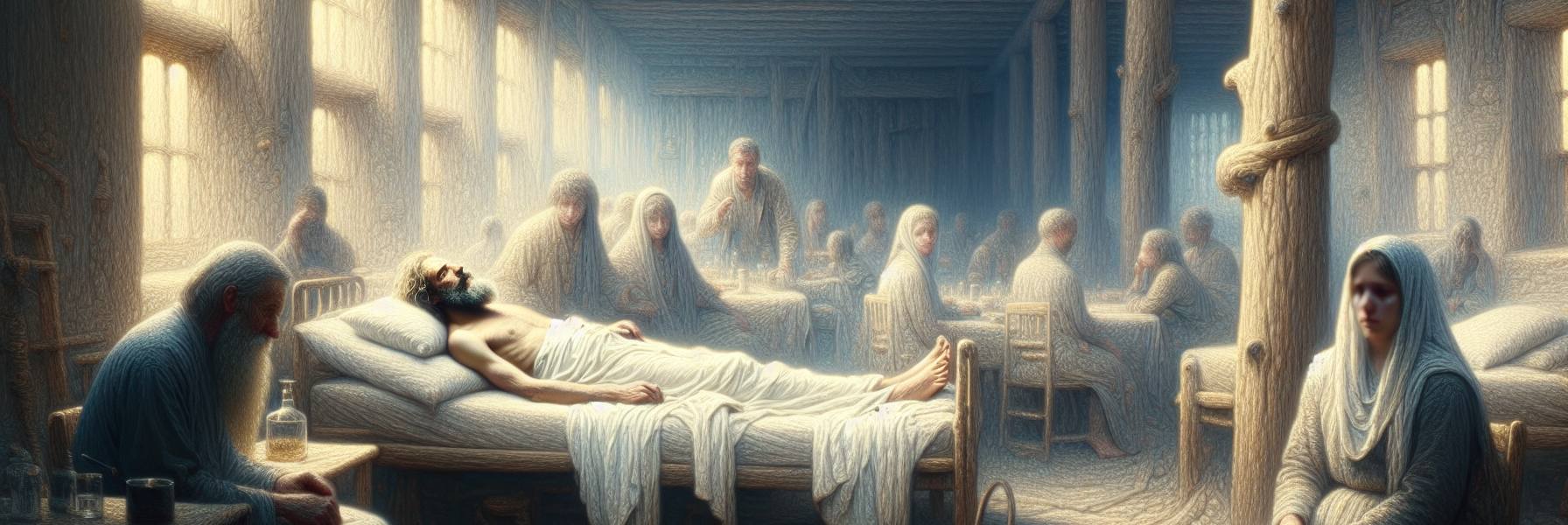
The illness had been a creeping tenant for weeks. It began as a fog in the joints, a weariness that made the weight of a water jar feel like millstones. Then the fever, a dry fire that stole the moisture from the world, leaving my lips cracked and my vision shimmering like a heat haze over the Salt Sea. My family’s faces above me became smudges of concern, their voices muffled as if heard through layers of wool. The healer came, muttered about imbalances of humours, applied poultices that smelled of earth and decay. They did nothing. The world shrank to the four walls of my room, to the patch of sunlight that traveled the floor and grew weaker each day.
That final afternoon, the pain subsided. A terrible relief. It was replaced by a profound detachment. I watched a fly buzz against the window, and its struggle seemed infinitely distant, a drama from another creation. The love I held for my wife, the laughter of my children, the memory of climbing the hills of Galilee in my youth—all of it seemed like pages from a book I had read long ago and poorly remembered. This was the sorrow the poets whisper of: the cords of Sheol entangling me, the snares of death laid bare. I was not fighting. I was unspooling.
And then, from a place deeper than marrow, a soundless word formed. It was not my voice, for I had none. It was the raw substance of my being, distilled to a single point.
*Yahweh.*
It was not a petition. It was a recognition. The last anchor in a dissolving sea. *O LORD, I beseech you, deliver my soul.*
There was no vision. No angelic choir. Only, after a span of time that held no meaning, a sensation of pressure releasing, as if a great stone had been rolled from my chest. Air, sharp and stinging, flooded into my lungs. I gasped, a ragged, ugly sound. The fly was still at the window. The patch of sunlight had moved an inch.
The recovery was not a sudden leap but a slow, stubborn tide returning. Strength returned first in whispers—the ability to hold a cup without trembling, to sit propped up and taste broth. My wife’s hand on my forehead felt real, its warmth a miracle. My youngest daughter, who had been afraid to approach the sickbed, laid her head on the blanket and wept. I wept too. The tears were different. They were not the hot, desperate tears of the fever, but something quieter, born of a awe so profound it verged on terror.
I had called. He had heard. The simplicity of it staggered me. I, a man of dust, had uttered a name into the void, and the Holy One, the God of armies, had inclined His ear to me. Why? I was not a prince or a prophet. My righteousness was a patched garment. Yet, in my extremity, He attended. The thought humbled me to the dust even as it lifted me from my bed.
As my legs relearned their duty and I could walk to the door to feel the sun, a resolve hardened within me, sweet and firm as a ripening fig. I would walk before the LORD. Not in the haphazard way of before, distracted by the marketplace and the worries of the harvest, but with intention. My delivered life would be a walked prayer.
I knew what was required. When the new moon came, I gathered my household. “We are going to Zion,” I said. We joined the stream of pilgrims on the road, their songs rising with the dust. My body was still weak; the journey was an act of will. Each step was a thank you. Each burning muscle a remembrance.
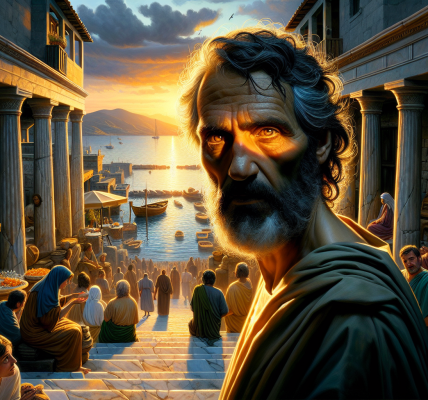
The Temple courts, when we entered, were a cacophony of devotion—the lowing of beasts, the chant of Levites, the murmur of a thousand prayers. I bought a lamb, its neck soft and warm under my hand. I could afford it. What is cost against a life? As I placed my hands upon its head, I felt the weight of my own mortality transfer, not as a superstition, but as a solemn transaction of grace. This creature would take my place, a testament that death had been paid a ransom.
Then, in the stone court, I raised the cup of salvation. It was not silver, just common clay, but the wine within caught the sun like liquid ruby. I called upon the name of the LORD. “I will pay my vows,” I said aloud, my voice steady amidst the crowd. “In the presence of all His people.” It was not a boast. It was a testimony. Let them see a man who was dead and is alive. Let my gratitude be public, accountable.
For His faithfulness is not a private commodity. In the courtyards of the LORD, in the midst of Jerusalem, His praise must be proclaimed. The death of His faithful ones is precious in His sight—a truth I now wore on my body like a scar. He does not discard His people lightly. He loosens the bonds.
And so, here I am. A servant, the son of Your handmaid. You have loosed my bonds. The vow is not a chain, but the opposite—the deliberate, joyous tying of my free will back to the source of its freedom. I will offer the sacrifice of thanksgiving.
I will take the cup, this ordinary, extraordinary cup of my delivered life, and I will drink its days. I will call on His name, not only from the pit, but from the table, from the field, from the quiet of evening. I will walk, a living, breathing, stumbling thank you, all the days that He has given back to me, in the land of the living, which is, today, so unbearably, beautifully bright.