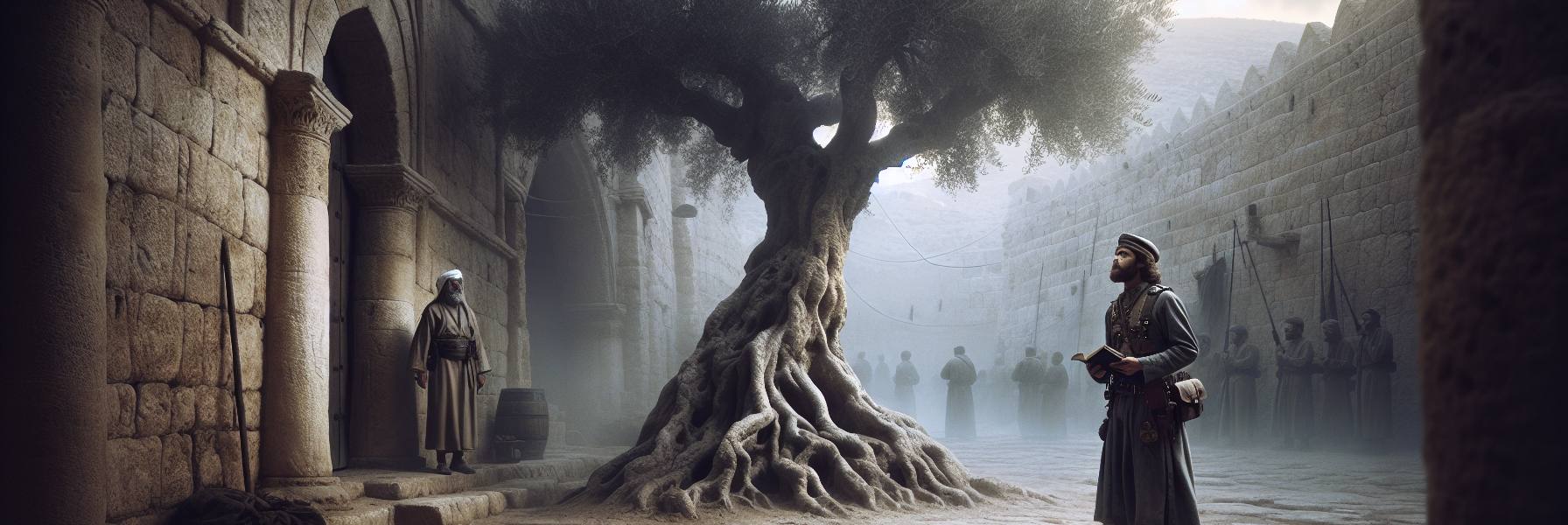

The air in the courtyard was still and thick with the smell of dust and hot stone. It was the hour before dawn, that quiet, grey time when the world seems to hold its breath. Eliab, captain of the gate watch, shifted his weight, the leather of his sandal creaking against the pavement. He kept his eyes on the king.
David stood alone by the old olive tree, its gnarled roots gripping the earth like the hands of a buried giant. He was not dressed for the throne room. He wore the simple, worn tunic of a soldier, a faded blue that had seen too many washings in the Jordan. In his hands was a small scroll, but his eyes were not on it. They were fixed on the eastern hills, beyond which the army of the Ammonites and their hired Syrians lay encamped, a dark stain on the land.
Eliab knew the signs. The set of the shoulders, the quietness that was not peace but a deep, still pool of concentration. They would march today. The mustering had been going on for weeks; the valleys around Hebron were thick with the camps of Judah and Israel. The smiths’ hammers had sung day and night, forging spearheads and mending chariot wheels. It was a sound of purpose, but also of dread.
A door scraped open in the lower palace, and the High Priest, Zadok, emerged, followed by two younger Levites. They carried no trumpets, no thuribles of smoking incense. This was not a public spectacle. Zadok’s robes, though clean, were the simple linen of service, not the jeweled ephod. He walked to where David stood, and the king turned, a faint, weary recognition in his eyes.
No words were exchanged at first. The priest simply stood beside his king, looking out at the same hills. One of the Levites handed Zadok a horn of oil, simple and unadorned. The priest took it, and his voice, when he finally spoke, was low, woven into the fabric of the pre-dawn silence.
“May the Lord answer you in the day of trouble.”
The words fell not like a proclamation, but like a seed planted in hard ground. David bowed his head slightly, his knuckles white where they gripped the scroll.
“May the name of the God of Jacob protect you.”
Eliab felt a prickling on his neck. This was the heart of it. Not the strategy, not the count of spears or the quality of the horses bought from Egypt. It was the name. The same name called upon by a shepherd boy facing a giant, by a fugitive hiding in caves. *The God of Jacob*. The trickster, the wrestler, the one who limped away from an encounter with the divine, blessed but broken. That was their God. Not a god of perfect, untouchable kings, but of flawed, striving men.
Zadok’s fingers dipped into the oil. “May he send you help from the sanctuary,” he continued, his touch firm as he anointed David’s forehead, “and give you support from Zion.”
*Zion*. The stronghold David had taken, the city he was still building. The prayer was rooted in place, in this dust, these stones. The help was not an abstract wish from heaven; it was to come from the very place where they had chosen to dwell with their God.
The second Levite stepped forward, holding a small, clay vessel. From it, Zadok took a handful of ground meal, a memorial offering. He let it sift through his fingers onto the stones at their feet, a pale, fragrant dust.
“May he remember all your offerings,” the priest murmured, the ritual intimacy at odds with the vast army awaiting them, “and regard with favor your burnt sacrifices.”
David’s eyes closed. Eliab knew what the king was seeing: the lines of bulls and rams that had stained the new altar at Gibeon, the smoke of submission and petition that had risen for days. Were they enough? Could the smell of roasting meat truly cover the scent of fear, the metallic tang of coming blood?
Then Zadok’s voice changed. It lost its ritual cadence and became something more urgent, more personal, as if he were no longer just a priest, but a father, a friend. He placed his hands on David’s shoulders.
“May he grant you your heart’s desire,” he said, and the words were like a breach in a dam. What was the king’s desire? Victory? Surely. But Eliab, watching the deep lines around David’s eyes, wondered if it was something else. Peace, perhaps. An end to the endless cycle of war. A son who would not have to stand where he stood.
“And fulfill all your plans,” Zadok finished.
A gust of wind, sudden and cool, swept through the courtyard, stirring the olive leaves and carrying away the scent of the meal offering. It felt like a breath.
The priests stepped back. Now it was David’s turn. He unrolled the scroll a little, though he did not need to read it. The words were in him. He spoke them not to the priests, not to Eliab or the few other guards, but to the hills, to the enemy, to the waking sky.
“May we shout for joy over your salvation,” the king said, his voice stronger now, a low rumble of gathering thunder, “and in the name of our God set up our banners.”
Eliab’s spine straightened. He saw it then—not the weary man, but the commander. The banners. The standards of Judah the lion, of Benjamin the wolf, would soon be unfurled in the face of the enemy. The prayer was moving from petition to proclamation.
David turned now, his eyes finding Eliab and the others. A fierce, tired smile touched his lips. “May the Lord fulfill all your petitions,” he said to them, a blessing flung to his men.
Then, the pivot. The core of the king’s strange, resilient faith. His gaze went back to the east, but it was no longer fearful. It was assessing, calm. “Now I know that the Lord saves his anointed,” David declared, the words a settled fact, a rock in a rushing stream. “He will answer him from his holy heaven with the saving might of his right hand.”
A silence followed, broken only by the first tentative chirp of a wakening sparrow. The grey light was warming to gold at the edges of the hills.
David’s final words were quiet, almost conversational, but they carried a weight that made the boasts of the Ammonite lords seem like the chirping of insects.
“Some trust in chariots, and some in horses,” he said, almost with pity, as if observing a fundamental, foolish error. “But we will remember the name of the Lord our God.”
He paused, letting the contrast hang in the new light. The immense, clattering, expensive power of the enemy—the chariots of Syria, famed throughout the world; the horses bred for war and shock. And on their side? A name. A memory.
“They will collapse and fall,” David said, with no particular triumph, merely stating a natural outcome, like the sun rising. “But we shall rise and stand upright.”
He rolled the scroll closed. The audience was over. Zadok bowed deeply, and he and the Levites withdrew, their task complete. The spell of the moment broke into the practicalities of the coming day. Servants began to emerge, carrying David’s armor. The sounds of the stirring camp—the clang of metal, the lowing of oxen, the shouts of sergeants—floated up over the walls.
Eliab took a deep breath. The fear was still there, coiled in his gut. He would be in the front lines soon enough. But it was a different fear now. Cleaner. It had been named, anointed, and placed beside a greater truth. He looked at his king, now being clad in his scaled breastplate, and he understood.
The prayer was not magic. It was not a guarantee against death or pain. It was orientation. It was the turning of the soul, like a flower to the sun, to face the only source of true strength. The chariots would charge. The horses would thunder. And they, remembering a name, would either rise, or fall having called upon it.
David caught his eye and gave a short, sharp nod. The time for prayer was over. The day of trouble had begun. But the answer, Eliab realized as he returned the nod and turned to his duties, had already been given. It was given in the remembering. The rest was in the fighting.