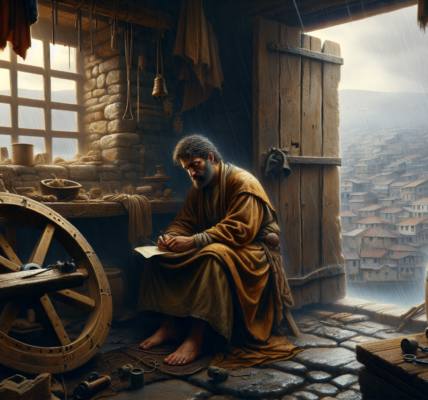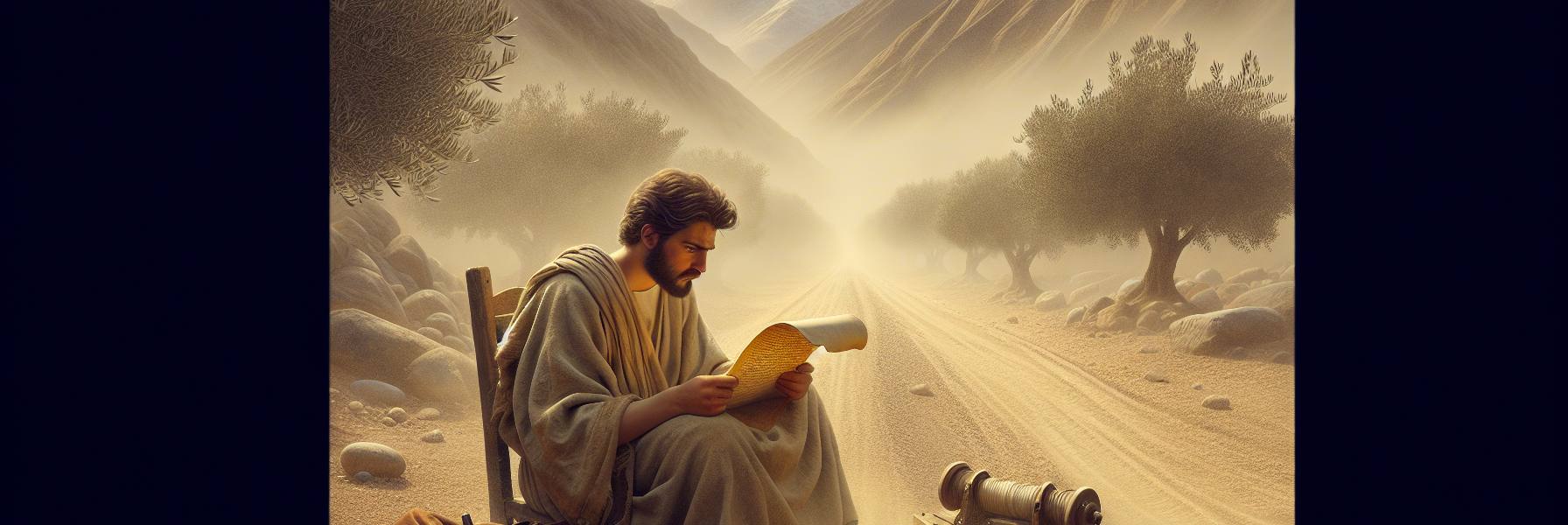

The dust of the Anatolian road was a fine, pale gold, and it clung to everything. It coated the olive leaves by the path, it hazed the distant peaks of the Taurus mountains, and it lay in a thin film on the scroll in my lap. I was reading it again, the letter from Paul. My name is Lysias. I am a freedman, a leatherworker in Iconium, and his words had found me like a cool draft in a stifling room.
It wasn’t the law that burdened me anymore. I’d never known the Law of Moses, not really. My burden was the new weight some were trying to strap to my shoulders. Men had come from Jerusalem, voices smooth as polished marble, speaking of completeness. “Yes, believe in the Messiah,” they said, “but to be a true son of Abraham, you must be marked. You must take on the customs, the feasts, the fullness.” Their arguments were logical, woven with scripture. A part of me, the part that always felt like an outsider in my own city, wanted that belonging. To have a lineage, a certificate of adoption written in flesh.
I put the scroll down and looked at my hands, scarred from needle and awl. I remembered the day of my manumission. My former master, a decent enough man by the world’s standards, had taken me to the magistrate. The declaration was made, the documents stamped. I was no longer *property*; I was a freedman with limited rights, but a freedman nonetheless. I had a bronze rod, a *vindicta*, as a token. Yet for years after, I woke in the grey dawn feeling the old anxiety. I would walk into the forum and catch myself looking down, avoiding the eyes of freeborn citizens. The habit of the slave is a ghost that lingers in the muscles and the mind.
Paul’s letter was speaking to that ghost.
*“When we were children,”* he wrote, *“we were enslaved to the elementary principles of the world.”* I thought of my childhood, not in slavery, but in fear. The household gods, the libations I poured to placate spirits I couldn’t see, the lucky charms, the dread of a misspoken omen. That was a slavery too. A bondage to a system of ‘if-then.’ *If* you perform the rite correctly, *then* the harvest might be good. *If* you avoid the unlucky day, *then* your journey might be safe. It was an endless, anxious servitude to elemental forces.
But then he wrote of the fullness of time. God sending forth His Son. Not a new lawgiver, not a stricter taskmaster, but a Son. Born of a woman, born under that very law, to accomplish what? To redeem those under the law. To buy them out of that custodial contract. So that *we might receive adoption as sons.*
The word echoed. *Adoption.* My legal adoption by my master would have been a different thing entirely. A more profound change of status. This was what Paul was shouting from the parchment. Not that we were given a better rulebook, but a new birth certificate. Because we are sons, he argued, God has sent the Spirit of His Son into our hearts, crying “Abba! Father!”
I stood up, the scroll falling to the woven mat. The workshop was quiet, smelling of tanning oils and cedar. “Abba.” It was an Aramaic word, I’d been told. A child’s word. Intimate, trusting, unceremonious. Not “O Almighty Judge” or “O Distant Patron.” *Abba.* The Spirit within me, he claimed, was not a spirit of fear leading me back to slavery, but a spirit of a child claiming a father’s embrace.
This was where the letter cut deepest, with a blade of brilliant, painful clarity. He turned to a story every one of us in the Galatian gatherings knew, the story of Abraham. But he saw in it a pattern we had missed. Hagar, the slave woman, and Sarah, the free woman. Two sons. One born according to the flesh—through human effort, a plan devised to *help* God’s promise along. The other born through the promise—a sheer, impossible gift.
“This is an allegory,” Paul wrote, and I could almost hear his voice, strained and passionate. Hagar represented Mount Sinai, the law-giving, and corresponded to the present Jerusalem, living in slavery with her children. Sarah represented the Jerusalem above, which is free, and she is our mother.
I leaned against the doorframe, watching the sun lengthen the shadows in the courtyard. The men from Jerusalem spoke of the present Jerusalem, of its temple, its authority. They offered a tangible, historical lineage. It was a compelling story. But Paul spoke of a higher city, a freedom born of promise, not of pedigree. Ishmael was born because Abraham and Sarah grew impatient with God’s method. Isaac was born because God was faithful to His own word, even when it seemed ridiculous. Which lineage did I want? The one built on human securing, or the one received as a gift?
The pressure I felt to be circumcised, to take on the full yoke of the law, was suddenly illuminated in this harsh, new light. It wasn’t a step up; it was a step back. It was choosing the slavery of Hagar over the sonship of Sarah. It was preferring the tangible token of the flesh to the invisible, crying witness of the Spirit. It was, as Paul concluded with startling bluntness, falling away from grace. Christ would be of no advantage to me if I chose to be justified by law; I would be a debtor to keep the whole thing, and I knew in my bones I never could.
Evening came on. I lit a small lamp. The words settled into me not as a new system, but as a liberation from all systems of earning. My status was not pending. My inheritance was not conditional upon my next moral performance. I was a son. Not because I had the right marks, but because the Father had sent the Spirit of the Son into my heart. The ghost of the slave retreated. The cry, “Abba,” felt less like a foreign word and more like a native tongue my heart had always been searching for.
I rolled the scroll up carefully. The dust of the road was still on it, and now the dust of my workshop. It was a human document, passed from hand to hand, carrying a word that shattered every human category. I was Lysias, freedman, leatherworker, son. The story of Hagar and Sarah was no longer just ancient history; it was the map of my own dilemma, and Paul had shown me the path to the free city. I picked up my awl to begin work again, but my hands felt different. They were the hands of an heir, working in his Father’s world.