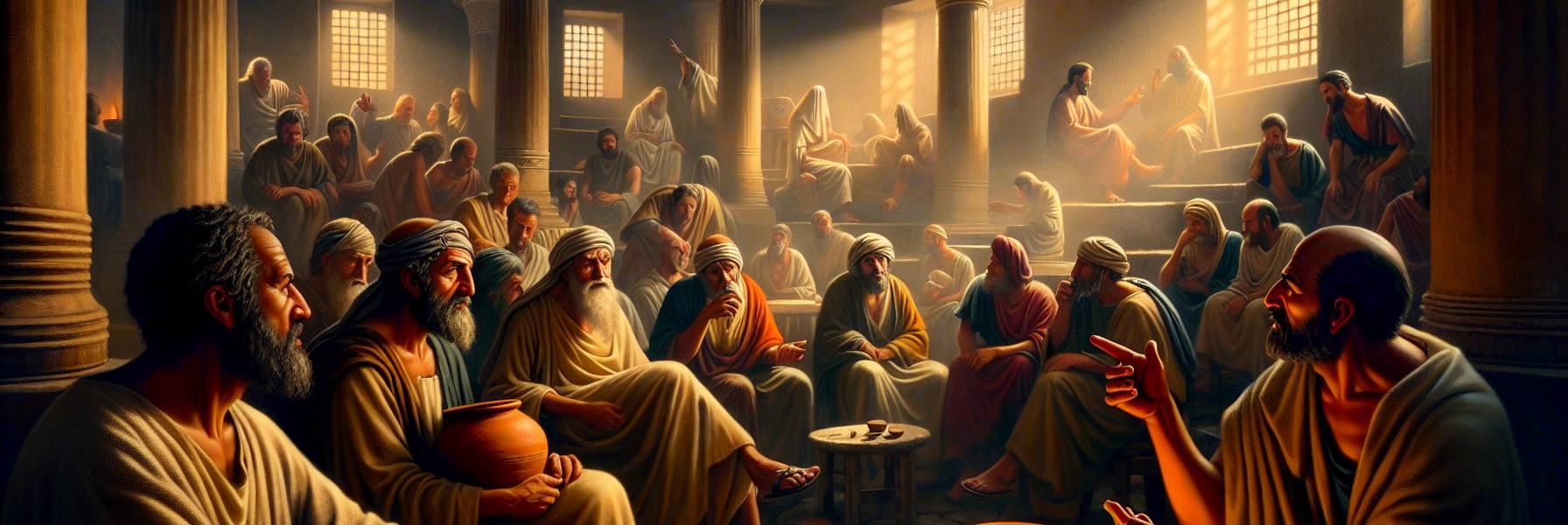

The air in Chloe’s house was thick, not just with the warmth of too many bodies in a confined space, but with a tension that had a taste—metallic, like the dust of the agora after a heated bargain. Stephanos shifted his weight on the low stool, his fingers tracing a chip in the terracotta cup he held. He didn’t drink. He was too busy listening, and the listening was making his stomach coil.
Across the room, Apollos, his beard neatly trimmed in the Alexandrian fashion, was speaking. His voice was a smooth instrument, weaving threads of Philo’s philosophy with the Prophet Isaiah. “Consider the Logos,” he was saying, hands painting shapes in the lamplight. “The divine reason, the ordering principle. In the Messiah, we see its ultimate expression—a cosmic harmony.”
A murmur of appreciation from a cluster of listeners. They were the educated ones, the freedmen who prided themselves on understanding the deeper mysteries. Stephanos saw Aristarchus, a Greek convert who had once studied rhetoric, nodding vigorously.
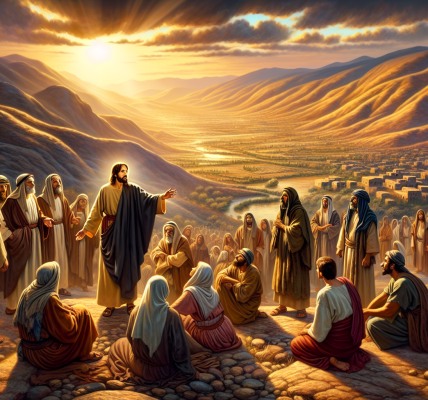
Then, from near the doorway, a gruffer voice cut in. It was Cephas—or as he insisted, Peter. “Harmony? Tell that to my back, still sore from the rods of the magistrates in Philippi. Tell it to the empty belly after a day’s fishing with no catch. The Messiah came to the poor, to the sinners. He ate with us. He touched the unclean. This isn’t about cosmic principles. It’s about calloused hands and a broken world waiting to be mended.”
A different kind of murmur, this one from the laborers and slaves who crowded the floor. They leaned forward, their faces hard and hopeful. Stephanos felt the divide like a crack in the earth beneath his feet. He had family in both camps.
And then there was the other refrain, the one that made him wince. It was whispered more than spoken, but it was there, a thread of smugness in certain greetings. “I am of Paul,” someone would say at the well, as if claiming allegiance to a winning charioteer. “Paul baptized me himself, you know. He laid hands on me.” As if the message were a product and the messenger its brand.
Stephanos loved Paul. He remembered the man’s intensity, his eyes burning with a fire that seemed to consume his own frail body. He remembered the words that had shattered his old life: “You are not your own; you were bought with a price.” But this… this factionalism felt like a betrayal of that very price.
The meeting dissolved into a polite enough farewell, but the cracks remained. Stephanos walked home through the crooked streets of Corinth, the night air cool on his skin. The city was a cacophony of ambition—sailors’ shouts from the port, the clang from a late-working coppersmith, laughter spilling from a tavern. A city built on trade, on wisdom, on prowess. A city that measured a man by his speech, his wealth, his patron.
And here they were, this little gathering of the *ekklesia*, the “called-out ones,” trying to import those very measures into the body of the Messiah. It made him sick.
Weeks passed. The factions didn’t ease; they calcified. Letters came from Paul, carried by traders. They were read aloud, full of practical instruction and aching love. But the undercurrent of division persisted. Then, a new letter arrived, carried by a dust-streaked brother from Ephesus. It was longer, heavier.
They assembled again, this time in the larger home of Gaius. The scroll was unsealed. The reader, a young man named Fortunatus, began, his voice clear in the hushed room.
“Paul, called to be an apostle of Christ Jesus by the will of God, and our brother Sosthenes, to the church of God in Corinth…”
The opening was familiar. Then the tone shifted. It was like a physician pressing a thumb directly on a festering wound.
“I appeal to you, brothers and sisters, in the name of our Lord Jesus Christ, that all of you agree with one another in what you say and that there be no divisions among you, but that you be perfectly united in mind and thought.”
Stephanos felt the words land. He saw Apollos look down at his hands. He saw Cephas stiffen.
“For it has been reported to me by Chloe’s people that there are quarrels among you. What I mean is this: One of you says, ‘I follow Paul’; another, ‘I follow Apollos’; another, ‘I follow Cephas’; still another, ‘I follow Christ.’”
The air left the room. To hear their petty slogans recited back to them in the solemn, apostolic script was a humiliation. It sounded so small, so foolish.
“Is Christ divided? Was Paul crucified for you? Were you baptized in the name of Paul?”
Each question was a hammer blow. The wisdom of the eloquent Alexandrian, the rugged authority of the Galilean fisherman, the fervent logic of the apostle to the Gentiles—all of it crumbled before these stark, unanswerable queries. The cross was not a banner for a faction. It was a single, terrible, wonderful tree upon which one man died for all.
The letter unfolded, and its heart was a paradox that turned the city of Corinth on its head. “God chose the foolish things of the world to shame the wise; God chose the weak things of the world to shame the strong. He chose the lowly things of this world and the despised things—and the things that are not—to nullify the things that are, so that no one may boast before him.”
Stephanos looked around the room. He saw Tertius, a slave whose back bore the scars of a cruel master. He saw Lydia, a seller of purple cloth, successful by Corinthian standards, but now with tears streaking her face. He saw the proud brow of Aristarchus furrowed in confusion. Here they all were: the weak, the foolish, the strong, the wise—all equally baffled, all equally addressed.
The message of the cross wasn’t a philosophy to be mastered by the learned. It wasn’t a political program for the oppressed. It was a scandal. It was God’s power, looking for all the world like God’s weakness. It demanded not intellectual ascent or social alignment, but surrender. A boast only in the Lord.
When the reading finished, there was a long silence. No one rushed to explain it. No one formed a party around a particular interpretation. The clever arguments they had rehearsed seemed like ash in their mouths.
Apollos was the first to move. He didn’t speak. He simply walked over to where Cephas stood, gripped the older man’s shoulder, and then, awkwardly, embraced him. It was not a neat reconciliation. It was clumsy, stiff with pride and pain. But it was a start.
Stephanos walked home again. The sounds of the city were the same—the ambition, the clamor, the striving. But he heard them differently now. They were the noise of a world still trying to boast in itself. And he, a foolish man by Corinth’s lights, carried within him a quiet, subversive truth: that God’s stubborn, saving foolishness was wiser than all of it. He didn’t have a party. He had a cross. And for now, in the quiet of his own heart, that felt like more than enough.