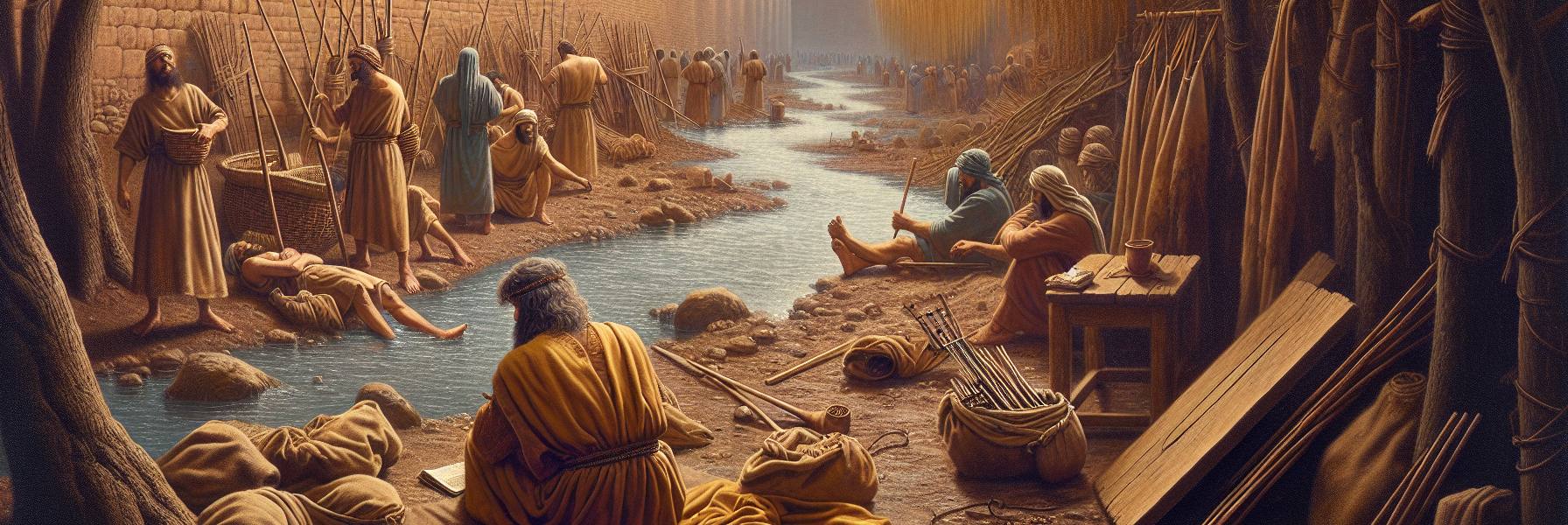

The river was brown. Not the clear, rushing gold of the Siloam, nor the deep, stone-lined channels of the Gihon. This was a slow, thick, muddy brown, sliding past Babylon’s walls with a smell of wet earth and rot. We sat by it, our backs to the willows, because the guards told us to. They liked the poetry of it, I think. The willows were for their songs, their gentle, rustling music. Ours was a different kind.
Ephraim sat next to me, his hands lying palms-up in his lap like dead things. They were musician’s hands once, long-fingered and sure. Now the fingers were calloused from hauling stone for the king’s new garden. He hadn’t touched a lyre in months. None of us had, not since the journey. The instruments were wrapped in sackcloth, stored in a corner of the mud-brick house we ten shared, a silent accusation.
“Sing,” the guard said. He wasn’t cruel about it, not today. He was bored. His Babylonian accent mangled our words. “Sing one of the songs of your high place.”
A few of the younger ones, born on the road or just after the siege, looked up blankly. What songs? Their memories were of dust and thirst and the long line of captives. But I remembered. Ephraim remembered. His jaw tightened, a muscle flickering under the grey-streaked beard.
Someone, I think it was little Miriam’s boy, began a halting melody—a harvest tune from the hills around Bethlehem. It was sweet and simple, about figs and barley. It died in the heavy air. It was wrong. Everything here was wrong. To sing that here, by this sluggish water, under this foreign sun, felt like a betrayal. It was taking something holy and making it a toy for bored soldiers.
Ephraim spoke then, his voice a dry rustle. “How can we sing the Lord’s song in a strange land?”
It wasn’t a question for the guard. It was the question that hung in the air between us all, every day, with the Babylonian dust. It was in the taste of the flat, unleavened bread that never tasted like home. It was in the way the stars at night were in the wrong places.
The guard shrugged and moved off, his interest waning. The moment passed, but the silence that followed was worse. It was full of the songs we weren’t singing.
My own memory, sharp as a shard of pottery, dug in. Not of the temple music—I was never a Levite—but of the sound of the city. The chatter at the Water Gate at dawn. The hawker selling lentils on the Street of the Bakers. The collective gasp of a thousand pilgrims seeing the walls for the first time, followed by the hum of psalms ascending. And the silence that came after the siege engines stopped. A silence so complete it rang in your ears. That was the song of Zion now: a ringing, awful silence.
Ephraim was crying. Not with sobs, but with a slow, quiet seepage from eyes fixed on the muddy water. “If I forget you, O Jerusalem,” he whispered, the words of the old vow, “let my right hand forget its skill.”
I looked at his hands, lying useless. Perhaps it already had.
He went on, the whisper hardening. “Let my tongue cleave to the roof of my mouth, if I do not remember you, if I do not set Jerusalem above my chief joy.”
That was the heart of it. The exile wasn’t just a place. It was a re-ordering of the soul. Joy itself was a suspect thing here. Any moment of ease, of laughter at a jest, of pleasure in a cool breeze off this hateful river, felt like a theft from the memory of Zion. To be happy here was to forget there. And to forget was to die a death deeper than the grave.
The conversation turned then, as it always did when the homesickness curdled into something darker. To the Edomites, who had stood at the crossroads and cheered as we were dragged away. To the ones who had called out, “Raze it, raze it, even to its foundation!” Their voice was a ghost in our ears, a taunt that replayed itself in our dreams.
Ephraim’s tears were gone. His face was like flint. He looked toward the grand, tiered bulk of the city, the Ishtar Gate glowing in the late sun. He wasn’t seeing its beauty. He was seeing the men who lived there, the children who would grow up in its shadow, never knowing what they had broken.
His final words were low, guttural, a curse not sung but planted like a bitter seed in the riverside mud. “Blessed shall he be who takes your little ones and dashes them against the rock.”
It shocked the younger ones. I saw them flinch. It shocked me, too, every time I heard it. It was not a prayer for the future, not a call to arms. It was the raw, bleeding edge of a grief so vast it had twisted into a howl for a justice that mirrored the scale of the loss. It was the sound of a heart so broken it believed only an equal breaking could ever balance the scales. It was theology scorched in the fire of memory.
We didn’t sing. We sat until the mosquitoes rose from the river and the guards changed shift. We walked back to the mud-brick house in the purple dusk. Later, in the dark, I heard Ephraim moving in the corner. I didn’t need to see. I knew he was unwrapping the sackcloth, taking out his lyre. Not to play it. To feel its shape, to trace the carvings on its soundbox, worn smooth by his father’s hands before him. He would hang it back on the wall then, on a nail. A silent thing, waiting for a different water, under different trees.