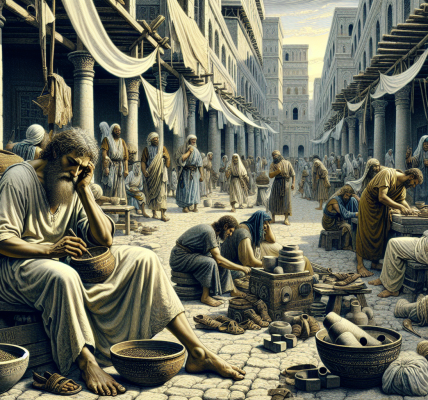

The heat of the day had not yet settled upon the city. It was that fragile hour just after dawn, when the light was clean and the dust still slept in the streets. I sat in the shaded corner of my grandfather’s workshop, the smell of cedar and olive wood shavings thick in the air. He was teaching me to recognize the grain, to follow it with the plane, not against it. “A thing must be built according to its nature,” he would say, his voice a low rumble like distant cart wheels. “And to know its nature, you must listen.”
It was then I heard it. Not with my ears, but in the stones of the street, in the slow unfurling of a vine leaf outside the window, in the very rhythm of my own breath. It was a calling. A voice that seemed both outside of me and deep within my bones. My grandfather saw my hands go still on the wood. He gave a slow, knowing nod.
“She is speaking again,” he said, simply.
The voice was not one of words at first, but of presence. It was the clear, cold logic of the spring at the city gate, the unwavering line of a well-laid foundation stone, the patient order of the seasons. It was the principle by which my grandfather’s plane sang as it found the true line of the cedar. It was, I somehow knew, older than the hills.
I left the workshop and wandered toward the main gate, where the city was just beginning to stir. The bakers were pulling hot loaves from ovens, their movements efficient and sure. A potter inspected a vessel, his thumb testing the curve of its belly for symmetry. In all of it, I heard her. Her voice began to resolve into something like language, not spoken, but understood.
*I am here,* it said, *where the path meets the gate. I am where the roads fork, where choices are made. To you, O people, I call out. My cry is to all who live.*
A merchant argued with a farmer over the price of wheat. Their voices were sharp, grasping. Beneath the clash, a steady, silent tone hummed: the true value of the grain, the fair exchange, the balance that would leave both men whole. That was her voice, ignored.
Children ran past, chasing a stray dog, their laughter a bright, chaotic peal. Woven into that joy was a pattern—the innocence of play, the freedom of limbs not yet bent by toil. She was there, too.
She spoke of her origin, and my mind strained to comprehend the scale. *The Lord formed me as the first of his works,* she declared, her tone not of pride, but of solemn witness. *Before the oceans were poured into their basins, before the mountains were thrust up like wrinkles on the skin of the earth, I was there. I was a master craftsman at his side.* I saw it then, not as a picture, but as a truth: the cosmos was not a chaotic explosion, but a careful, joyous construction. Wisdom was the set of plans, the understanding of stress and beauty, the delight in a thing working as it was meant to. She was the *why* behind the sun’s reliable path and the moon’s gentle pull on the tide.
*Then I was beside him, filled with delight day after day,* her voice continued, a soft warmth entering it, *rejoicing in his whole world and delighting in mankind.*
The human part struck me. Of all the wonders—the whirlwind of stars, the leviathans in the deep—her delight found a focus in us. In our capacity to understand, to choose, to build, to love. Wisdom was not a cold, abstract law; it was the joyful pattern for human flourishing.
By the gate, a city elder sat to judge a dispute. I watched him. He listened not just to the words, but to the spaces between them. He sought the thread of truth that would untangle the knot. His verdict, when it came, was clear and left no room for malice. *By me kings reign,* she whispered, *and rulers issue just decrees. By me princes govern, and all nobles who rule with equity.* It was not about power, but about governance that mirrored the orderly grace of creation itself.
The sun climbed higher, and the crowd thickened. Hawkers cried their wares, friends greeted each other, donkeys brayed under their loads. The noise was a tapestry of human life. And over it all, clear and persistent as a silver bell, was her invitation.
*Now then, my children, listen to me; blessed are those who keep my ways. For whoever finds me finds life and receives favor from the Lord. But whoever fails to find me harms himself; all who hate me love death.*
It was not a threat, but a statement of fact, as natural as my grandfather’s lesson. To cut against the grain is to splinter the wood. To build on sand is to watch the house fall. To ignore wisdom is to choose a slower, more insidious crumbling. It is to love the shadow that has no substance.
I returned to the workshop as the noon light blazed white. My grandfather was drinking water from a clay cup. He looked at me, his eyes crinkled at the corners.
“You heard her?”
“I think so,” I said. “It was… everywhere.”
He set the cup down. “It is. She calls from the highest point, from the crossroads, from the very gates of the city. The trick is not in hearing, boy. The trick is in listening when the market is loud, when your own heart is loud. To choose the path that follows the grain.” He placed a fresh piece of wood before me. “Begin again.”
As I took up the plane, I felt the solidity of the timber, the promise in its straight lines. And in the quiet of the shaded room, with the voice of the city a murmur beyond the walls, I understood. Wisdom was not a secret to be hoarded. It was the public song of a well-made world, the constant, loving call to build our lives according to the original, joyful blueprint. It was the first and truest thing. And it was for anyone who would stop, and listen, and learn to follow the grain.