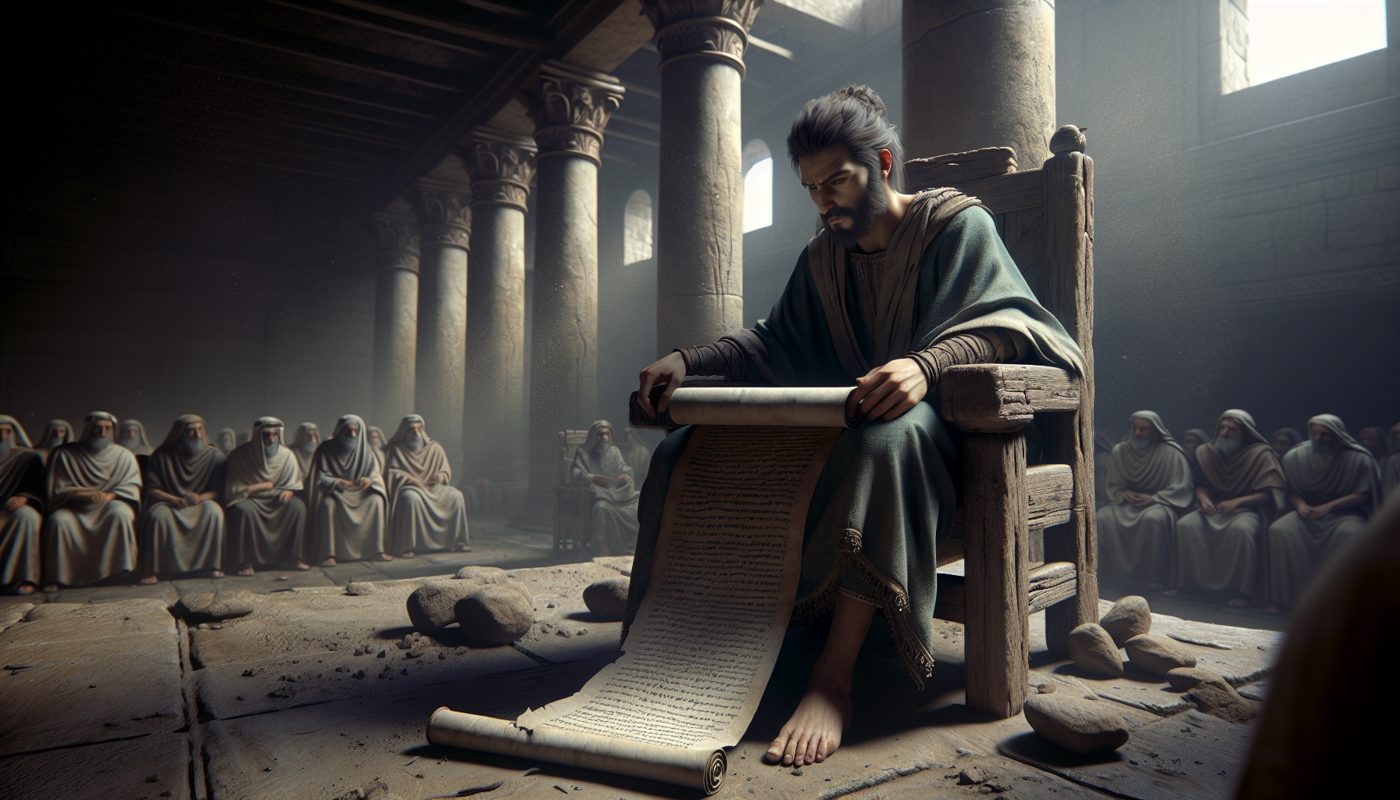
The proverb writer does not offer a gentle moral essay. He draws a line from the ruler's ear to the condition of the land. A king who listens to falsehood recruits an entire court of wicked servants. The air in the chamber goes bad, and the people do not need a report to know it. They sigh. That is the word the text uses for a population under a wicked ruler—not a rebellion, not a famine, but a long, audible exhale of exhaustion.
The chapter does not let the righteous off with a private piety. The righteous man is defined by what he does with the poor. He takes knowledge of their cause. The wicked, by contrast, lacks the understanding even to register that the poor have a cause worth knowing. This is not a matter of charity but of cognition. The wicked man's mind simply does not work on that frequency.
There is a political theology here, but it is not abstract. The king who judges the poor faithfully will have a throne established forever. The king who exacts gifts—bribes, favors, the normal currency of power—overthrows the land. The text does not say he weakens it or damages its reputation. It says he overthrows it. The mechanism of collapse is not an invading army but a routine transaction at the ruler's gate.
The chapter also refuses to separate public rule from private discipline. The rod and reproof give wisdom; a child left to himself brings shame to his mother. The connection is not sentimental. A ruler who cannot correct his own household will not correct his court. A man who raises a servant delicately, without the stiffness of authority, will end up with a son who does not know his place. The household is the first seat of judgment.
Pride gets its own sentence, and it is a short one. A man's pride will bring him low. The lowly spirit obtains honor. This is not a promise of social advancement. It is a structural observation about how power actually holds. The proud man cannot see the snares at his feet. The lowly man, accustomed to looking down, sees them clearly.
The fear of man is called a snare. Trust in the Lord is called safety. The verse does not explain how this safety operates in a world where the wicked increase and the righteous are hunted. It simply states the two options as if they were the only two doors in a corridor. Many seek the ruler's favor, but judgment comes from the Lord. The ruler's favor is a crowded room. The Lord's judgment is a solitary verdict.
The chapter ends with a clean division. The unjust man is an abomination to the righteous, and the upright man is an abomination to the wicked. There is no neutral ground. The two groups do not merely disagree. They find each other repulsive at the level of instinct. This is not a call to polarization. It is a description of what happens when the moral architecture of a society has settled into its final shape.
The proverb writer does not promise that the righteous will win every contest. He promises that the righteous will sing and rejoice even while the wicked are caught in their own snares. The song is not triumphalist. It is the sound of a man who has stopped looking at the ruler's face and started looking at the Lord's judgment. That shift in attention is the only real political change the chapter offers.
Comments
Comments 0
Read the discussion and add your voice.
Members only
Sign in to join the conversation
We keep comments tied to real accounts so the discussion stays clean and trustworthy.
No comments yet. Be the first to add one.