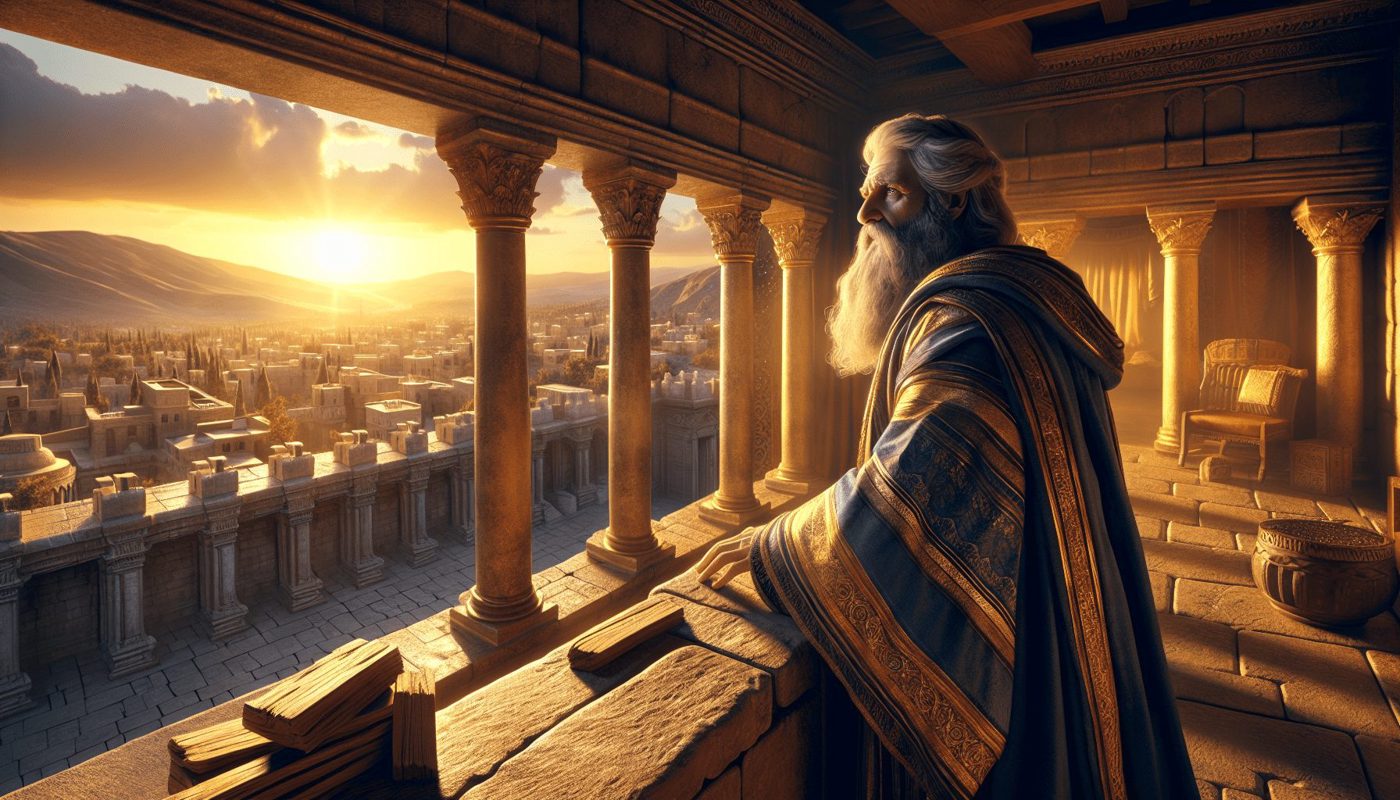
David speaks first in this chapter, and he speaks with the authority of a king who knows his time is short. He declares that the house of the Lord and the altar of burnt offering for Israel belong on this site, and he does not hesitate. The work begins immediately, not with a ceremonial groundbreaking, but with a command to gather the resident aliens living in Israel and set them to hewing stone. David is not building the temple himself, but he is making sure nothing stops the man who will.
He prepares iron in abundance for the nails and the couplings, and bronze so plentiful it is not weighed. Cedar logs arrive without number, brought by the Sidonians and the men of Tyre. The chapter does not describe negotiations or treaties; it simply records that these materials came in abundance to David. The king is stockpiling everything a builder could need, and he is doing it with the urgency of a man who will not see the walls rise.
David explains his reasoning to his son Solomon. Solomon is young and inexperienced, and the house that must be built for the Lord must be exceedingly magnificent, famous and glorious throughout every land. David will not leave that burden on a boy without preparation. So he prepares abundantly before his death. The phrase is blunt and final. David knows he will not lay a single stone of the sanctuary, but he will not die with empty hands.
He calls Solomon and charges him directly: build a house for the Lord, the God of Israel. Then David recounts the word that came to him. He had wanted to build this house himself. It was in his heart. But the Lord told him plainly that he had shed much blood and waged great wars, and for that reason he would not build a house for the Lord's name. The chapter does not moralize about this. It simply states the fact. David's wars disqualified him from this particular work.
The Lord promised David a son who would be a man of rest. That son's name would be Solomon, and in his days the Lord would give peace and quietness to Israel. That son would build the house for the Lord's name. The Lord would be a father to him, and he would be a son to the Lord, and his throne would be established over Israel forever. David does not argue with this. He accepts it and passes the charge to Solomon.
David prays for his son: may the Lord be with you, may you prosper, may you build the house of the Lord your God as he has spoken. But the prayer is also a command. David asks the Lord to give Solomon discretion and understanding, and to give him charge concerning Israel, so that he may keep the law of the Lord. Prosperity, David says, depends on observing the statutes and ordinances that the Lord commanded Moses concerning Israel. Be strong and of good courage. Do not fear. Do not be dismayed.
Then David tells Solomon what he has already prepared. In his affliction—the word is striking—he has set aside a hundred thousand talents of gold, a thousand thousand talents of silver, bronze and iron without weight, timber and stone. And Solomon may add to it. The numbers are staggering, but the chapter does not pause to marvel at them. It moves on to the workmen: hewers, stonecutters, carpenters, every kind of skilled craftsman. There is no counting the gold, silver, bronze, or iron. David's final word to his son is simply this: arise and be doing, and may the Lord be with you.
David does not stop with Solomon. He commands all the princes of Israel to help his son. He asks them: is not the Lord your God with you? Has he not given you rest on every side? He has delivered the inhabitants of the land into David's hand, and the land is subdued before the Lord and before his people. David frames the temple project not as a private ambition but as the next step in a story the Lord has already been writing. The rest is already given. Now the sanctuary must be built.
The chapter ends with David's charge to the leaders: set your heart and your soul to seek the Lord your God. Arise and build the sanctuary of the Lord God, so that the ark of the covenant of the Lord and the holy vessels of God may be brought into the house that is to be built for the name of the Lord. The temple is not an end in itself. It is the place where the ark will dwell, where the covenant will be housed, where the Lord's name will rest. David prepares the materials, the workmen, and the charge, but he will not enter that house. He leaves that to his son.
Comments
Comments 0
Read the discussion and add your voice.
Members only
Sign in to join the conversation
We keep comments tied to real accounts so the discussion stays clean and trustworthy.
No comments yet. Be the first to add one.