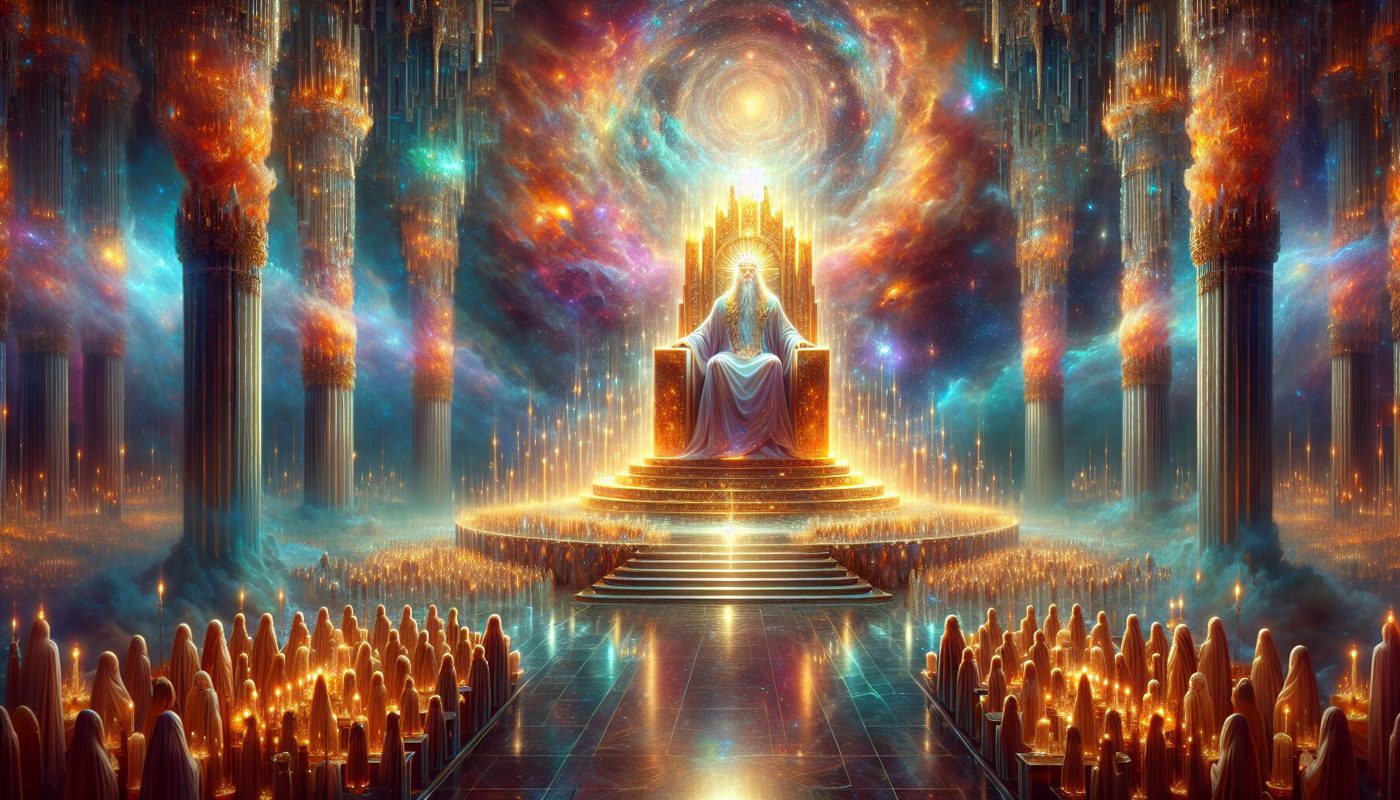
The chapter opens with a door standing open in heaven. John hears the same voice that spoke to him earlier, a voice like a trumpet, and it tells him to come up and see what must take place after these things. He does not climb or ascend by his own effort. The voice commands, and John is in the Spirit at once.
What he sees first is a throne set in heaven. Someone sits on it. John does not describe the face or form of the one seated. He compares the appearance to jasper and sardius, two precious stones, one clear and one red. Around the throne is a rainbow that looks like an emerald. The throne itself is the fixed center of the vision. Everything else is arranged around it.
Twenty-four thrones encircle the central throne. On them sit twenty-four elders. They wear white garments and gold crowns on their heads. John does not name them or explain their origin. They are simply there, seated, crowned, and dressed in white, positioned as a council around the main throne.
From the throne itself come lightnings, voices, and thunders. These are not decorative. They are the audible and visible signs of the one who sits there. Before the throne burn seven lamps of fire. John is told these are the seven Spirits of God. The number seven recurs in the book, but here it is tied directly to the lamps before the throne.
In front of the throne lies what looks like a sea of glass, clear as crystal. It is not water. It is still, transparent, and smooth. Nothing moves on it. It simply lies there as a floor or a boundary before the throne.
In the midst of the throne and around it are four living creatures. They are covered with eyes, front and back. Each creature has a distinct appearance. The first looks like a lion. The second looks like a calf. The third has a face like a man. The fourth looks like a flying eagle. They are not symbols that John explains. He reports what he sees.
Each living creature has six wings. They are full of eyes, both around and within. They never stop speaking, day or night. They say, Holy, holy, holy is the Lord God, the Almighty, who was and who is and who is to come. The repetition of holy three times is the only words they speak. They do not explain themselves. They simply declare this without rest.
Whenever the living creatures give glory, honor, and thanks to the one on the throne, the twenty-four elders respond. They fall down before the one on the throne. They worship the one who lives forever and ever. They take the crowns from their own heads and cast them before the throne. This is not a gesture of surrender. It is an act of recognition that the glory, honor, and power belong to the one on the throne, not to them.
The elders speak as they cast their crowns. They say the one on the throne is worthy to receive glory, honor, and power because he created all things. They say that by his will everything existed and was created. The vision ends there. John does not add his own reaction. He does not describe his own worship or fear. He simply records what the elders say and do.
The chapter gives no explanation of the twenty-four elders, the seven Spirits, or the four living creatures. It does not interpret the stones, the rainbow, or the sea of glass. The vision is presented as something John saw and heard. The weight of the chapter rests on the throne, the one who sits on it, and the unceasing declaration of his holiness and worth as creator.
Comments
Comments 0
Read the discussion and add your voice.
Members only
Sign in to join the conversation
We keep comments tied to real accounts so the discussion stays clean and trustworthy.
No comments yet. Be the first to add one.