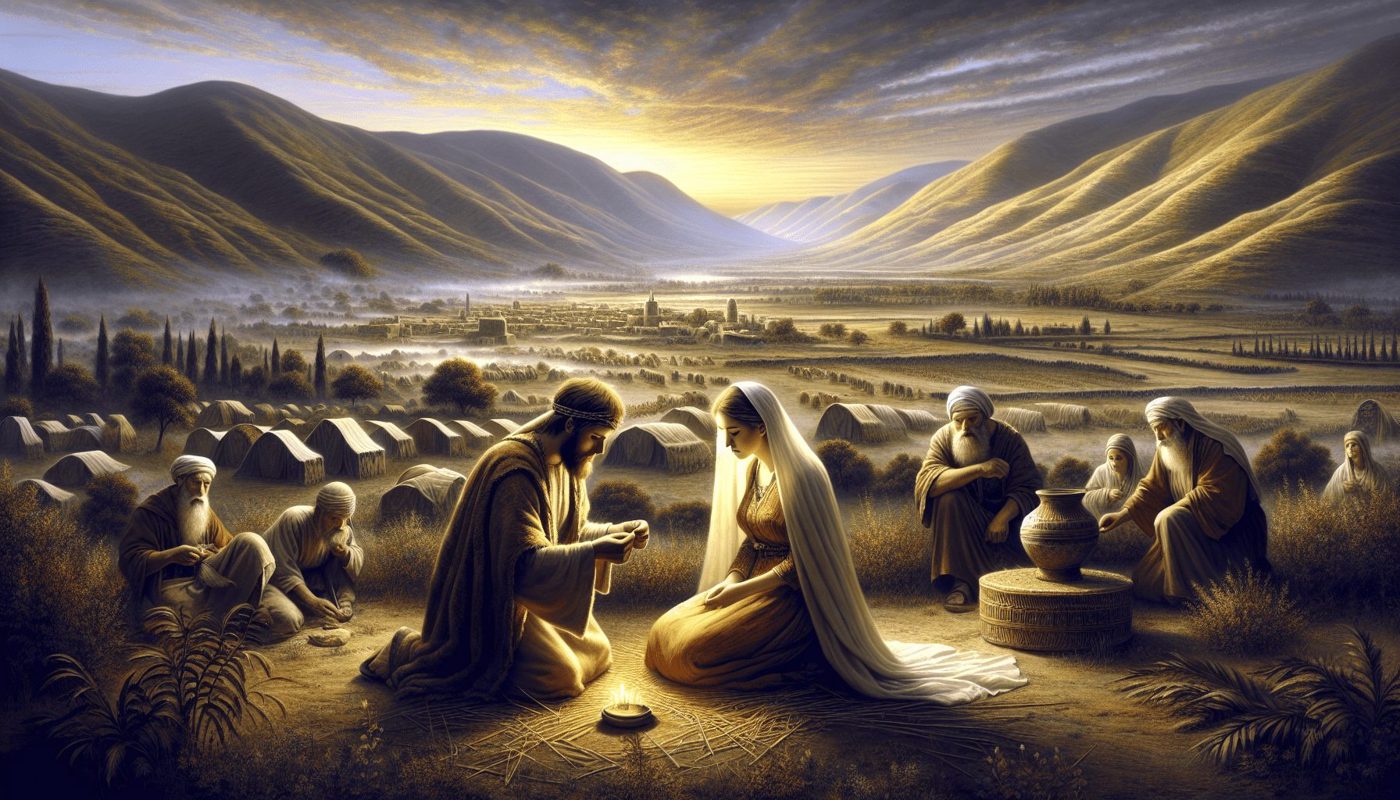
The final chapter of Proverbs opens not with a proverb but with a king's memory. Lemuel, a name that appears nowhere else in the book, recites the oracle his mother taught him. The chapter begins with a queen mother's voice, not a sage's. She speaks directly to her son about what destroys kings: women, wine, and the neglect of justice. She does not lecture in abstractions. She tells him to give strong drink to the dying and the bitter, not to princes who must judge the afflicted. The opening nine verses are a political warning, not a domestic ideal.
Then the poem shifts. The mother's instruction ends, and an acrostic begins. Each verse from verse 10 to 31 starts with a successive letter of the Hebrew alphabet. The subject is a worthy woman, but the poem does not name her. She is not Miriam, not Ruth, not any figure from Israel's stories. She is a type, a portrait painted in twenty-two strokes. The first stroke sets the value: her price is far above rubies. The poem does not define her by her husband or her children but by what she does.
The heart of her husband trusts her. That trust is not abstract. He has no lack of gain because of her. She does him good all the days of her life, not just when it is convenient. The poem does not describe her feelings or her piety. It describes her hands. She seeks wool and flax and works willingly. She rises while it is still night to give food to her household and tasks to her maidens. She is not passive. She considers a field and buys it. With the fruit of her hands she plants a vineyard. She is like merchant ships bringing bread from afar. Her arms are strong because she makes them strong.
The poem moves through her day and her year. She perceives that her merchandise is profitable. Her lamp does not go out at night. She lays her hands to the distaff and holds the spindle. She makes linen garments and sells them. She delivers girdles to the merchant. She is not a woman of leisure. She is a producer, a trader, a manager. The poem does not romanticize her labor. It records it with the same concreteness as the mother's warning to the king.
But her labor is not only for her household. She stretches out her hand to the poor. She reaches forth her hands to the needy. The poem does not say she gives from surplus or that she organizes charity. It says she stretches out her hand. The same hands that hold the spindle and buy the field are the hands that reach to the poor. Her strength and dignity are her clothing. She laughs at the time to come. That laughter is not nervous. It is the laughter of someone who has prepared and who trusts the Lord.
She opens her mouth with wisdom. The law of kindness is on her tongue. The poem does not say she teaches or preaches. It says she speaks with wisdom and that kindness is the law of her speech. She looks well to the ways of her household. She does not eat the bread of idleness. The poem is precise: idleness is not just laziness. It is eating bread you did not work for. She earns what she consumes.
Her children rise up and call her blessed. Her husband praises her. He says, Many daughters have done worthily, but you excel them all. The poem does not say she seeks praise. The praise comes from those who have seen her work. The husband's voice is the only voice in the poem besides the narrator's and the mother's. He speaks from the gates, where he sits among the elders. His position in the gates is not separate from her work. She makes the linen and the garments; he sits in the gates because of what she does.
The poem ends with a warning and a promise. Grace is deceitful. Beauty is vain. Both pass. But a woman who fears the Lord shall be praised. The fear of the Lord is the only foundation that does not collapse. The poem does not say she is perfect. It says she fears the Lord. That fear produces the hands, the wisdom, the kindness, the strength, the laughter, the trust. The final verse commands: give her of the fruit of her hands. Let her works praise her in the gates. The gates are where judgment and commerce happen. Her works are not hidden in the home. They are public. They speak for her.
The chapter that began with a mother warning her son about wine and women ends with a woman whose works praise her in the gates. The queen mother warned about women who destroy kings. The worthy woman does not destroy. She builds. The poem does not say she is the only kind of woman. It says her price is far above rubies, and that she is rare. But it does not despair. It ends with a call to give her what she has earned. The poem is not a checklist. It is a portrait. The woman who fears the Lord is not a fantasy. She is a reality the poem invites its readers to recognize and to honor.
Comments
Comments 0
Read the discussion and add your voice.
Members only
Sign in to join the conversation
We keep comments tied to real accounts so the discussion stays clean and trustworthy.
No comments yet. Be the first to add one.