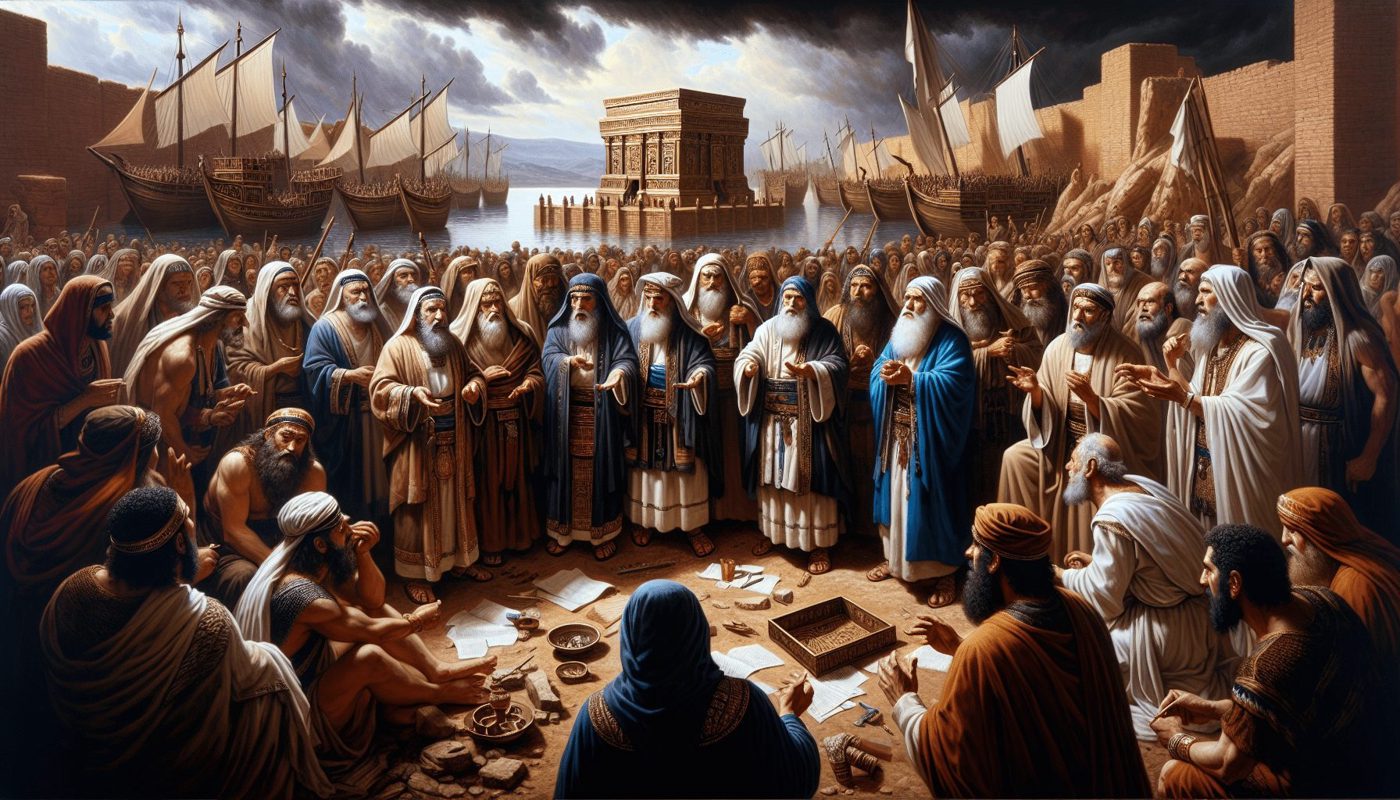
Seven months the ark of the Lord had sat in Philistine territory, and the whole time the hand of the Lord had been pressing hard. Tumors broke out. The land was overrun with mice. The five lords of the Philistines—the rulers of Ashdod, Gaza, Ashkelon, Gath, and Ekron—had no relief. By the time they called for their priests and diviners, the question was no longer whether to send the ark back but how.
The priests and diviners gave a specific answer: do not send it empty. If the Philistines wanted healing, they had to return a trespass offering. That offering was not to be grain or cattle but images of the very plagues that had struck them—five golden tumors and five golden mice, one for each of the Philistine lords and their cities. The logic was blunt: the same plague had hit all of them, so the offering had to match the scale of the judgment.
The priests also gave a warning. They reminded the Philistine rulers of what happened to Egypt and Pharaoh. The Egyptians had hardened their hearts, and the Lord worked wonders among them until they finally let Israel go. The Philistines were told not to repeat that stubbornness. The implication was clear: if they resisted, the plagues would not stop.
Then came the test. The Philistines were told to take a new cart and two milk cows that had never been yoked. The calves of those cows were to be shut up at home, away from their mothers. The ark was placed on the cart, and the golden offerings were put in a coffer beside it. Then the cows were released to go wherever they chose. If the cows went straight toward Israelite territory, toward Beth-shemesh, then the Philistines would know the Lord had done this. If the cows wandered off, they could call it chance.
The cows did not wander. They took the straight road to Beth-shemesh, lowing as they went, and did not turn right or left. The Philistine lords followed them all the way to the border. That was not a random event. The cows, with their calves waiting behind them, ignored every instinct to turn back and headed directly into Israelite land.
The men of Beth-shemesh were harvesting wheat in the valley when they looked up and saw the ark. They rejoiced. The cart came to a stop in the field of a man named Joshua, a Beth-shemite, beside a large stone. The men of Beth-shemesh broke up the cart for firewood, slaughtered the cows, and offered them as a burnt offering to the Lord. The Levites took down the ark and the coffer of gold and set them on the stone. That same day the people of Beth-shemesh offered burnt offerings and sacrifices.
The five Philistine lords watched all of this, then turned around and went back to Ekron. They had seen the ark arrive in Israelite hands, and they had seen the offering accepted. They returned to their own cities, but the story does not end with their departure.
The men of Beth-shemesh looked into the ark of the Lord. The text does not say why. It does not describe a ritual or a ceremony. It simply reports that the Lord struck down seventy men—and in some manuscripts, fifty thousand men—because they had looked into the ark. The people of Beth-shemesh mourned. Their joy at the ark's return turned into terror. They asked, "Who is able to stand before the Lord, this holy God? And to whom shall He go up from us?"
They did not try to keep the ark. They sent messengers to the inhabitants of Kiriath-jearim with a direct message: the Philistines have brought back the ark of the Lord; come down and take it up to you. The ark moved again, not because the Philistines wanted to keep it and not because Israel had earned it, but because the Lord's holiness could not be handled carelessly by anyone.
Comments
Comments 0
Read the discussion and add your voice.
Members only
Sign in to join the conversation
We keep comments tied to real accounts so the discussion stays clean and trustworthy.
No comments yet. Be the first to add one.