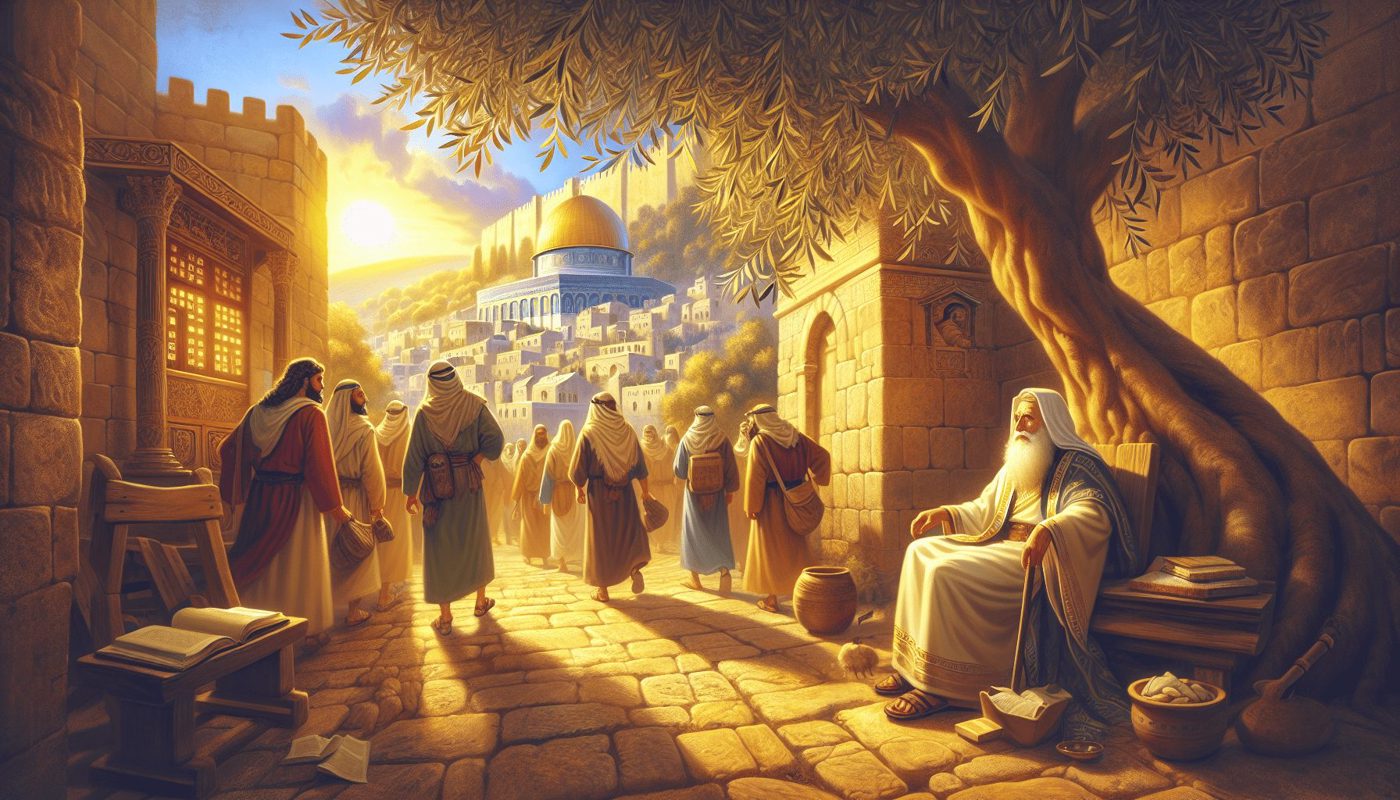
The chapter opens with a question about wisdom and interpretation. A man's wisdom, the text says, makes his face shine and changes its hardness. This is not a metaphor for personal enlightenment. It is a claim about visible composure under authority. The wise man does not flinch. He knows how to read a situation, and that reading shows on his face.
The counsel that follows is blunt: keep the king's command, and keep it in regard of the oath of God. The two are bound together. The king's word has power, and no one can say to him, "What are you doing?" This is not flattery. It is a description of how power works under the sun. The wise man does not waste his breath challenging what he cannot change. He watches, obeys, and waits.
But the text immediately complicates this obedience. The wise man's heart discerns time and judgment, because for every purpose there is a time and a judgment. The misery of man is great upon him, and he does not know what will be. No one can tell him how it will be. So the obedience is not blind. It is practiced within a thick fog of ignorance about outcomes.
Then the chapter turns to limits. No man has power over the spirit to retain it. No man has power over the day of death. There is no discharge in war. Wickedness will not deliver the man who is given to it. These are not abstract statements. They are observations from a man who has applied his heart to every work done under the sun. He has seen one man have power over another to his hurt, and he has seen the wicked buried while the righteous are forgotten in the city. That is vanity.
The delay of justice is a central pressure here. Because sentence against an evil work is not executed speedily, the heart of men is fully set to do evil. The text does not explain why God delays. It simply reports the consequence: people take the gap as permission. Yet the writer holds a firm conviction: it will be well with those who fear God, and it will not be well with the wicked. The wicked's days are like a shadow, because he does not fear before God.
But the observation does not stop there. There is a vanity done on the earth: righteous men get what the wicked deserve, and wicked men get what the righteous deserve. The writer calls this vanity. He does not resolve it. He does not offer a hidden justice behind the scenes. He simply names the mismatch and moves on.
What he commends instead is mirth. Eat, drink, and be joyful, because that will abide with a man in his labor all the days of his life that God has given him under the sun. This is not escapism. It is a deliberate choice in the face of unsolvable mystery. The joy is not a reward. It is a companion to labor, given by God.
The chapter ends where it began: with the limits of human knowledge. The writer applied his heart to know wisdom and to see the business done on the earth. He saw people who neither day nor night see sleep with their eyes. He beheld all the work of God, and he concluded that man cannot find it out. No matter how much a man labors to seek it, he will not find it. Even if a wise man thinks he knows it, he will not be able to find it.
This is not a failure of effort. It is a structural limit. The work of God under the sun is not designed to be fully discovered. The wise man's face shines not because he has solved the puzzle, but because he has accepted the boundary. He keeps the command. He fears God. He eats his bread with joy. And he does not pretend to see what is hidden.
Comments
Comments 0
Read the discussion and add your voice.
Members only
Sign in to join the conversation
We keep comments tied to real accounts so the discussion stays clean and trustworthy.
No comments yet. Be the first to add one.