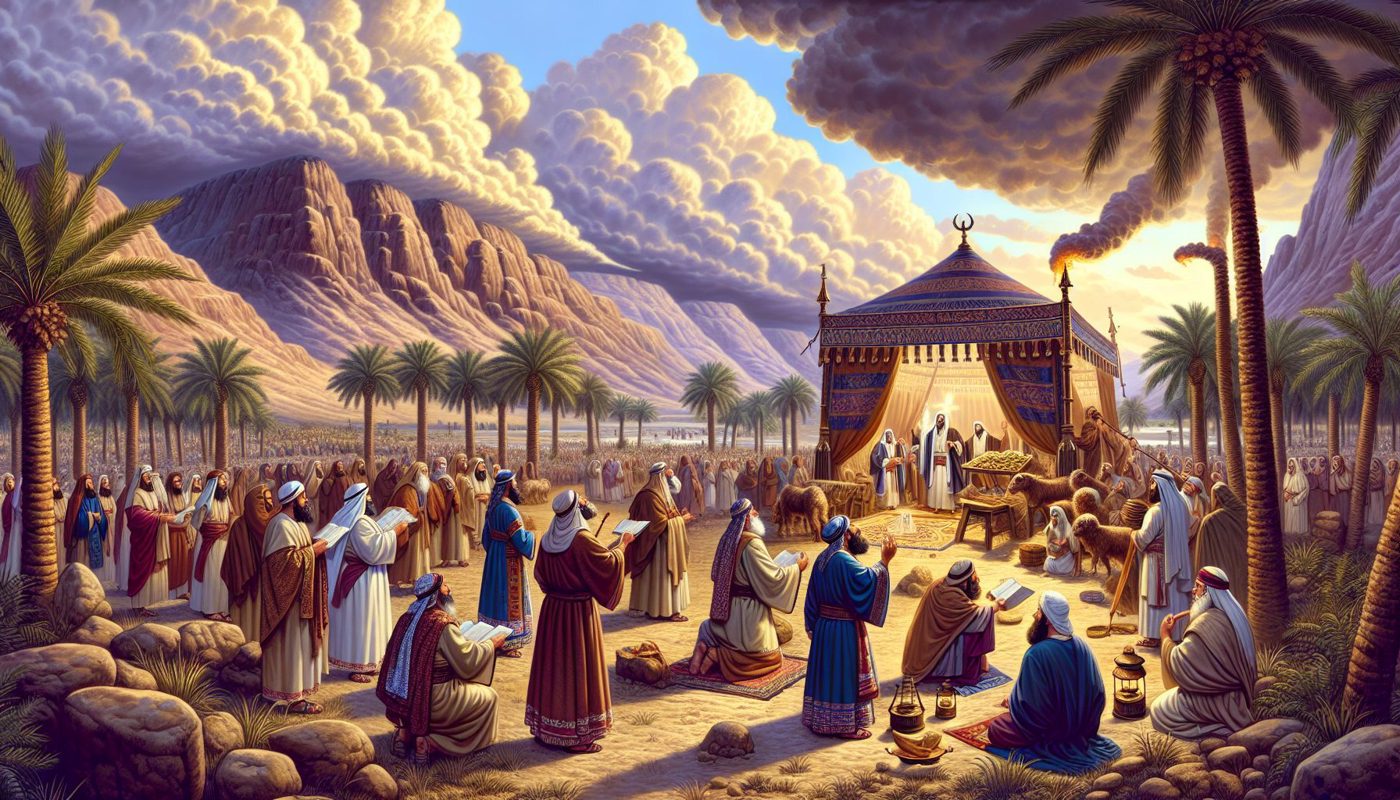
The Lord spoke to Moses again, and the instructions were precise. Aaron and his sons were to separate themselves from the holy things the people of Israel consecrated to the Lord. They were not to profane His holy name. The penalty for approaching those holy things while unclean was severe: that person would be cut off from before the Lord.
The priests themselves carried the weight of this command. Any man of Aaron’s line who had leprosy or a bodily discharge could not eat the holy things until he was clean. Touching anything made unclean by a dead body, or a man with an emission of semen, or any creeping thing that defiles, or any person who carried uncleanness—all of these rendered a priest unclean until evening. He had to bathe in water, wait for sunset, and only then could he eat the holy things again, because those were his bread.
They were not to eat an animal that died of itself or was torn by beasts, for that would defile them. The Lord commanded them to keep His charge, lest they bear sin and die for profaning the holy things. The Lord is the one who sanctifies them.
No stranger was allowed to eat the holy thing. That included a sojourner living with a priest or a hired servant. But if a priest bought a slave with his own money, that slave could eat of it. Anyone born in the priest’s house could also eat of his bread. If a priest’s daughter married a stranger, she could not eat the heave-offering of the holy things. But if she became a widow or was divorced, had no child, and returned to her father’s house as in her youth, she could eat of her father’s bread. Still, no stranger was to eat of it.
If a man ate of the holy thing unwittingly, he had to add a fifth of its value and give it to the priest along with the holy thing itself. The priests were not to profane the holy things the people of Israel offered to the Lord. Doing so would cause the people to bear iniquity and guilt when they ate their own holy things. The Lord is the one who sanctifies them.
Then the Lord spoke to Moses again, this time addressing Aaron, his sons, and all the children of Israel. Any man of the house of Israel or any sojourner in Israel who offered an oblation—whether a vow or a freewill offering—as a burnt offering to the Lord had to bring a male without blemish from the bulls, sheep, or goats. Only then would it be accepted. Anything with a blemish was not acceptable.
For a peace offering to accomplish a vow or as a freewill offering, the animal had to be perfect. No blemish was allowed. The Lord listed specific defects: blind, broken, maimed, having a wen, scurvy, or scabbed. None of these were to be offered on the altar as an offering made by fire. A bullock or lamb with anything superfluous or lacking in its parts could be offered as a freewill offering, but not for a vow. No animal with bruised, crushed, broken, or cut testicles was to be offered, and such practices were forbidden in the land.
No foreigner’s hand could offer the bread of God from any of these animals, because their corruption was in them. They had a blemish and would not be accepted.
The Lord gave further instruction about the timing of offerings. When a bullock, sheep, or goat was born, it had to remain with its mother for seven days. From the eighth day onward, it could be accepted as an offering made by fire. A cow or ewe was not to be killed together with its young on the same day.
When a sacrifice of thanksgiving was offered, it had to be eaten on the same day. None of it was to be left until morning. The Lord commanded His people to keep His commandments and do them. They were not to profane His holy name. He is the Lord who hallows them, who brought them out of the land of Egypt to be their God.
Comments
Comments 0
Read the discussion and add your voice.
Members only
Sign in to join the conversation
We keep comments tied to real accounts so the discussion stays clean and trustworthy.
No comments yet. Be the first to add one.