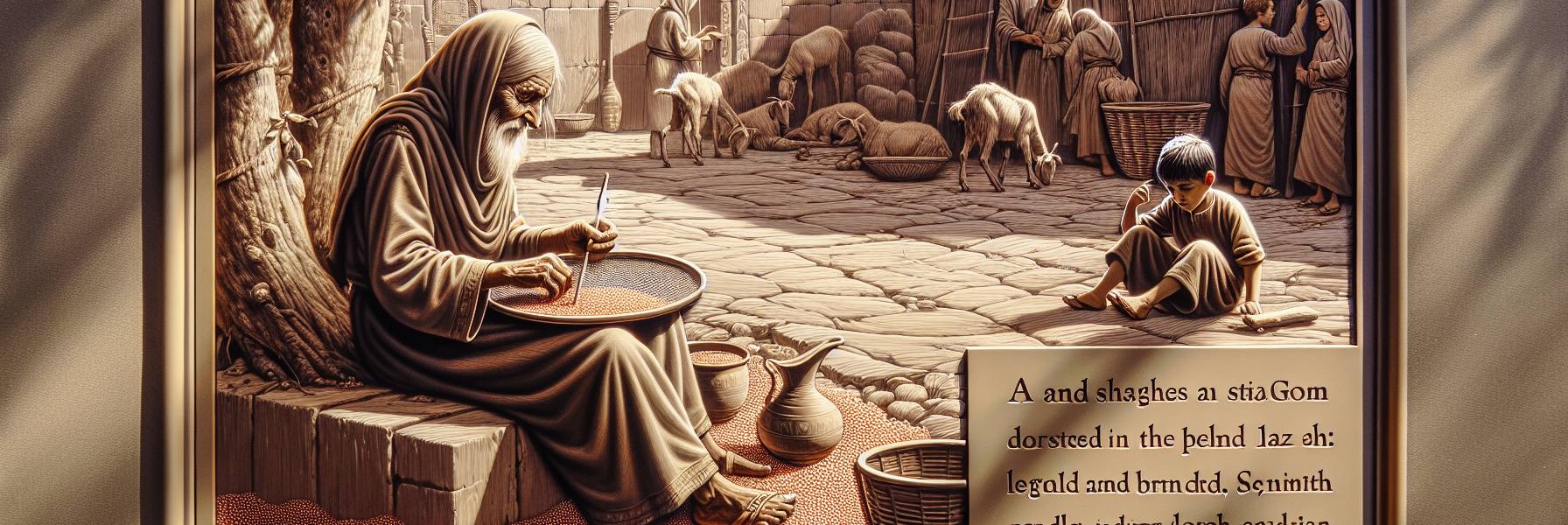

The heat in Tekoa rose from the stones of the courtyard in visible shimmers. Old Mara, her back bent like an olive branch gnarled by wind, sorted lentils on a flat sieve, the *shush-shush* of her work a dry rhythm against the silence of midday. Her grandson, Eben, squatted in the sliver of shade by the wall, listlessly poking at a beetle with a stick.
“Lift your hands, boy,” Mara said, not looking up. Her voice was the sound of two stones grinding. “Idle hands are the devil’s loom. They weave only shame.”
Eben sighed, a dramatic sound he hoped she’d hear. “What is there to do? The goats are penned, the cistern is low. Father and Asher won’t be back from the market until evening.”
Mara paused, a wrinkled hand full of tiny pebbles and broken lentils. She looked at him, her eyes deep-set and dark as well-water. “There is always work for a willing heart. The store-room needs sweeping. The grinding stone needs cleaning. A heart that trusts in haste,” she said, turning back to her task, “is like a mouth without a gate. It swallows flies.”
Eben knew the sayings. They fell from her lips like water from a cracked jar, steady and predictable. He pushed himself up, dust sticking to his damp tunic. He preferred his father’s stories of battle, or his brother Asher’s boasts of shrewd deals in the Hebron market. Grandma’s proverbs were for children and old women.
Out on the road, a cloud of dust announced a runner. It was Levi, the potter’s son, his chest heaving. “Eben! Your father and brother—there’s been trouble at the gate. A dispute over weights.”
A cold knot formed in Eben’s stomach. Mara stood slowly, wiping her hands on her apron. No fear touched her face, only a deep, weary certainty. “A false scale is an abomination to the Lord,” she murmured, almost to herself. “But a just weight is his delight.”
The scene at the city gate was a knot of shouting men and curious onlookers. Eben’s father, Jamin, stood like a rooted oak, his face thunderous. Before him was Asher, Eben’s older brother, his usual smug confidence replaced by a defiant, pale anger. A merchant from Beth Zur, a man with greasy ringlets and a voice like a tearing cloth, was waving a set of bronze scales.
“He cheated me!” the merchant shrilled. “The weight is light! He has taken wool for a lamb’s price!”
Asher spat in the dust. “Your eye is greedy, and your measure shrinks with your honesty. The weight is true.”
But the elder judging the matter, a man named Zadok with a beard like untrimmed wool, held the disputed weight in his palm, then a true weight from his own pouch. He did not need to speak. The difference was clear in the set of his shoulders. Asher had been using a stone hollowed out with cunning patience.
Jamin’s face collapsed in on itself, not with anger, but with a grief so profound it silenced the crowd. He looked not at the accuser, but at his son. “The memory of the righteous is a blessing,” he said, his voice thick, “but the name of the wicked will rot.” He turned and walked away, the crowd parting for him. The matter was settled. The fine would be paid, the wool returned, but the true cost hung in the air, bitter as gall.
That night, in their house, the silence had a texture. It was the sound of a blessing withheld. Asher skulked in the corner, shame curdling into resentment. Jamin stared into the low fire. Mara moved between them, placing bread and oil on the table, her movements the only grace in the room.
“A wise son makes a glad father,” she said quietly, breaking the bread. “But a foolish son is a sorrow to her who bore him.” She did not look at Asher, but at Eben. The words weren’t a jab; they were a fact, as plain and hard as the truth-stone Zadok had carried.
Weeks passed. The drought tightened its grip on the land. The cistern’s water level fell, revealing a ring of white stone like a hungry mouth. Prayers for rain rose with the dawn, but the sky remained a relentless, polished brass. Famine walked the edges of the village, a specter in the whispers of the women at the well.
Asher’s folly had cost them more than reputation. The fine had taken a measure of their grain reserve. Jamin worked from first light until the stars were thick, his labour a quiet, desperate prayer. Eben worked beside him, the taste of his brother’s disgrace sour in his mouth. He saw how his father’s honest toil, though it did not fill the bins, brought a measure of peace. “The hand of the diligent makes rich,” Mara would say, watching them trudge in at dusk. “But the slack hand craves and gets nothing.”
Asher’s hand was slack in a different way. He dreamed of quick restoration, of a dramatic reversal. He took to lurking near the caravans that passed through, his eyes sharp for opportunity. One evening, he returned with a small, heavy sack. His eyes glittered. “Syrian silver,” he whispered to Eben. “Bought for a song from a desperate man. We’ll triple it in Jerusalem.”
Eben looked at the sack, then at his brother’s feverish face. He heard Mara’s voice in his memory, not chiding, but stating a truth of the world: “Treasures gained by wickedness do not profit. A lying tongue is but for a moment.” He said nothing, but his silence was a wall.
The Syrian silver was, of course, base lead cleverly plated. The trader was long gone. Asher’s cry of rage when he discovered the truth was a wild thing in the courtyard. He smashed a water jug against the wall. Jamin merely watched, his exhaustion now complete.
It was the drought that finally broke Asher, or perhaps it was the sight of his grandmother. While others hoarded, Mara took her meager portion of grain and oil and quietly, without ceremony, began to bake extra loaves of rough barley bread. Each evening, as the sun bled into the hills, she would walk to the edge of the village where the widow Tirzah lived with her fatherless children, and later to the hovel where old, blind Seth sat alone. She would leave a loaf, sometimes two, saying nothing.
Eben followed her one evening, hidden by the purple twilight. He saw Tirzah’s children fall upon the bread, their small hands clutching. He saw old Seth’s groping fingers find the offering, a tear cutting a path through the dust on his cheek. He returned home, his heart a strange tumult of ache and warmth.
“Why, Grandmother?” he asked her later as she kneaded the next day’s dough. “We have so little.”
She worked the rough flour, her knuckles prominent. “The blessing of the Lord makes rich,” she said, her breath a little short with the effort. “And he adds no sorrow with it. A man is cursed who hoards his grain for himself alone. But righteousness,” she paused, looking out at the unforgiving sky, “righteousness delivers from death.”
Eben finally understood. The proverbs were not just words. They were the deep, hidden grain of the world, the true weights and measures. Asher’s way—the hasty, cunning, greedy path—was the slack hand. It brought noise, drama, and then emptiness. His father’s way, his grandmother’s way, was the diligent hand. It was quiet, often thankless, rooted in a different economy. It was the way of the righteous, whose foundation would never be moved.
The change in Eben was not sudden, but like the turning of the seasons. He rose earlier. He carried water for Seth without being asked. He stopped pining for his brother’s vanished silver and saw the real wealth in his father’s steadfastness. He began to listen to Mara’s sayings not as the chirping of a cricket, but as the steady drip of water on stone, each drop wearing a groove of truth.
One afternoon, while mending a wall in the far pasture, he found a hidden seep, a tiny fern-lined crack in the rock that wept water, clear and cold. It was not enough for the fields, but it was a thread of life. He showed his father. Jamin placed a calloused hand on his shoulder, and the silence between them was full, a blessed silence.
Asher left before the rains finally came. He went to seek his fortune in Ashkelon, among the Philistines. No one knew what became of him. In time, his name was rarely spoken, and when it was, it was with a soft sigh, a story of warning for restless boys.
The rains did return, washing the dust from the leaves and filling the cistern with a sweet, echoing music. The righteous, like Jamin and Mara and now Eben, had been like a tree planted by water, sending out its roots to the stream. They did not fear when heat came. Their leaves remained green. They had not ceased from bearing fruit.
And in the cool of the evenings, as the family sat in their replenished courtyard, Eben would sometimes speak. He would talk of the balance of things, of the seen and the unseen yield. His words were his own, yet they carried the familiar, unshakeable rhythm of the ancient wisdom, learned not from a scroll, but from the living of days. They were, in their own way, a proverb in the making.