
The ash was still in the air. You could taste it, a fine grit on the tongue, carried on the wind that swept across the empty spaces where flocks had once grazed. Job sat on the ground, not on the ash-heap of the city gate, but on a flat stone outside what remained of his dwelling. His skin still carried the memory of sores, a tight, pink map of suffering. But the physical pain was a ghost now. The deeper ache, the cavern carved by loss—for his sons, his daughters, the laughter that had filled his halls—that remained, a hollow companion.
He had spoken his last words into the whirlwind, and the whirlwind had answered. Not with explanations, but with presence. A presence that dwarfed the foundations of the earth and charted the paths of the Pleiades. Job’s arguments, so meticulously crafted in his anguish, had crumbled like dried clay. He hadn’t been answered; he had been met.
“I had heard of you by the hearing of the ear,” he whispered now to the empty sky, the words rustling like dry reeds. “But now my eye sees you.”
It wasn’t a sight of form or face. It was the seeing that comes when the scales of self-justification are scrubbed away by the sheer, terrifying majesty of a God who asks, “Where were you?” It was a vision of a universe so vast, so intricately wild and beyond his management, that his own righteousness suddenly seemed a small, dusty thing. His right to an answer felt childish. So he retracted it. He placed his hand over his own mouth.
“Therefore I despise myself,” he murmured, the confession not one of self-hatred, but of a profound re-ordering. “And I repent in dust and ashes.”
The repentance wasn’t for some secret sin that had caused his calamity. The three friends, Eliphaz the Temanite, Bildad the Shuhite, and Zophar the Naamathite, had been wrong about that. It was a repentance of perspective. He repented of the smallness of his understanding, of the arrogance of demanding a universe comprehensible to a grieving man. He repented into the dust because dust was what he was, and it was a relief finally to know it.
A shadow fell across him. It was Elihu, the younger man who had spoken last, his face pale and earnest. “They are here,” he said simply.
Job looked up. The three friends were approaching, their steps slow, hesitant across the broken ground. Their fine robes were travel-stained. They did not meet his eye. The fury and the fervent, flawed theology they had hurled at him was gone, replaced by a shamed silence. They had spoken what they thought was truth about God, and God had not been pleased.
Job felt a strange movement in his spirit. No vindictive triumph rose in him. Looking at their downcast faces, he felt only a heavy pity, and a clarity. The Lord had spoken to him, and in that speaking, a command had been implicit in the very fabric of the encounter: the one who is restored must become a restorer.
He stood, his joints stiff. “You must go to my tent,” he said, his voice stronger than he expected. “Take seven bulls and seven rams from what little the raiders left. Go, and offer a burnt offering for yourselves.”
Eliphaz raised his eyes, a question in them.
“My servant will pray for you,” Job continued. “And I… I will ask the Lord to accept your prayer. For I will accept you. And He will not deal with you according to your folly, for you did not speak of Him what is right, as I have.”
The admission hung in the air. *As I have.* It was the final surrender of his lawsuit. He was not the innocent plaintiff against a negligent God. He was a man, speaking rightly only when his words ended in worship and intercession.
The sacrifice was made on a rough altar of uncut stone. The smoke, clean and sharp-scented, rose into the immense sky, a different smoke from the ashes of his children. This was smoke of surrender, of atonement sought and offered. Job prayed, not with elaborate pleas, but with a simple turning of his face upward, his spirit leaning into the presence he now knew. He prayed for the men who had failed him. And as he prayed, the hollowness within him did not vanish, but it was… inhabited. It was no longer an empty tomb of loss, but a chamber waiting to be filled.
The turning point was not dramatic. It was gradual, like the first green shoots forcing their way through scorched earth. After Job prayed for his friends, the Lord restored his fortunes. The text says it plainly, but the reality was slow, earthy, and miraculous in its mundanity.
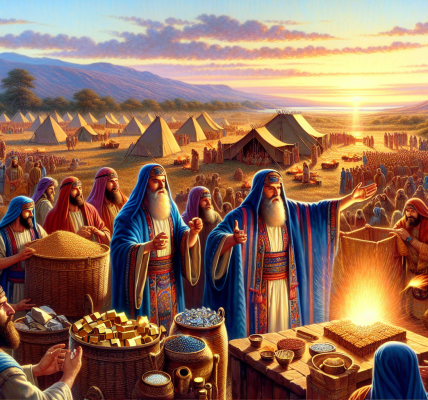
It began with kin. Distant cousins, men and women who had kept their distance during the years of sores and sorrow, now appeared. They ate with him, not speaking much, but their presence was a balm. They brought bread, and a ewe lamb, and a skin of wine. They clasped his shoulders, their eyes wet. They gave him a piece of silver and a gold ring, not as charity, but as a token. “For you are our brother,” one said, and the words rebuilt a wall of belonging that had been shattered.
Then, the livestock. It seemed one morning a small herd of spotted goats appeared, trailed by a wary herder from Uz who said simply, “They are yours.” A week later, a man brought three camels, heavy with wool. “A debt owed to your house from long ago,” he claimed, though Job remembered no debt. The Lord was restoring Job’s fortunes, and He was using the hesitant, generous, awkward hands of people to do it.
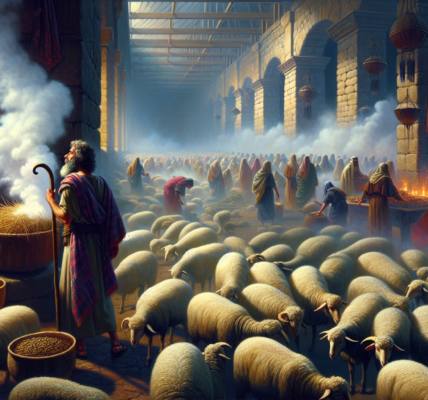
The numbers grew. Seven thousand sheep. Three thousand camels. A thousand yoke of oxen, their lowing a profound music at dawn. A thousand donkeys. They filled the pastures, the air thick with the sound and smell of life. It was double what he had before. A sign, perhaps, that what was to come was not a replacement, but a fullness that acknowledged the loss even as it overflowed.
And then, the daughters.
He had seven sons again. Good men, who feasted in their homes. But it was the three daughters who stopped the heart of everyone in the land. They were not named before. Now they were: Jemimah, which means “Dove”; Keziah, “Cinnamon”; and Keren-Happuch, “Horn of Antimony,” a vessel of rare cosmetic. Their names spoke of beauty, fragrance, and precious adornment.
And they were breathtaking. The scripture says no women in all the earth were found so beautiful as Job’s daughters. But their beauty was not merely in form. It was a beauty lit from within by a father’s peculiar blessing. In a world where daughters inherited only through brothers, Job did an unthinkable thing. He gave them an inheritance among their brothers.
He saw it in them—a grace forged in the furnace of his own suffering, a depth their brothers, born in ease, perhaps did not possess. He saw Jemimah’s gentle strength, Keziah’s keen wisdom, Keren-Happuch’s fiery compassion. They were his living testament, not to restored wealth, but to a restored soul that now valued differently, loved more fiercely, blessed more freely.
Job lived. He saw his children, and his children’s children, to the fourth generation. He died, old and full of days. The man who had cursed the day of his birth died content, having tasted a goodness that was not the absence of sorrow, but a richness that included it. He had seen the edges of God’s ways, heard the fringes of His whisper. And it was enough. More than enough. It was a feast after a long famine, and he died with the taste of it, sweet and solemn, still on his lips.