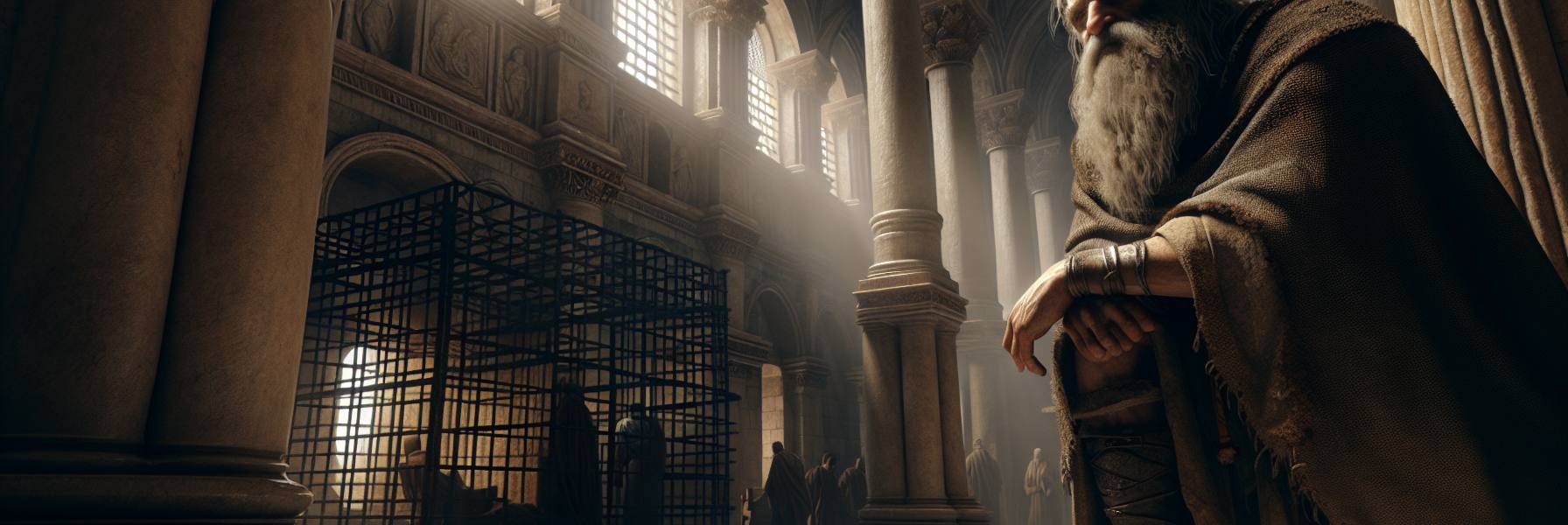

The salt air of Caesarea carried the scent of damp stone and distant rain. For two years, Felix had left him here, a forgotten piece of administrative clutter in the governor’s palace dungeon. Paul of Tarsus felt the ache in his joints, a cold that had settled into the marrow from the perpetual damp of his cell. Yet, his spirit felt oddly untethered, not defeated. The long silence was its own kind of wilderness, a place where the voice of the Lord grew no quieter, only more patient.
Then the air changed. A new procurator arrived—Porcius Festus, a man from Rome with the dust of the Italian road still on his boots and a ledger of problems in his eyes. Three days after his arrival, Festus ascended the dais in the great hall of Herod’s palace. The marble was cool, the light from the high windows cutting sharp angles across the mosaic floor. Festus, a compact man with a practical face, gestured, and they brought Paul in.
The prisoner stood, not with defiance, but with a weary solidity. His chains clinked softly. Festus studied him: this small, aging man with keen eyes that seemed to catalogue everything—the new governor’s uncertain posture, the bored expressions of the Roman aides, the hostile glares of the delegation from Jerusalem who had already descended upon him with their demands.
“You have many serious charges laid against you by the chief priests and elders,” Festus began, his Latin crisp and official. He listed them: sedition, sectarianism, profaning the Temple. They were political charges, polished smooth for Roman ears.
Paul’s voice, when it came, was clear and carried a surprising calm. “I have committed no offense against the law of the Jews, nor against the temple, nor against Caesar.”
Festus leaned forward, a politician’s instinct in his gaze. “Are you willing to go up to Jerusalem and stand trial before me there on these charges?”
The question hung in the air. Paul knew what it meant. The road to Jerusalem was a long corridor of ambush. Promises of safe passage meant little to men whose zeal burned hotter than their fear of Rome. He saw it in the tight smiles of the Jerusalem delegates. This new governor, eager to placate, might hand him over piecemeal to keep the peace.
Paul drew a slow breath. The moment crystallized. This was not a choice between courts, but between a hidden knife and an open sword. He lifted his head, and his words fell into the hall with the finality of a seal pressed into wax.
“I am now standing before Caesar’s tribunal, where I ought to be tried. I have done no wrong to the Jews, as you yourself know very well. If I am guilty of doing anything deserving death, I do not refuse to die. But if the charges brought against me by these men are not true, no one has the right to hand me over to them. I appeal to Caesar.”
A murmur, sharp and then stifled, ran through the Roman aides. The Jerusalem delegates stiffened, their plan unraveling with five words. *I appeal to Caesar.* It was the ultimate procedural card, the right of every Roman citizen, pulling the case out of provincial shadows and into the stark light of the Imperial court.
Festus sat back. He conferred briefly in hushed tones with his legal advisor. The appeal, once uttered, was irrevocable. A local headache had just become an imperial report. “You have appealed to Caesar,” he said, his voice flat. “To Caesar you will go.”
Weeks bled into one another. The weather turned, and the sea beyond the port grew a deeper, more formidable blue. Then King Agrippa arrived with his sister Bernice, a visit of state dripping with gold and perfumed oil. Agrippa, a petty king of the Jews with Roman favor, was a man caught between worlds, understanding the tangled threads of Jewish dispute better than any Roman ever could.
Over wine, Festus unburdened himself. “There is a man left a prisoner by Felix…” He laid out the puzzle of Paul: the furious accusations, the theological quibbles about a certain Jesus, who Paul claimed was alive. “I was at a loss how to investigate such matters,” Festus confessed, the frustration plain on his face. “So I asked if he would go to Jerusalem. But he appealed. Now I have to send him to the Emperor, yet I have nothing definite to write to His Majesty.”
Agrippa, intrigued, a scholar of sorts in his own right, leaned in. “I should like to hear this man myself.”
“Tomorrow,” Festus said, relief softening his features. “Tomorrow you shall.”
The following day, it was not a trial but an audience. The great hall was filled with military tribunes and the prominent men of the city, a spectacle of power and curiosity. Agrippa and Bernice entered with great pomp, their arrival a rustle of fine linen and a glint of jewels. Then Paul was brought, still in chains, a small, steady figure amidst the glitter.
Festus made a grand, slightly embarrassed gesture. “King Agrippa, and all here present… you see this man. The whole Jewish community has petitioned me about him, shouting that he ought not to live any longer. I found he had done nothing deserving death, but because he made the appeal, I decided to send him. But I have nothing specific to write. So I have brought him before all of you, and especially before you, King Agrippa, so that after this examination I may have something to write. It seems to me unreasonable to send a prisoner without specifying the charges against him.”
Agrippa nodded, a king granting a favor. “You have permission to speak for yourself.”
Paul straightened. He did not begin with arguments or defenses. He began with a story. His voice, at first soft, grew in strength, filling the space not with shouting, but with a relentless, personal conviction. He spoke of his former life, a Pharisee of Pharisees, his fury against the followers of the Way. He described the road to Damascus, not as a doctrine, but as a blinding, world-shattering event—a light from heaven, a voice, a calling. He spoke of the risen Jesus, of his mission to Jew and Gentile alike, to open eyes and turn them from darkness to light.
“Therefore, King Agrippa,” he said, his gaze fixed not on the governor, but on the king who understood the prophets, “I was not disobedient to the heavenly vision.”
Festus, the practical Roman, had heard enough of ghosts and resurrections. His patience for this eastern mysticism snapped. He interrupted, his voice loud and derisive, echoing in the hall. “You are out of your mind, Paul! Your great learning is driving you insane!”
Paul turned to him, calm, unshaken. “I am not insane, most excellent Festus. What I am saying is true and reasonable.” Then he turned back to Agrippa, the key to the puzzle. “The king is familiar with these things, and I can speak freely to him. I am convinced that none of this has escaped his notice, because it was not done in a corner.” He leaned into the silence, his words a direct, breathtaking appeal. “King Agrippa, do you believe the prophets? I know you do.”
Agrippa was cornered, and a flicker of amusement and discomfort crossed his face. The theologian in him was engaged; the politician in him was horrified. This was no longer about charges; it was about a choice laid bare before his courtiers. With a deflector’s grace, he parried. “Do you think that in such a short time you can persuade me to be a Christian?”
Paul’s answer was neither triumphant nor bitter. It was an open-handed wish, sincere and startling. “Short time or long—I pray to God that not only you but all who are listening to me today may become what I am, except for these chains.”
A ripple went through the assembly. The king stood, and the audience was over. In the private chamber, Agrippa turned to Festus. “This man could have been set free if he had not appealed to Caesar.”
But the die was cast. The gears of empire had already begun to turn. As Paul was led back to his cell, the sound of the sea a constant whisper through the high, barred window, he felt not the cold of the stone, but the strange warmth of a path made clear. Jerusalem’s shadows were behind him. Before him lay the storm-tossed journey to Rome, and the unknown judgment of Caesar. He had traded a local verdict for a heavenly one, and in that trade, he found not safety, but a fierce and terrible freedom. The story was leaving the provinces. It was going to the heart of the world.