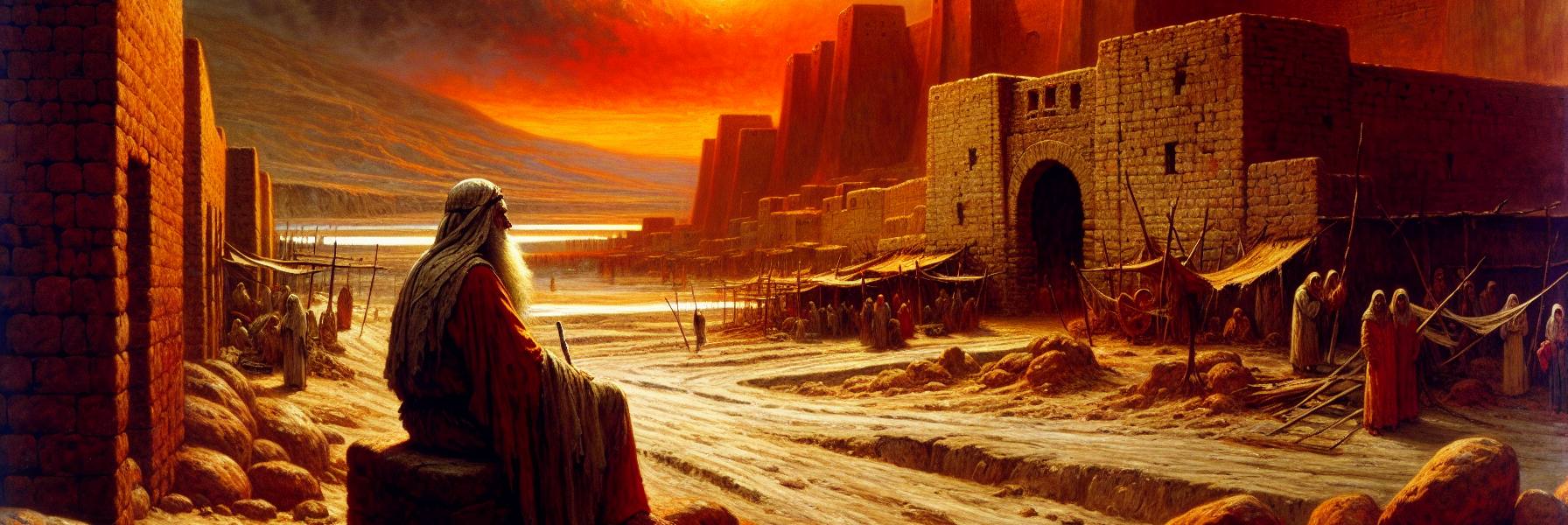

The sun was a weary, blood-orange disc sinking behind the western hills, casting long, distorted shadows across the plain of the Jordan. The city of Sodom, even in the fading light, seemed to hold its heat close, like a fever. Dust from the road hung in the air, thick and parched, and the very stones of the walls radiated a residual warmth from the day’s brutality.
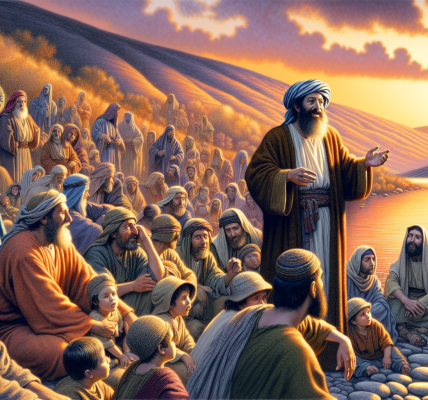
Lot sat in the gateway, as was his custom. It wasn’t a place of honor for him, not really. It was a place of listening, of watching the faces that came and went, a thin attempt at influence in a city that had long ago ceased to listen. The weight of the place was a physical thing on his shoulders. He felt the glances of the merchants and the idle men—not hostile, precisely, but assessing, as one might assess a strangely shaped tool of uncertain use.
That’s when he saw them. Two men walking up from the direction of the terebinths of Mamre. They moved with a purpose that seemed to cut through the lethargic evening air. Their garments were travel-stained, but they wore no packs, carried no staffs for the long road. Their faces were calm, set, and as they drew nearer, Lot felt a chill that had nothing to do with the coming night. It was a recognition, deep and wordless, that these were not ordinary wayfarers. Something in their eyes, too clear, too seeing.
He rose quickly, his joints protesting. The custom of hospitality was ancient, sacred, but here in Sodom it had become a twisted mockery. Yet the impulse in him was pure and urgent. He bowed low, his face nearly to the dust of the square.
“My lords,” he said, his voice rough. “Please, turn aside to your servant’s house. Wash your feet, spend the night, and then you may rise early and go on your way.”
They stopped and regarded him. One of them spoke, his voice quiet yet carrying. “No. We will spend the night in the square.”
A spike of genuine fear shot through Lot. The square, after dark? It was unthinkable. He knew what happened in the shadows of the square, the things that gathered when the sun fled. He pressed them, his entreaties growing more earnest, almost desperate. “Please, I beg you.” He stepped closer, lowering his voice. “It is not safe.”
Something in his insistence, perhaps the flicker of the old righteousness that had once drawn his uncle Abraham, seemed to move them. They exchanged a glance, a communication that needed no words. Finally, they nodded. “Very well. Lead on.”
Relief flooded him, mixed with a deeper, unnamed dread. He brought them to his house, ordered water brought for their feet, and had his wife and daughters hastily prepare a meal. The atmosphere in the home was tense. His wife moved silently, her face a mask of worry. The daughters stole glances at the visitors, curious and afraid. The visitors ate, but sparingly, as if the act itself were a formality. They did not speak of their journey.
Then came the sound.
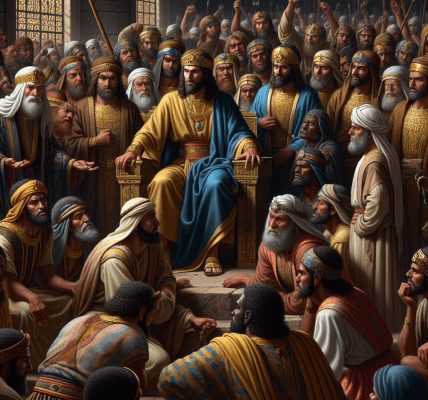
It started as a murmur, a gathering noise from the street, which swelled into a rumble, then a roar. It was the sound of a mob, not drunk and merry, but focused and hungry. Lot knew that sound. His blood ran cold. A pounding shook his door, not a knock but a steady, insistent thudding of many fists.
“Lot!” voices cried, young and old, snarling and laughing. “Where are the men who came to you tonight? Bring them out to us, that we may know them!”
The vulgarity of the demand hung in the air, thick as the city’s smell. To *know* them. It was the idiom of the city, a euphemism that had lost all subtlety, all restraint. It was a demand for violation.
Lot’s heart hammered against his ribs. He motioned for his guests to stay back in the inner room. His hands were trembling as he went to the door, unbarred it, and stepped out quickly, pulling it shut behind him. The press of bodies was immediate, hot and smelling of sweat and dust and malice. Faces leered at him in the torchlight.
“Brothers, I beg you,” he shouted, his voice cracking. “Do not act so wickedly!” The plea was pathetic, he knew it even as he said it. These men had no concept of wickedness anymore; it was their currency, their sport.
“Stand back!” he tried again, a desperate, foolish idea seizing him. He gestured toward his own house. “Look, I have two daughters who have not known a man. Let me bring them out to you, and do to them as you please. Only do nothing to these men, for they have come under the shelter of my roof.”
The offer was monstrous. It fell from his lips, the product of a mind torn between a degraded understanding of hospitality and a primal terror. He was bargaining with a morality he had absorbed from the very pit he sought to remain in. The mob only jeered louder. “Stand back!” one of them roared. “This fellow came to sojourn, and he has become the judge! Now we will deal worse with you than with them!”
They pressed forward, pushing Lot back against the door until the wood groaned. Hands reached for him to drag him aside. In that moment, just as the violence was about to erupt into the house, the door flew inward.
The two men stood there. In the confined space of the doorway, they seemed to grow, not in size, but in presence. A profound silence, colder than the night, emanated from them. They reached out, grasped Lot by the shoulders, and pulled him inside with an easy strength. The door shut of its own accord with a final, solid *thud* that shook the frame.
Outside, the noise of the mob twisted. The jeers turned to shouts of confusion, then to cries of pain and terror. Lot, panting against the wall, heard them scrabbling at the door, then a blindness, they said later, a dazzling, disorienting darkness that fell upon every man at the threshold, young and old, until they wearied themselves groping for a door they could no longer find.
Inside, the air was still. One of the men turned to Lot. His voice was low, but it filled the house. “Who else is here? Sons-in-law, sons, daughters, anyone who belongs to you in the city—bring them out of this place. For we are about to destroy it. The outcry against its people has become great before the Lord, and He has sent us to destroy it.”
Lot staggered out into the city, his mind reeling. He went to the homes of the men pledged to marry his daughters. His words came out in a frantic jumble. “Up! Get out of this place! The Lord is destroying the city!” But to them, he seemed like a man jesting. Their laughter echoed in the narrow streets as they turned him away. The city’s normalcy was its own judgment; the warnings of heaven sounded like madness to those steeped in sin.
Dawn was a faint, grey smear in the east when the men urged Lot again. “Arise, take your wife and your two daughters who are here, lest you be swept away in the punishment of the city.” He lingered. The terror was real, but so was the pull of the life he had built, the possessions, the standing, however hollow. It was a paralysis of the soul.
Seeing his hesitation, the men—the messengers—acted. They took him, his wife, and his two daughters by the hand, the Lord being merciful to him, and they brought him out and set him outside the city. The air outside the walls was different—cleaner, sharper, smelling of earth and wild herbs.
One of them spoke, and now his words carried the full, terrifying weight of command. “Escape for your life! Do not look back or stop anywhere in the valley. Escape to the hills, lest you be swept away!”
Lot looked toward the distant, rugged hills, and fear gripped him anew. “Oh no, my lords!” he pleaded, a different desperation now. “Your servant has found favor in your sight, and you have shown me great kindness in saving my life. But I cannot escape to the hills; the disaster will overtake me, and I shall die. See, this city is near enough to flee to, and it is a little one. Let me escape there—is it not a little one?—and my life will be saved!”
There was a pause, a moment where the fate of cities and a single, flawed man hung in balance. “Very well,” the voice said, a concession of staggering patience. “I grant you this favor also; I will not overthrow the city of which you have spoken. Hurry! Escape there, for I can do nothing until you arrive there.”
That place was called Zoar, *Little One*. The sun had just begun to peek over the rim of the earth, spilling a bland, ordinary light onto the plain, when Lot entered its small gates. It was then, as he reached the safety he had begged for, that the thunder began.
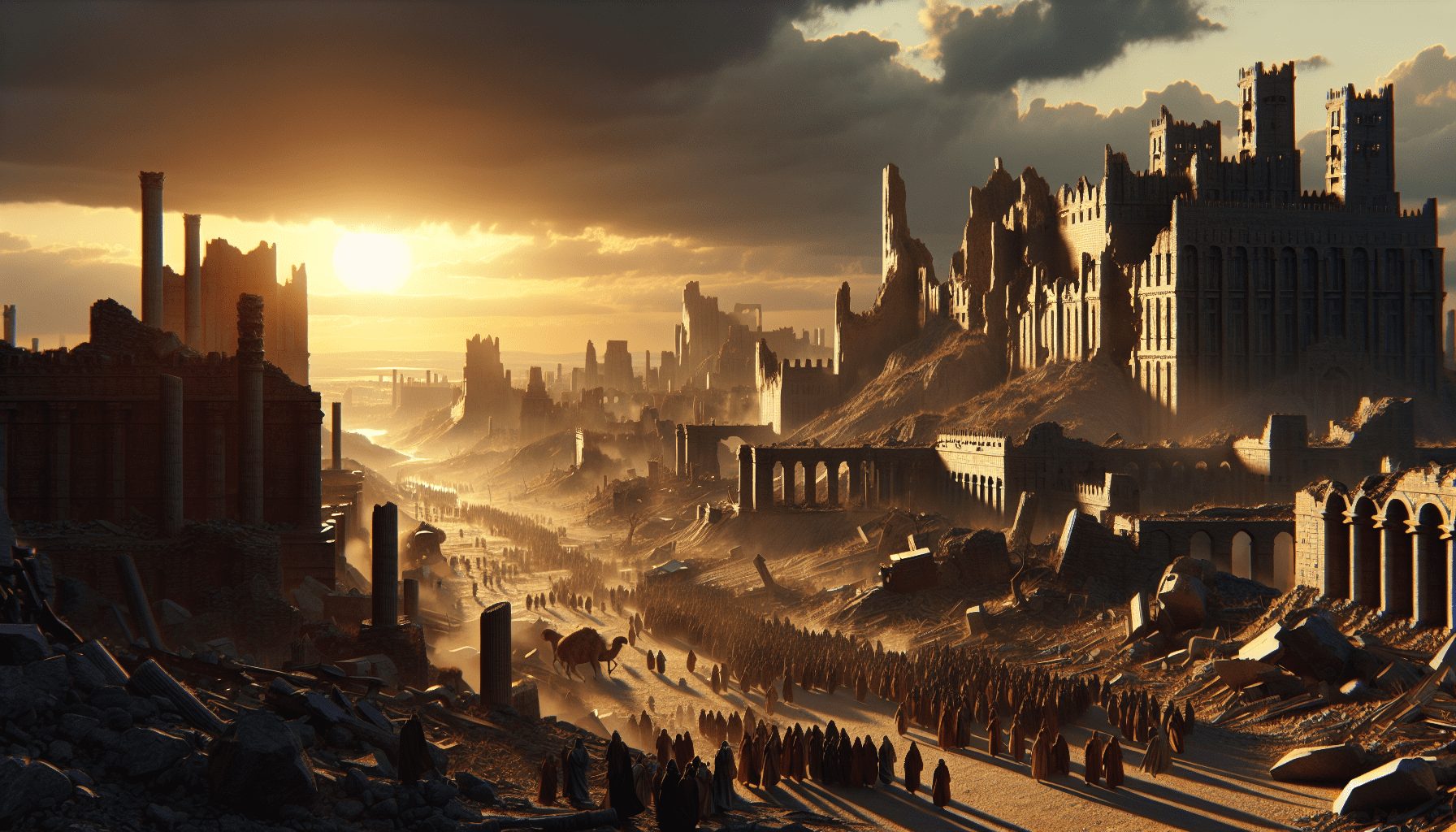
It was not thunder from clouds. It was a deep, subsonic groaning from the earth itself. In Sodom, and in Gomorrah to the south, and in all the cities of the plain, the foundations of wickedness gave way. The Lord rained down fire and brimstone—a storm of burning sulphur—from the heavens. It was not a mere conflagration; it was an unmaking. The very chemistry of the place was reversed, the elements of life turned to agents of absolute death. The cities, the valley, all its inhabitants, and everything that grew from the soil were blotted out.
Lot’s wife, walking behind him, her heart a tangled knot of fear for her life and longing for what was lost—her home, her friends, the entire shape of her world—heard the cataclysm. She stopped. Against the direct command, drawn by a gravity of memory stronger than the fear of God, she turned. She looked back. And in that look, her fate was sealed. She became a pillar of salt, not a statue, but a standing deposit, a crystalline monument to hesitation, her very body consumed and transformed by the fury of the judgment she witnessed.
From a high place, Abraham looked out early that morning toward Sodom and Gomorrah. He saw the smoke of the land rising like the smoke from a furnace. A deep silence settled over him. Down in the valley, Lot, afraid once more, did not stay in Zoar. He took his daughters and went up into the hills after all, to live in a cave with them, a broken man in a shattered world, the smell of fire and salt forever on the wind.