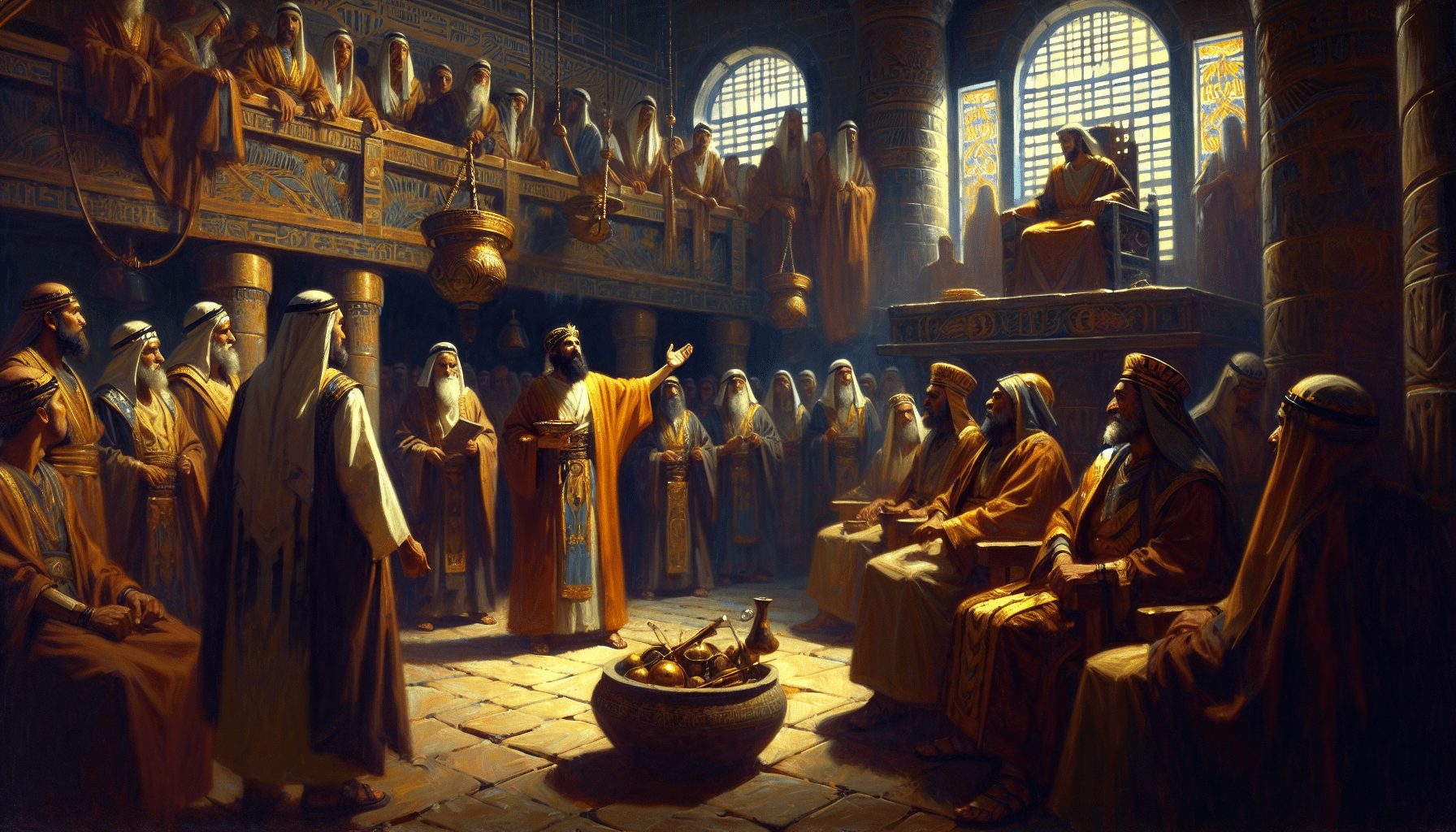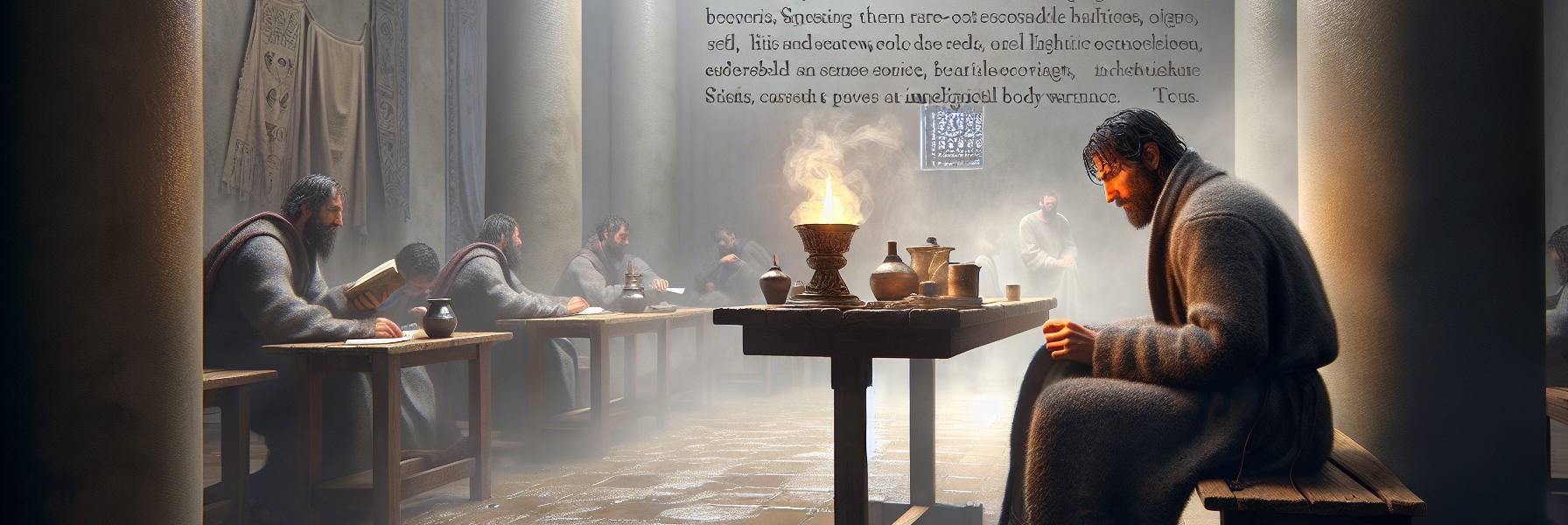

The rain had finally stopped, but the damp clung to everything in Thessalonica. It seeped into the wool of Marcus’s cloak and hung in the air of the small, rented room where the believers gathered. The smell was a mix of wet stone, cheap lamp oil, and human warmth. Marcus shifted on the hard bench, his knuckles white where he gripped its edge. Across from him, Eleutherios was speaking again, his voice a patient, relentless stream.
“The full observance is not a burden, brother, but a safeguard,” Eleutherios said, his fingers tracing an invisible line on the table. “The God of Abraham requires a marked people. How else will the world see we are set apart?”
Marcus’s eyes drifted to the doorway where Tychicus stood, arms crossed, his face a mask of quiet intensity. Tychicus had carried the letter from Paul. Its words still buzzed in Marcus’s mind, clashing violently with Eleutherios’s smooth assurances. He thought of the letter’s sharp, liberating anger: *For freedom Christ has set us free; stand firm therefore, and do not submit again to a yoke of slavery.*
Slavery. The word caught in his throat. He had been a slave once, to a Roman magistrate, before his peculiar manumission funded by a sympathetic believer. The yoke was not a metaphor to him; he could still feel the chafe of the raw wood on his neck, the bite of the strap. What Eleutherios offered felt like a different kind of strap, finely crafted and religiously polished, but a strap all the same.
Later, walking the slick cobbles towards the warehouse district where he worked, the conflict churned within him. Eleutherios spoke of order, of clear lines. It was appealing. The world was chaos. The Roman authorities were suspicious, the pagans mocked, and even the Jewish community was fractured by this new sect. A list of rules, a tangible identity—it was a fortress to build in a storm. But Paul’s voice in the letter was the storm itself, a wild, Spirit-driven wind that threatened not the community, but the very walls they were trying to build.
His work was mindless, sorting damaged amphorae. The physical monotony let his thoughts run. He recalled another phrase, scribbled on a wax tablet he’d copied for himself: *For you were called to freedom, brothers. Only do not use your freedom as an opportunity for the flesh.* The flesh. That, he understood. He knew the pull of the tavern after payday, the quick flash of temper when cheated at the docks, the gnawing envy for the foreman’s warmer cloak. That was a slavery he knew intimately, a tyranny from within. Eleutherios’s rules seemed aimed at the outside, at the appearance. Paul’s warning struck deeper.
Days bled into one another, marked by tense gatherings. The conflict was no longer just theological; it was tearing at the seams of their fellowship. Chloe and her husband hadn’t spoken in a week, a disagreement over festival days festering into silence. Two men had nearly come to blows over a point of circumcision debate. The air in the room grew thick with wounded pride and whispered judgments. Marcus felt a profound despair. This was the freedom in Christ? This bickering, this invisible cage of “I am more correct than you”?
One evening, a traveling believer from Corinth joined them, a leathery woman named Phoebe. She spoke of Paul not as a distant authority, but as a weary, loving, exasperated father. She listened to their debates, her eyes missing nothing. When she finally spoke, it wasn’t with a theologian’s precision, but with the simplicity of one who had carried burdens.
“You are all so concerned with the law,” she said, her voice rough. “But the law, Paul says, is like a child’s guardian. We are no longer children. We are heirs.” She looked around, her gaze resting on Marcus’s troubled face. “An heir does not live by the rules of the nursery. He lives by the spirit of his father’s house. So, I ask you: what is the spirit of this house?”
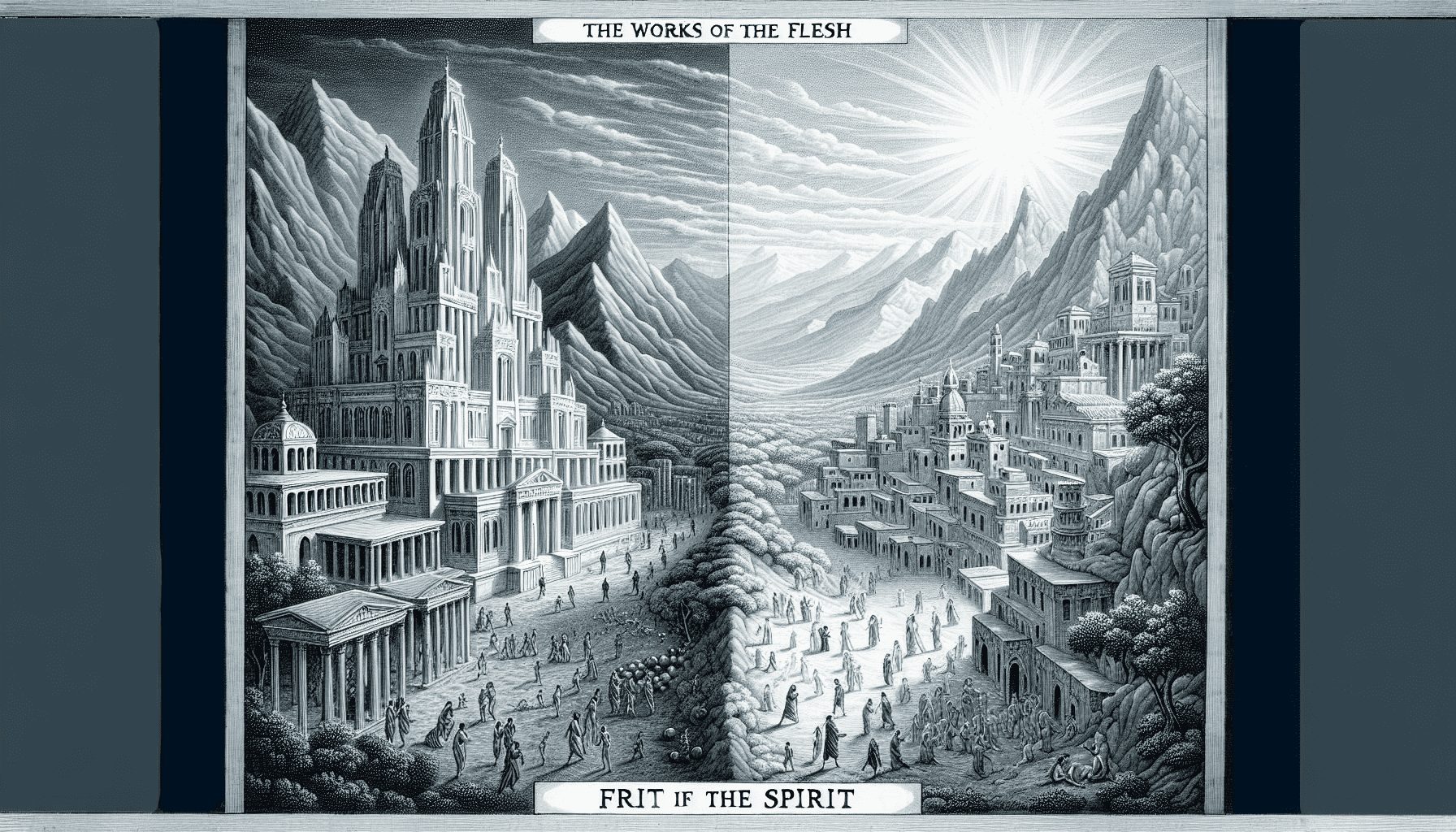
That night, under a sky pricked with cold stars, Marcus found himself alone on the flat roof of his tenement. The words of the letter returned, not as a debate, but as a portrait. *But the fruit of the Spirit is love, joy, peace, patience, kindness, goodness, faithfulness, gentleness, self-control.* He repeated them like a strange, foreign melody. This was not a new list of laws to fail. It was a description. A harvest. You don’t *command* a vine to bear grapes; you tend it, you prune it, you give it sun, and the fruit comes. Or it doesn’t.
He thought of the “works of the flesh” Paul had listed—the enmities, strife, jealousy, fits of anger, rivalries, dissensions, divisions, envy. A cold recognition settled in him. He had seen every single one displayed in their little community in the past month. They were the bitter, thorny yield of a life lived for the self, even a religious self. The rules of Eleutherios, for all their good intent, had not produced love or joy. They had produced factions. They had produced a sharp, sanctimonious pride that was just another form of enmity.
The breakthrough came not in a flash, but like a slow dawn. Freedom wasn’t permission to do anything. That was just another cage, the cage of appetite and impulse. True freedom was the capacity, powered by a Spirit he didn’t fully understand, to choose something else. To choose to walk away from a quarrel. To choose kindness when offense was justified. To choose patience with Eleutherios himself, who was, Marcus now saw, not a villain but a frightened man building a wall he thought would keep God’s favor in.
At the next gathering, when Eleutherios began again on the necessity of the old observances, Marcus didn’t feel the old heat of contradiction. He felt a pang of sadness. “Brother,” he interrupted, softly. The room went still. They expected a fight. “Eleutherios. If we are led by the Spirit, we are not under the law. You keep warning us of lawlessness. But what grows in a lawless life? I have lived it. It is chaos and death.” He paused, gathering the new thoughts. “But what grows in a life chained only to the law? I have seen that now, too. It is… division. And a different kind of death.”
He looked at Tychicus, who gave a slow, almost imperceptible nod. “Paul writes of a third way. Not law, and not license. The way of the Spirit. It is harder, I think. There is no list to check. Only a voice to learn, a fruit to look for. Does this choice lead to love? Does it lead to peace? Or does it lead to a faction, a bitterness, a work of the flesh?”
Eleutherios stared, his arguments derailed not by a superior proof-text, but by a question he couldn’t easily answer. The debate didn’t end that day. But its nature changed. It moved from the courtroom of legal correctness to the murkier, more demanding soil of the heart.
Weeks later, Marcus found himself mending a fishing net with a man he’d previously despised for his laxity. They worked in a comfortable silence for a while. Then the man, without looking up, said, “That day you spoke… I was angry. I thought you were judging me. But then I saw you later, helping old Sarah carry her water. Even though she sides with Eleutherios on everything. There was no… strife in it.”
Marcus pulled a cord tight. He felt no triumph. He felt a fragile, quiet warmth that was entirely new. It wasn’t the certainty of being right. It was the subtler, stronger assurance of being, however clumsily, connected to a different kind of vine. The freedom was terrifying. It was vast. But for the first time, it smelled not of damp stone and lamp oil, but of clean earth, and of fruit slowly ripening in the sun.