The air in the quarry was thick with dust and purpose. It hung in the afternoon light, a golden haze through which the sounds of iron on stone rang out—a sharp, percussive music. David stood on a rough outcrop, his robe stained with pale powder, watching. His hands, once sure on the grip of a sling or the hilt of a sword, now traced the edges of a drafted parchment unrolled over a worktable. The lines were not of battle formations, but of foundations, chambers, and porticos.
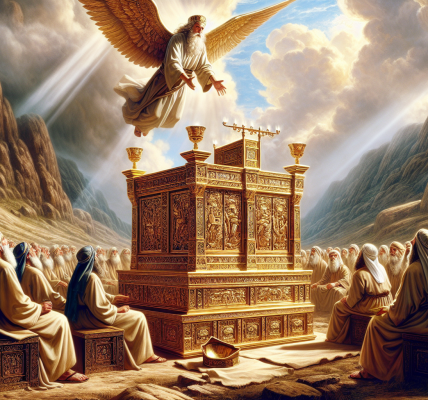
He was an old man, and the silence from the prophet Nathan still echoed in his bones. *You have shed much blood.* The words were not an accusation, but a fact, heavy as the ashlar blocks being shaped below. The warring was done, the kingdom knit together under his hand, yet the house for the Name of the Lord remained unbuilt. A tent. It grieved him that the Ark of the Covenant, the very footstool of the Holy One, dwelt under curtains while he, the king, lived in a palace of cedar.
So he had begun to prepare. Not with the trumpet’s blast, but with the quiet, relentless industry of a man making amends for a lifetime of necessary violence. He had become a quartermaster for God.
“More cedar from Tyre,” he muttered to a scribe, his voice gravelly. “The Sidonians know their work. See that the logs are seasoned, not a hint of green in them.” His mind was a ledger of divine logistics. Countless stones, dressed and waiting. Iron for nails and fittings, more than could be weighed. Bronze beyond measure, gleaming dully in great heaps. And the gold… the refined gold, not for his throne, but for the hooks, the lampstands, the place where the cherubim would spread their wings.
He moved through the stockyards and storehouses, a monarch turned chief steward. His fingers, knotted and strong, tested the grain of a great cedar beam. He remembered the feel of Goliath’s sword hilt. Different weight, same devotion.
One evening, he summoned Solomon, his son, still young but with a quietness in his eyes that David recognized as the soil where wisdom could grow. The council chamber was lit by oil lamps, the plans spread between them like a shared secret.
“My son,” David began, the words coming slowly, forged in private longing. “It was in my heart to build a house of rest for the Ark, a place for the feet of the Lord. But the word of the Lord came to me, saying, ‘You have shed much blood. A son will be born to you who will be a man of peace. His name shall be Solomon, and I will give peace and quiet to Israel in his days. He shall build a house for my name.’”
David leaned forward, the lamplight carving deep shadows into his face. “So now, the Lord be with you. He has given you the kingdom. Your task is not to conquer it, but to establish it in justice and righteousness. Understand this: the building of the House is not merely a king’s project. It is the covenant made visible. It requires a peace I was not granted to give.”
He saw the weight settle on Solomon’s shoulders, not as a burden, but as a mantle. “I have taken pains to prepare,” David continued, his hand sweeping over the inventories. “The strangers in our land, the skilled craftsmen, the materials—they are yours now. There is no counting it. Arise and begin the work. Do not be afraid or dismayed, for the Lord God is with you. He will not fail you nor forsake you until all the work is complete.”
David’s instructions then became practical, fatherly. He spoke of the divisions of priests and Levites, the need for men of skill in wood and stone, the importance of the pure gold for the Most Holy Place. His theology was in the details—the right wood, the proper metal, the consecrated hands. This was not a transfer of power, but a passing of a sacred dream.
In the days that followed, David gathered all the leaders of Israel. Before them, he poured out his withheld ambition, not as a king’s decree, but as a father’s testament. “The house to be built must be exceedingly magnificent, of fame and glory throughout all lands.” His voice filled the hall. “For my son is young and tender, and the work is great. Yet it is not for man, but for the Lord God.” He turned to the assembly, his gaze holding the seasoned commanders, the tribal chiefs. “Now set your heart and soul to seek the Lord. Arise and build.”
He gave Solomon the plans—not just architectural sketches, but the pattern of the spirit of the place, received, he insisted, by divine inspiration. “All this,” David said, his voice dropping to a whisper meant for Solomon alone, yet heard by all in the hushed room, “the Lord made me understand in writing by His hand upon me.”
The story ends not with the sound of construction, but with a charged silence of anticipation. David, his life’s final campaign planned and provisioned, commands his leaders to help his son. And Solomon, sitting in the stillness after the assembly, looks at the plans, feels the gaze of a father who fought a world to make a space for peace, and understands. The temple would be built of stone and cedar, of gold and bronze. But its first foundation was laid in a quarry of a king’s repentance, and in the careful, hopeful hands of a father preparing a gift he would never live to see finished.