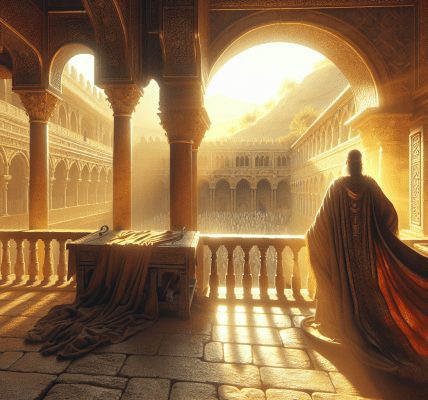

The clay was dry again. The water jar at my elbow stood empty, a faint dusting of desert grit already settling in its belly. I wiped my forehead with the back of a stained hand and stared at the papyrus. The record demanded completion, but the words came like pulling stones from a field. My father, and his father before him, had kept the chronicles. It falls to me now, in this stifling room, to set down the days of kings. Not as the palace heralds would sing them, with boasts of grandeur and victory, but as they were. A slow unraveling.
It began, as these things often do, with a man who did right in the eyes of the Lord. Azariah, son of Amaziah. He reigned in Jerusalem for fifty-two years, they say. A lifetime. I remember him as an old man, his face a map of wrinkles, his posture still rigid with a forgotten discipline. He rebuilt Elath and restored it to Judah, a small port clutching the Red Sea, a whisper of Solomon’s forgotten reach. But the whisper is the thing. The text says he did what was right, yet the high places remained. The people still sacrificed and burned incense on the hilltops, a stubborn habit of the heart. Perhaps Azariah lacked the force to tear them down. Or perhaps, after so long, he simply stopped seeing them.
And the Lord touched him. A leprosy, white as sun-bleached bone, spread over his skin. He lived in a separate house until the day he died, and his son Jotham judged the people of the land. The kingdom was whole, but the king was sequestered, a living ghost in a back chamber. You see the shape of it? The outward form persists, the throne, the rituals, the chronicle’s entry. But at the center, a rot, a quiet isolation.
While Azariah turned to dust in his separate house, the north was a shattering pot.
Up in Samaria, they crowned Zechariah, son of Jeroboam. He lasted six months. The word of the Lord to Jehu—that his sons would sit on the throne to the fourth generation—it was a promise, but also a sentence. A ticking measure. Zechariah was the fourth. He did evil, walking in the ways of his fathers, clinging to the sin of Jeroboam who made Israel to sin. Then Shallum, son of Jabesh, conspired against him. Struck him down before the people. I heard a trader from Shechem describe it once, his voice low over a brazier of coals. Not in battle, not in some darkened courtyard. In Ibleam. A public, vulgar end. The blood soaked into the dust of the road. And with Zechariah, the line of Jehu was extinguished, like a lamp whose last, sputtering flare is snuffed by a passing wind.
Shallum reigned a single month in Samaria. One cycle of the moon. He had time, perhaps, to have a new seal made, to sample the better wines from the royal storehouse. Then Menahem, son of Gadi, came up from Tirzah. He arrived with the sound of clashing metal and the desperation of a man who knows his own claim is just as thin. He took Samaria, struck down Shallum, and secured his throne the way men like him always do: with terror. The city of Tappuah, because it did not open to him, he ripped open. He ripped open the women with child. The chronicle states it plainly. I write the words, and the ink is black, but the memory is a dark, uncongealed red. This was a king of Israel.
To pay the Assyrian, that great wolf Pul, a thousand talents of silver, Menahem exacted the money from every wealthy man in the land. Fifty shekels each. He bought a breathing space, a subsidy for his reign, by making his own people a farm to be harvested. He reigned ten years, doing evil, and then slept with his fathers.
His son Pekahiah followed, for two years. Evil, like the rest. And his own captain, Pekah, son of Remaliah, conspired. He took fifty Gileadites with him—rough men from the east of the Jordan—and murdered the king in his citadel, with Argob and Arieh beside him. The chronicle notes the two officers. Just names. Did they die shielding their lord? Or were they cut down as they reached for their own swords? We are not told. The record only marks their presence, then their end. Pekah took the throne.
And all this time, in Jerusalem, Jotham had come into his own after his father’s sequestered death. He built the Upper Gate of the house of the Lord. A substantial work. High, fortified stone. He did what was right, it is written. Yet, the high places remained. He did not remove them. The people still sacrificed. There is a pattern here, a spiritual lethargy. A good king builds a gate, but he does not tear down the illicit altar just over the hill. The structure stands; the heart strays.
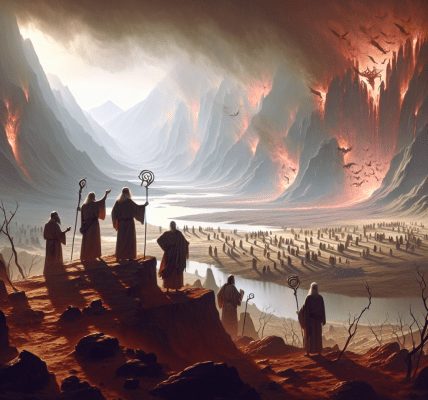
In the north, under Pekah, the final cracks became chasms. The Lord began to send against Israel the fury of Tiglath-Pileser, king of Assyria. Not just a raider seeking tribute now, but a force of nature. He came and took Ijon, Abel-beth-maacah, Janoah, Kedesh, Hazor. He took Gilead and Galilee, all the land of Naphtali. The geography of loss. I have a map etched on a shard of pottery. I trace the names with a finger. They are not just towns; they are the inheritance of tribes, the allotments made when Joshua cast lots under a sun that seemed brighter. Now they were administrative districts of a foreign power. He carried the people captive to Assyria. Not just soldiers. Farmers, potters, children. A whole world packed up and marched east toward the rivers of Babylon.
It was the beginning of the end. The bleeding out.
And Pekah? Pekah reigned twenty years of this decline, doing evil. Then Hoshea, son of Elah, conspired. Struck him down. Took his throne. The chronicle moves on. Another name. Another brief, bloody tenure awaiting its notation.
Jotham slept with his fathers, was buried in the city of David. His son Ahaz reigned in his place.
I sit back. The light is failing. The entries are made. Azariah, Jotham in Judah. Zechariah, Shallum, Menahem, Pekahiah, Pekah, Hoshea in Israel. A ledger of reigns, a inventory of coups and bloodshed and purchased time.
But the story is not in the list. It is in the silences between my lines. It is in the high places that were never removed, in the sigh of a good man who built gates but lacked the will for reformation. It is in the echo of a promise fulfilled to its grim letter as a dynasty ends in the dust of Ibleam. It is in the methodical, godless brutality of a Menahem, which becomes the political norm. It is in the relentless, grinding advance of Assyria, the tool in the hand of Providence, harvesting the fruit of generations of idolatry.
The chronicle is a skeleton. The breath, the stench, the taste of fear, the sound of a city gate closing for the last time—that is the history. And it hangs in this twilight room, heavier than the scroll before me. I will seal the jar. Tomorrow, God willing, I will begin the record of King Ahaz. But for now, the dry clay and the empty water jar are enough. The story is, for this moment, complete. And it is a lament.