
The dream of the Temple was a weight Solomon carried in silence. It was not his own dream, not at first. It was his father’s—the fierce, flawed, God-touched David who had yearned to build a house for the Name and had been told, gently but irrevocably, *No*. That *no* had settled on Solomon’s shoulders with the crown. The peace his father won with the sword, he, Solomon, was to consecrate with cedar and gold.
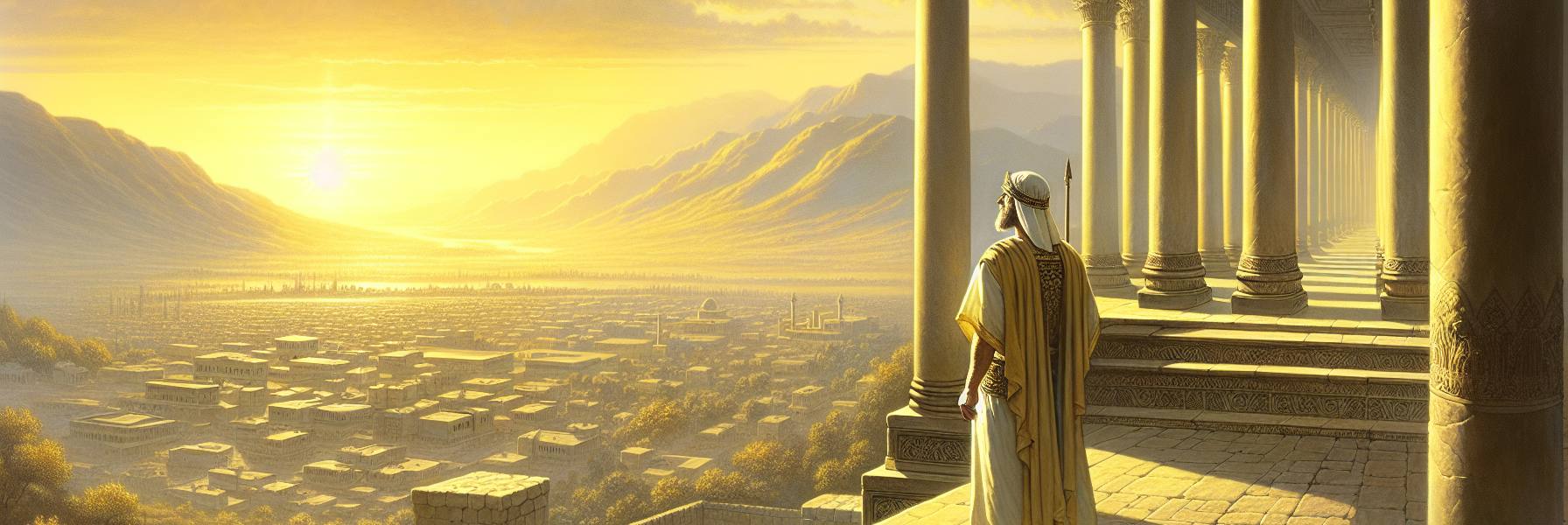
He walked the terraces of his palace in Jerusalem, the morning sun warming the pale stone. Below, the city stirred, a hive of ordinary life. But his eyes were fixed on the threshing floor of Araunah the Jebusite, that bare, elevated plot north of the city where the angel’s sword had been sheathed. There was nothing there now but wind and dust and memory. But in his mind, Solomon saw foundations cut from living rock, walls rising, an interior breathless with shadow and the scent of incense.
The plans were in his head, in the scrolls of his architects, in the murmured prayers of the priests. But the materials… they were in distant lands. The thought brought him not anxiety, but a quiet, deliberate focus. This was to be a work of peace. His father’s hands, stained with the blood of war, were not permitted to hold the measuring line. His own reign, blessed with *shalom*, was.
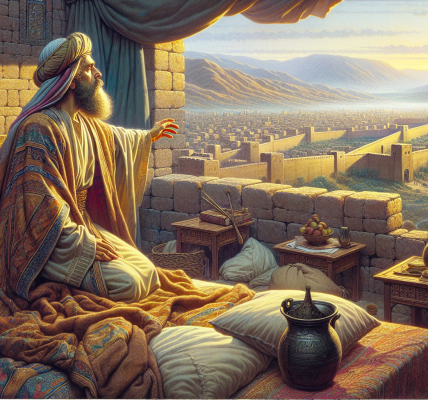
He called for his scribe. The man came, reed pens and a fresh papyrus scroll tucked under his arm. “We will write to Hiram of Tyre,” Solomon said, his voice measured. “Word for word as I speak.”
The letter began not with a king’s demand, but with a son’s testimony. *You knew David my father*, it said, acknowledging the old bond between the warlord of Judah and the shrewd Phoenician king. It spoke of the divine prohibition, a thing Solomon still turned over in his heart like a smooth stone. *Yahweh, for the sake of His Name, would not permit him.* Then, the declaration of the new reality: *But now, Yahweh my God has given me rest on every side. There is neither adversary nor misfortune.* The Temple was not a monument to ambition, but the fruit of granted peace.
He came to the request. It was specific, almost tender in its detail. *Command that they cut for me cedars from Lebanon. My servants will join your servants. I will pay you whatever wages you set for your servants.* It was a partnership, a contract between equals under God’s silent providence. He ended with a quiet confession of purpose that was also a boast of divine favor: *For you know there is no one among us who knows how to cut timber like the Sidonians.*
The scroll was sealed and sent north with a royal escort. Weeks passed. Solomon oversaw the kingdom, judged disputes, offered sacrifices at the high places, all with a part of his mind listening for the sound of returning hooves from the coast.
Hiram’s reply, when it came, was a gust of sea air and pragmatic reverence. The scribe read it aloud in the council chamber. *Blessed be Yahweh this day,* it began, and Solomon felt a knot loosen in his chest. The Phoenician king, worshipper of Baal and the gods of the sea, acknowledged the God of Israel in the language of Solomon’s own court. It was diplomacy, yes, but it felt like a nod of cosmic permission. *He has given David a wise son over this great people.*
The terms were set. Hiram would do all Solomon desired concerning the cedar and cypress. His famed lumbermen would fell the mighty trees on the fog-shrouded slopes of Lebanon. They would float them down the coast in great rafts to Joppa, the port where the Judean foothills kissed the sea. From there, Solomon’s men would haul them up the brutal ascent to Jerusalem. In return, Solomon would provide vast quantities of wheat and beaten olive oil, the fat of the land, for Hiram’s household. It was a covenant of grain for timber, of the pasture for the forest.
The machinery of a kingdom began to turn. Solomon raised a levy of laborers from all Israel—thirty thousand men. He did not take them as slaves, but in rotations: ten thousand would go north for a month to the logging camps in Lebanon, working alongside Hiram’s Sidonians, learning the secrets of the axe and adze. Then they would return home for two months. The cycle was meant to be a burden shared, not a life consumed.
But the work in the hills of Judah was even more immense. He assigned seventy thousand men as burden-bearers and eighty thousand as quarrymen in the hill country. They were not soldiers, but farmers and shepherds called to a new duty. The air around Jerusalem and far to the south, near the stone beds of Bethel, began to ring with a new music: the precise *tap-tap* of metal points finding the grain in limestone, the groan of levers, the shouted commands as blocks of stone, some as large as a farmer’s cottage, were slowly coaxed from the earth.
Solomon traveled once to the quarry at Zarethan, near the Jordan. The scale was beyond human. Men looked like ants against the nascent cliffs they were creating. Dust coated everything—skin, hair, the sparse midday meal of bread and onions. A foreman, an old man with shoulders like a bull, showed him a cornerstone. It had been dressed at the quarry, its edges true, its face smooth. “We do the work here, my lord,” the man said, his voice raspy with stone-dust. “So that at the holy site, there will be no sound of hammer or chisel or iron tool. Only the sound of setting, of fitting together.”
The king placed his hand on the sun-warmed stone. It was cool underneath. This was the hidden work, the unseen preparation. The silence of the building site would be a testimony to the precision of the labor here, in the sun and dust. It was a parable, he realized. The peace of the finished Temple was being bought with the strain of countless unseen, faithful acts.
Back in Jerusalem, the reports flowed in. The first rafts had made landfall at Joppa. The cedars, wet and aromatic, were a shock to the senses—trees that had breathed mountain air for centuries now lying on the hot sand. Teams of oxen, hundreds of them, were yoked. The roads up to the highlands needed widening, their curves eased. The groaning of the carts under their colossal loads became a familiar sound on the pilgrim paths.
And through it all, Solomon and Hiram, two kings separated by culture and creed, maintained their bond. The wheat of Judah filled the storehouses of Tyre. The oil, golden and fragrant, sailed north in countless jars. In Tyre, they likely spoke of a shrewd trade. In Jerusalem, Solomon saw the hand of the God of peace, who had given him rest, and who now allowed the very bones of the earth and the flesh of the forest to be gathered for His dwelling.
The threshing floor was no longer empty. It was a hive of quieter activity, of surveyors with measuring lines, of priests consecrating the ground with prayers and offerings. The great stones from the quarry began to arrive, settling into their waiting beds with a deep, final sigh. The cedars were stacked in towering, fragrant ricks, seasoning in the sun.
The building had not yet begun. But the house was already being built—in the alliance of kings, in the calloused hands of the quarrier, in the patience of the farmer turned lumberjack, in the wisdom of a son fulfilling a father’s restrained desire. It was being built in the *shalom* that was not merely the absence of war, but the presence of a shared, sacred purpose, moving like a deep, sure current beneath the everyday life of the kingdom. The dream was no longer a weight. It was a foundation, already laid, and waiting for the walls to rise.