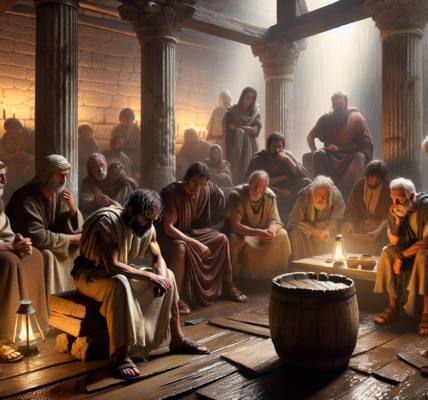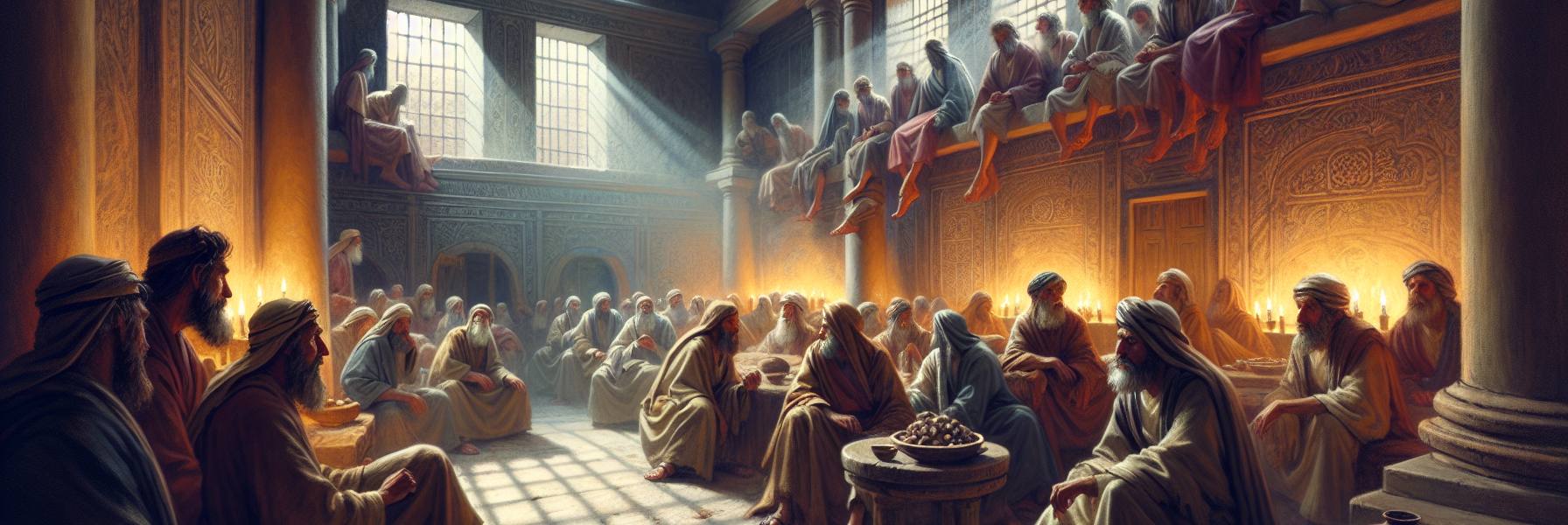

The room held the close, warm smell of roasted lamb, bitter herbs, and the dust of the city still clinging to sandaled feet. It was a borrowed space, large enough for them all, with uneven plaster walls and the low hum of distant Jerusalem barely penetrating its shuttered windows. The light from oil lamps swam in the hazy air, casting long, wavering shadows that made the faces of the men look ancient, even the young ones.
Jesus sat among them, quiet. A deep weariness lined his eyes, a weariness that had nothing to do with miles walked. He watched them. They were arguing again, not with shouts, but with that low, tense grumbling that had become more frequent. It was about the kingdom, of course. Always about the kingdom. Who would sit where. Who was greatest. The old dream, stubborn as a root, pushing up through the soil of every conversation even now, on this night of all nights.
He felt the basin before he saw it, cool ceramic against his knee. The servant’s towel, rough linen, lay folded beside it. The water jug was heavy, cool. No one had performed the duty. The householder had provided the space, but no servant had been left for the task. It was the first, basic act of hospitality in a dry and dirty land—the washing of feet. And it lay there, undone, a silent testament to the dispute hanging in the air. To do it would be to acknowledge a lower status. Not one of them would move.
So He moved.
He stood, not with a teacher’s authority, but with a quiet deliberation that slowly drew their eyes. He said nothing. He removed his outer garment, folding it and laying it aside on a low bench. The lamplight caught the simple weave of his tunic. He took the towel and tied it around his waist, the knot pulled tight. The image was so utterly ordinary, so domestic, that for a moment the disciples just stared, their argument dying in their throats. This was the posture of a slave.
Then he took the basin, and the jug, and he went to the first man.
It was Andrew, I think. Andrew, who always seemed to be slightly in the shadow of his louder brother. Jesus poured the water, the sound of it splashing into the basin shockingly loud in the quiet room. He knelt, taking Andrew’s dust-caked foot in his hands. Andrew flinched, a small, sharp intake of breath. He tried to pull away, but Jesus held him, not forcefully, but with a firm gentleness that was impossible to resist. With the towel, he began to wash. He worked the cloth over the calloused heel, between the toes, cleaning away the grime of the road, the dung of the city, the sweat. He did it carefully, thoroughly. Andrew looked down at the bowed head of his teacher, his face a mask of confusion and shame.
He moved to the next, and the next. James and John, the “Sons of Thunder,” sat stiffly, their earlier ambitions now tasting like ash. He washed their feet. He washed Philip’s, Bartholomew’s, Matthew’s. The only sounds were the slosh of water, the soft scrape of cloth on skin, the occasional crackle from the lamps.
Then he came to Peter.
Peter had been watching the whole thing with a growing, volcanic discomfort. His brows were knitted, his jaw set. As Jesus knelt before him, Peter could bear it no longer.
“Lord,” he said, the word bursting out. “Are you going to wash *my* feet?”
Jesus looked up, his hands resting on the basin’s edge. His eyes were endless in the dim light. “You do not understand now what I am doing,” he said, his voice low and calm, carrying through the still room. “But later you will understand.”
Peter shook his head, vehement. “No. No, you shall never wash my feet.”
The stillness shattered. Jesus’s reply was quiet, but it carried a finality that felt like stone. “Unless I wash you, you have no share with me.”
The words hung there. *No share with me.* It was the ultimate exclusion, the very thing Peter feared most. His bravado collapsed. All the fight went out of him, leaving only a raw, desperate need.
“Then, Lord,” he stammered, his voice thick, “not just my feet, but my hands and my head as well.”
A faint, sad smile touched Jesus’s lips. He began to pour the water over Peter’s feet. “A person who has had a bath needs only to wash his feet; his whole body is clean. And you are clean—” his hands worked the towel, “—though not every one of you.” The words were soft, but they fell into the silence with a terrible clarity. He knew. He knew about the betrayal already taking root in the heart of one of them. The disciples glanced at one another, uneasy, but no one spoke.
When he had finished, he set the basin aside, the water now cloudy with the filth of the road. He put his garment back on and returned to his place. He looked at them, and his gaze seemed to wash over them anew, cleaner now than any water could make them.
“Do you understand what I have done for you?” he asked. No one answered. “You call me ‘Teacher’ and ‘Lord,’ and rightly so, for that is what I am. Now that I, your Lord and Teacher, have washed your feet, you also should wash one another’s feet. I have set you an example, that you should do as I have done for you.”
He paused, letting the image sink in—the basin, the towel, his knees on the floor. “No servant is greater than his master, nor is a messenger greater than the one who sent him. Now that you know these things, you will be blessed if you do them.”
The air in the room had changed. The weight of their petty argument was gone, replaced by a different, heavier weight—the weight of a love so profound it bent to the lowest task. The smell of the meal was still there, the lamplight still danced, but nothing was the same. The path to glory, they now saw with a dawning, painful clarity, did not climb a throne. It knelt on a dusty floor. And in that quiet, after the water was poured out, there was only the sound of their own breathing, and the unimaginable future waiting just beyond the door.