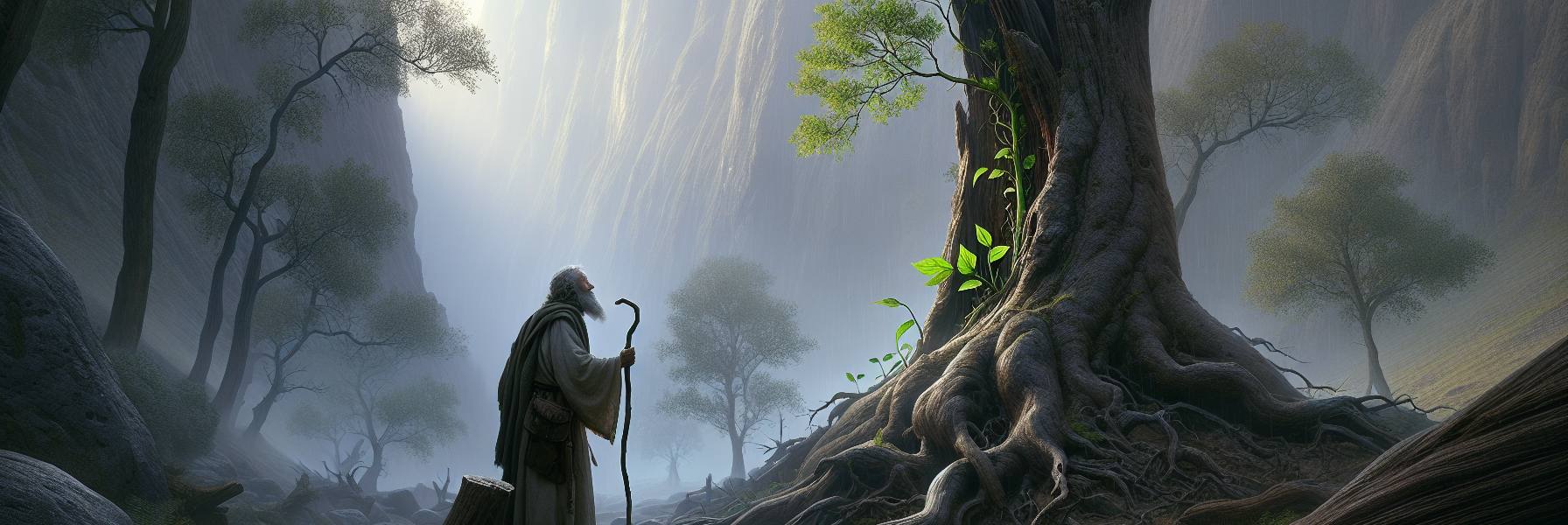

The rain had finally stopped, but the damp clung to everything in the little valley of Ephrathah. It seeped into the cloak of old Micah as he rested against the gnarled trunk of what had once been a great oak. Now it was just a stump, blackened by a lightning strike years before, its heartwood rotted out. From its base, however, a single, slender shoot had fought its way upward, its leaves a startling, defiant green against the gray morning.
Micah’s bones ached with the moisture. He’d come to this forgotten patch of land, this field of his ancestors, to remember—or perhaps to forget. The world felt like that stump: charred, cut down, bereft of majesty. The house of David, once a towering cedar, was now a whispered memory, a lineage clinging on in obscure villages like this one. Kings in Jerusalem? They were puppets now, their robes trimmed with the arrogance of empires. The Spirit of the Lord seemed a distant rumor.
His eyes traced the lines of the young shoot emerging from the dead wood. A thought, unbidden and worn smooth from decades of turning over in his mind, surfaced. *A shoot from the stump of Jesse…* The words of the prophet Isaiah, passed down from his grandfather. They felt less like a promise and more like a taunt here in the chill air.
A rustle in the brambles broke his reverie. A fox, lean and red, emerged, nose twitching. It paused, looking not at Micah but at a depression in the earth where rainwater had pooled. From the thicket on the other side came a rustle of a different kind. A young goat, strayed from some unseen flock, stepped delicately into the clearing. Micah held his breath. This was the way of the world: the chase, the pounce, the sharp cry silenced.
But the fox didn’t spring. It lowered its head and drank from the pool. The kid, after a moment’s tense observation, did the same, a few paces away. Their reflections wavered together in the muddy water. For a long minute, there was only the sound of lapping. Then the fox lifted its head, water dripping from its whiskers, and trotted away without a backward glance. The kid bleated once, softly, and wandered back into the undergrowth.
Micah stared at the spot, his heart beating strangely fast. It was nothing. A coincidence of thirst. Yet the image stuck, superimposing itself on the dead stump and its living branch. *The wolf shall dwell with the lamb…* Was it a picture, a mere metaphor for peace among men? Or was it something more concrete, a literal recalibration of creation itself? He had always assumed the former. Now, watching the place where predator and prey had shared a drink, he wondered.
The rest of the day passed in a haze of strange clarity. On his walk back to the village, he saw things as if for the first time. He saw young Enoch, a boy known for his slow, thoughtful speech, patiently explaining the setting of a snare to his impatient, quick-tempered brother. The words weren’t many, but they were right, cutting to the heart of the matter. *The Spirit of wisdom and understanding…* It wasn’t just about knowing things. It was a seeing into the heart of things.
He passed the rude dwelling of Leah, a woman from the coastal plains who had married a local man. Her accent was still thick, her ways different. Some muttered about her. But Micah saw her now, not as a foreigner, but as a woman hanging washing next to old Sarah, who had never left Bethlehem. They were laughing, a shared laugh over a dropped garment. *He shall not judge by what his eyes see… but with righteousness he shall judge the poor.* Righteousness wasn’t merely fairness; it was a vision that pierced through custom and prejudice to the person beneath.
That night, by his own meager fire, the pieces began to settle, not as a systematic theology, but as a slow-dawning light. This branch from Jesse’s stump wouldn’t be a king like the others, a stronger strongman. His power would be of a different order entirely. The Spirit resting upon him—the spirit of wisdom, understanding, counsel, might, knowledge, and the fear of the Lord—wouldn’t be for conquest, but for discernment. His rule would be so profoundly just it would feel like a deep, exhaled breath for the whole weary world. The meek would receive a verdict that felt like deliverance. The ruthless would be addressed with a word that fell like a stonemason’s hammer, precise and final.
And the peace… the peace would not be the brittle silence of truce or the heavy peace of oppression. It would be woven into the very fabric of life. It would be like that fox and kid, not acting against nature, but revealing a deeper, older nature buried under the groan of creation. The nursing child playing over the cobra’s hole—it wasn’t about the removal of danger, but the removal of the very *knowledge* of danger. A restoration so complete that trust was the default state of being.
Micah stepped outside his door. The moon was high, washing the rocky hills in silver. He looked toward the field where the stump stood. He couldn’t see it from here, but he knew it was there. And he knew the green shoot was there, gathering strength from the roots that no one could see. The world was still broken. He still ached. But the promise was no longer a taunt. It was a root in dry ground, waiting for its season. It was a breath held, ready to be released. He went back inside, and for the first time in a long time, his sleep was not haunted by the shadows of empires, but cradled by the faint, impossible scent of a rose growing from a dead stump, and the sound of a lion, somewhere in the future, chewing straw like an ox.