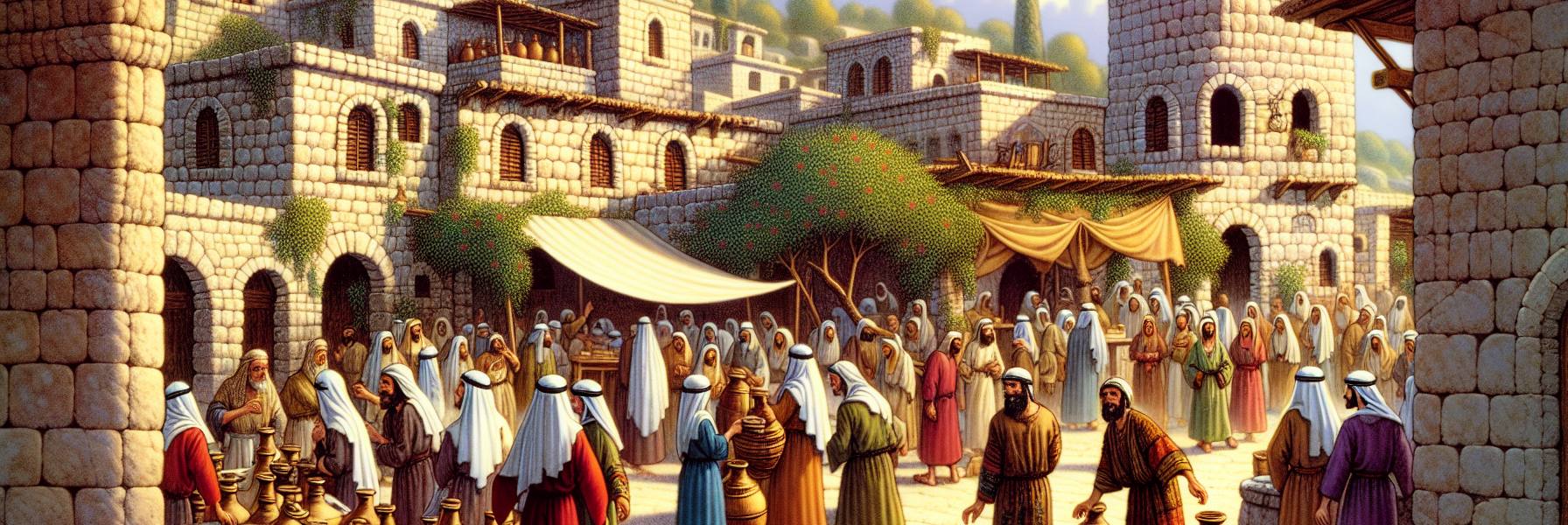

The third day found them in Cana, a clutter of sun-bleached stone houses clinging to a Galilean hillside. The air itself was thick with the scent of baking bread and crushed thyme, and from a particular courtyard echoed the laughter and the frantic, happy music of a flute. A wedding. It was a feast that had already stretched two days, and the fabric of hospitality, worn thin, was about to tear.
Mary moved through the crowd with a quiet urgency. She had seen the steward, his face ashen, whispering to a servant by the empty storage jars. The wine was gone. Not running low—gone. In a culture where shame could cling to a family for generations, this was a social disaster of the highest order. She found her son near the edge of the courtyard, apart from the merriment. He was watching, as he often did, his eyes holding a depth that seemed to take in more than the scene before them.
“They have no wine,” she said, her voice low.
He looked at her, and in that look was a gentle, unbridgeable distance. “Woman,” he said—a term of respect, yet it held a formal note that checked her— “what does this have to do with me? My hour has not yet come.”
Mary did not argue. She simply turned to the servants hovering anxiously nearby and said, with a calm that brooked no question, “Do whatever he tells you.”
Six stone water jars stood against the wall, meant for the Jewish rites of purification. They were massive, hollowed from limestone, each holding twenty or thirty gallons. The dust of the road and the sweat of the feast clung to every guest; these jars were for washing, for making clean, for ceremony.
“Fill the jars with water,” Jesus said.
The servants blinked. It made no sense. The crisis was wine, not water. And to use the purification jars for a banquet remedy? But they remembered the mother’s command. They took up their buckets and began the long, laborious trek to the well and back, sloshing water, heaving it into the great jars until the liquid sloshed against the brim. The work was sweaty, mundane, a brute physical task under the hot sun.
“Now,” Jesus said, when the task was done, “draw some out and take it to the master of the feast.”
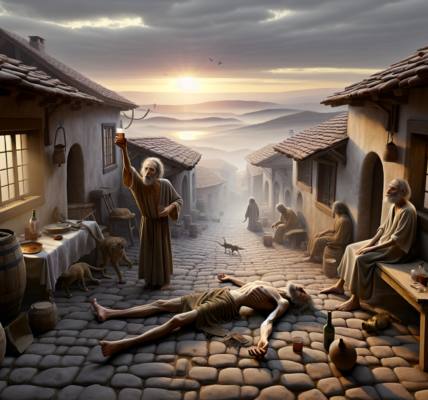
A servant dipped a pitcher into the jar. In the shadow of the stone, the water was dark. But as he lifted it, the sun caught it. It was not clear. It was a deep, ruby red. He smelled it. The aroma was not of dust and well-water, but of fruit and earth and life—the smell of a rich, dark wine that had no business being in a purification jar. His hands trembled as he carried the pitcher to the steward.
The steward, harassed and expecting the worst, took the cup without looking. He sipped. Then he stopped. He sipped again, his eyes widening. He turned not to the servants, but to the bewildered bridegroom, who had been steeling himself for public humiliation.
“Everyone serves the good wine first,” the steward boomed, his voice cutting through the chatter. “And when the guests have well drunk, then the inferior. But you have kept the good wine until now!”
The celebration, which had begun to falter, surged with renewed vigor. Laughter grew louder, the flute player found a second wind, feet stomped the dusty ground in rhythm. Only the servants knew. They stood by the stone jars, staring at the impossible abundance. Over a hundred gallons of the finest wine. From water. In vessels of the law. They looked at one another, a silent understanding passing between them. They had drawn the water; they had tasted the wine. The miracle was not in the spectacle, but in the quiet, overwhelming fullness that came from an obedient dipping of a pitcher into the ordinary.
***
Weeks later, the chill of early spring still clung to the stones of Jerusalem. The Passover feast drew crowds like a river to the sea, and the Temple courts were a chaos of piety and commerce. The lowing of cattle, the bleating of sheep, the sharp clatter of coins being counted and recounted—it created a din that drowned out prayer. The air was thick with the smell of dung, sweat, and cheap incense. Pilgrims from Alexandria and Babylon, their hearts full of longing for Zion, found their path blocked by money-changers whose tables littered the Court of the Gentiles, the one place set apart for the nations to seek God.
Jesus walked in alone. He saw not just disorder, but a theft. A theft of sacred space, a theft of a father’s house from his children. His earlier quietness in Cana was gone, replaced by a terrifying, focused heat.
He did not shout at first. He went to the stalls selling doves, the offering of the poor. With his own hands, he began untying the cords that held the cages shut. The doves, confused, burst into the air in a flurry of wings. Then he moved to the sheep and oxen, driving them not with violence toward the people, but with a relentless authority toward the gates, his voice a whip-crack of command that cut through the animal noise. He reached the money-changers’ tables. With a strength that seemed both human and more, he overturned them. Wood splintered. Coins of Tyrian silver, Athenian drachmas, Roman denarii skittered and rang across the pavement, rolling into drains and between sandaled feet.
Then, and only then, he spoke, and his voice filled the cavernous court. “Take these things away! Do not make my Father’s house a house of trade!”
His disciples, trailing behind him, remembered the words of the Psalmist: *Zeal for your house will consume me.*
The silence that followed was louder than the chaos. The merchants and priests, recovering from their shock, gathered their wits and their indignation. “What sign do you show us for doing these things?” they demanded, their authority wounded.
Jesus looked at them, the fire in his eyes banked to a smolder. “Destroy this temple,” he said, his gesture taking in the massive Herodian stones, gleaming in the sun, “and in three days I will raise it up.”
A scornful laugh rippled through them. “This temple has been under construction for forty-six years,” a priest scoffed. “And you will raise it in three days?”
But he was not speaking of the mountain of limestone and gold. He spoke of the temple of his body. They did not understand, not then. Later, when the stone was rolled away and the dawn broke on an empty tomb, his disciples would remember. They would remember the water made wine, a sign of overflowing grace, of a new covenant in his blood. And they would remember the cleansed temple, a sign of a fierce, purifying love that would not abide a barrier between humanity and God. The first revealed his glory; the second, his purpose. And his bewildered, believing followers began, haltingly, to trust in the word that held both.