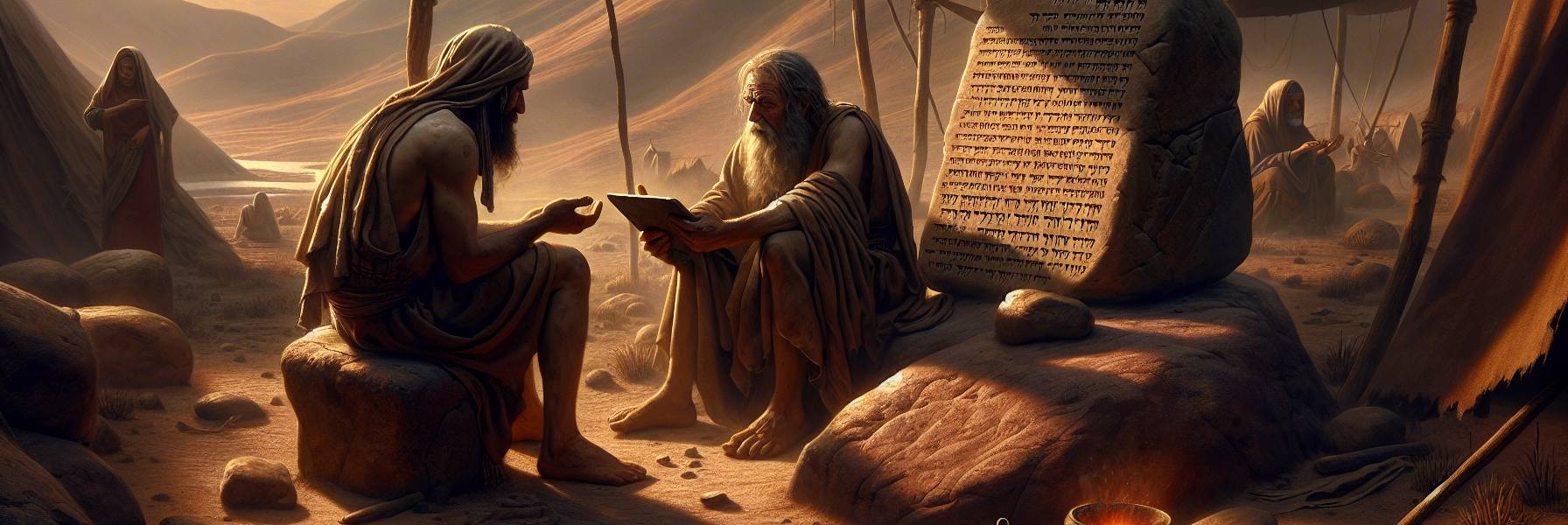

The heat hadn’t lifted. It clung to the valley floor, a heavy wool blanket soaked in the day’s sun, smelling of dust and trampled grass and the lingering scent of thousands of cookfires. I sat on a low rock outside my tent, the tablet heavy on my lap, not reading, just feeling the weight of the words carved into it. The Voice from the mountain still echoed in my bones, a profound silence that was louder than any thunder. And now… this. The judgments. The *mishpatim*.
My son, Reuven, approached, his shadow long in the fading copper light. He’d been among the people all day, listening.
“They are arguing by the well, father,” he said, sinking down beside me. “About the Hebrew servant.”
I nodded, my fingers tracing the first lines. *If you buy a Hebrew servant…* It wasn’t an abstraction. We were all Hebrews. Yesterday’s slave, tomorrow’s free man. The law was for us, about us, in our own rough hands.
“Tell me,” I said.
“It’s Eliazar. The one whose family plot failed two years running. He entered Avishai’s household to clear the debt. His six years are nearly done. But he has a wife now, and two little ones. Avishai provided the woman, a Canaanite maidservant. If Eliazar goes free, they stay. They are not his; they are Avishai’s property.”
The human knot of it tightened in my chest. Freedom that meant leaving your children in bondage. A cruelty woven into the remedy.
“And the other option?” I asked, though I knew.
Reuven’s voice was low. “He says he will not go out free. He loves his wife and his sons. He wants Avishai to take him to the doorpost, to pierce his ear with an awl. He will serve him forever.”
We sat in the gathering dusk. A dog barked somewhere. A baby cried, a sharp, hungry sound quickly soothed. This was the bone and sinew of the law. Not a list, but a life. The awl through the ear wasn’t a mark of shame, I realized slowly, feeling the truth of it settle. It was a public, permanent witness. A man choosing a belonging born of love, over a liberty that meant desolation. His service, forever, became a different kind of covenant. A chosen one.
“And the fights?” I prompted.
“Some say he is a fool. Others say Avishai should just free the woman and the boys. But Avishai says the law is clear. She is his property. To give her away is to violate the rule himself.”
I looked at the tablet. The law was a fence, but life was a wild, sprawling field. The fence kept the chaos from consuming everything, but within its bounds, thorns and flowers grew together.
“Tomorrow,” I said, my voice rough with fatigue and wonder, “we will gather. We will hear them. We will affirm that the wife and children do go with him if he chooses freedom. But we will also make clear the solemnity of the doorpost ritual. It is not to be entered lightly. It is a sign for all to see.”
The next case came with the morning, sharp and bloody. Two men, Shem and Jared, had brawled near the stone pile. It was over a disputed boundary, a line of stones shifted in the night. In the heat of it, Shem had swung a fist, not with a closed hand, but with a stone held tight. Jared fell, his eye a ruined mess, weeping blood and fluid into the dust.
They stood before me now, a circle of elders around us. Shem was pale, trembling, his knuckles crusted. Jared’s face was a grotesque mask of swelling and stained linen.
The law was stark. *Eye for eye, tooth for tooth.* I had heard the people mutter it like a curse, a license for vengeance. But as I looked at them—the one permanently broken, the one sick with guilt—I saw it not as a sword, but as a measure. A limit.
“You have taken his eye,” I said to Shem, my voice carrying in the still air. “Should we take yours?”
A gasp went through the crowd. Shem whimpered, covering his face.
“That is the principle,” I continued. “The value of the thing taken. But the law also speaks of restitution. Of settlement.” I turned to Jared. “His eye is gone. No payment will restore it. But his life is not over. He can still work. He can still lead his household. Would you have Shem’s eye, and gain nothing but another one-eyed man in the camp? Or would you have a restitution that helps you live?”
Jared’s one good eye, fierce with pain, fixed on Shem. “What can he give? He has little.”
“Then he will work. He will give you a portion of his labour, of his flock, for years. He will become your supporter, because you are weakened by his hand. The eye is the measure. The payment is the justice.”
It was not clean. It was not satisfying in the way raw vengeance is. But it was sustainable. It prevented a feud that would echo through our grandchildren. The *lex talionis* was not a brutal command; it was a dam against the flood of disproportionate retaliation. It said: *the punishment must fit the crime, and no more.*
The days unfolded like a scroll, each case inking the laws onto our hearts. The young bull that gored, not once, but twice—the owner’s negligence now a matter of life and death. The open pit left uncovered, a hidden mouth in the earth that swallowed a neighbour’s donkey. The theft of a sheep, not in the field, but from the fold—a violation of a different order, requiring a greater restoration.
I saw it then, the tapestry God was weaving. This was not merely about order. It was about seeding a conscience in us. It was about the sanctity of the body, the responsibility for one’s animals and property, the delicate threads of family and servitude and debt. It was a framework for a society that was to be *different*. Where even a slave had rights. Where violence was checked not by greater violence, but by proportional justice. Where negligence carried a price.
One evening, Reuven found me again. The arguments had subsided. Eliazar had chosen the awl and the doorpost, his family clustered around him, weeping. Shem was now Jared’s helper, a living restitution.
“It feels… unfinished,” Reuven said, frustration in his young voice. “So many specifics. The goring ox, the pregnant woman struck in a brawl… it’s like a patchwork.”
I looked toward the mountain, shrouded in purple shadow. “We were slaves, my son. Our world was chaos under the whip. The Holy One is giving us a world where things have weight, and consequence, and meaning. A world where a man knows what is expected, what is owed, what is sacred. It starts here.” I tapped the tablet. “With the ox, and the pit, and the servant. It starts by learning that every life, every action, every tooth and eye, matters to Him. The weave may seem coarse now. But He is teaching us the pattern. One thread at a time.”
The night wind came, cool and clean, lifting the day’s stifling heat. It carried the smell of the wilderness, of freedom, and the immense, terrifying weight of the Law that was to make us truly free.