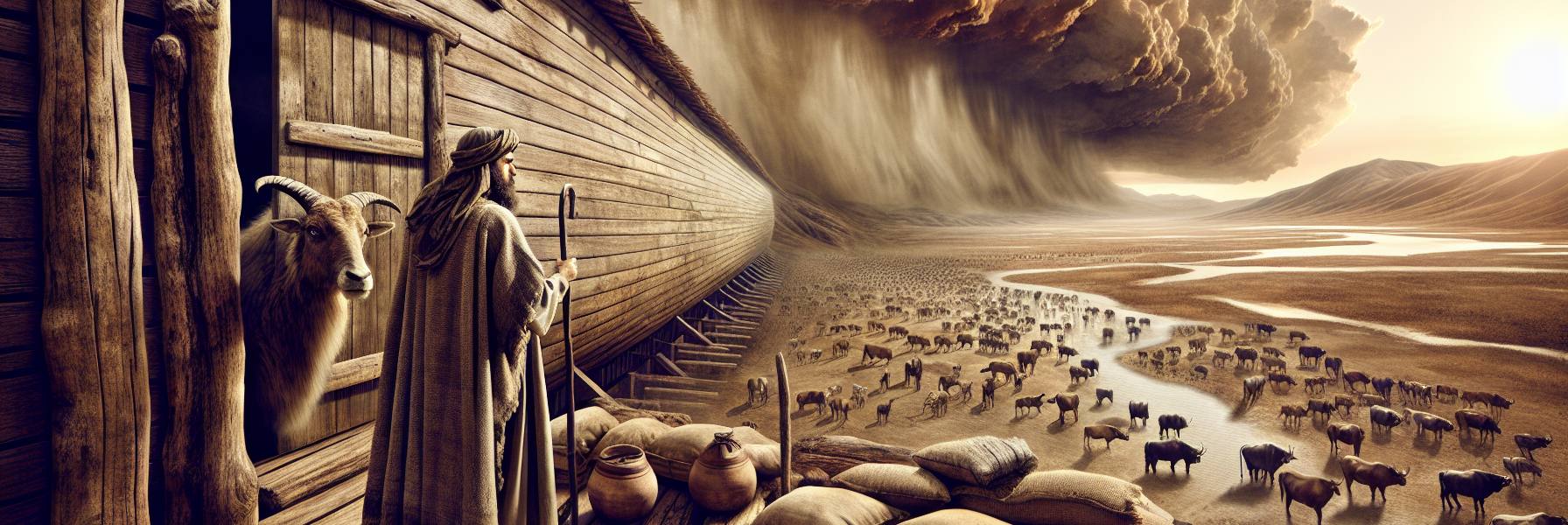

The air changed first.
It wasn’tt a gradual shift. One afternoon, the breeze that usually carried the scent of dry grass and distant livestock turned heavy, tasting of damp stone and deep earth. Noah stood in the doorway of the ark, his hands, calloused and weathered from decades of work, resting on a timber still smelling of fresh pitch. He looked west, where the sky met the barren plains. A wall of cloud, the colour of bruised iron and soot, was mounting on the horizon. It didn’tt drift; it gathered, swelling upwards like a terrible, silent breath.
The Lord had said seven days. The last of the provisions—sacks of grain, clay jars of oil, great wheels of cheese cloth-wrapped and precious—had been hauled up the ramp that morning. The animals were a living, breathing tapestry inside the three decks. The low, patient rumble of the cattle, the skittering of rodents in their designated pens, the occasional shriek of a bird of prey, momentarily indignant at its confinement. The family moved among them, Shem, Ham, and Japheth with their wives, their voices hushed, their tasks performed with a solemn efficiency. There were no more jokes, no debates about the weather. The reality of the thing had settled upon them, a weight as tangible as the timber around them.
On the seventh day, in the fading copper light of late afternoon, the first drops fell. They were fat, warm, and sparse, leaving dark, coin-sized stains on the dust. Then more, a hesitant patter on the vast roof. Then, as if a seal had been torn from the heavens, the torrent came. It was a roar that swallowed all other sound, a ceaseless, vertical river. Noah watched from a small, high opening, seeing the world he knew dissolve into a grey, churning mist. The carefully dug channels around the ark filled in moments, then overflowed. The water wasn’t merely falling; it was rising from below, too. Great fountains, with a sound like grinding rock, burst forth from fissures in the earth, merging with the flood from the sky. It was the undoing of creation, the boundaries between the waters above and the waters below dissolving at God’s command.
For forty days and forty nights it continued. The ark, which had seemed so monstrous and out of place on the dry land, began to move. It was not a sailing ship; it was a vast, wooden pod, lifted. There was no sense of waves, not at first, just a profound, buoyant lifting, a groaning of joints as the immense vessel was cradled by the deep. The world of men and their cities, their fields and their altars to forgotten things, was buried under the relentless, climbing sea.
Inside, the world was lamplight and shadow. The rhythmic creaking of the structure became their constant music. They learned the sounds of the creatures: the contented sigh of the ruminants, the sleep-heavy rustle of birds, the soft huff of the great cats in their secure stalls. The smell was a complex tapestry—hay, dung, wet animal fur, the tang of brine seeping through the caulking, the smell of their own bodies and their simple, cooked meals. It was neither pleasant nor foul; it was the smell of life, preserved.
Noah would make his rounds, his wife often silent at his side. They would check the pitch seals at the seams, their fingers probing for any softness, any telltale trickle. There was none. The Lord had shut them in. That phrase hung in the air, a truth more solid than the oak beams. They were not prisoners, but refugees. The only world that existed was this one, this wooden womb in a universe of water.
After the forty days, the rain ceased. The silence that followed was louder than the storm had been. It was a ringing, absolute quiet, broken only by the lap of water against the hull and the myriad sounds of life within. The endless, monotonous grey outside the window began, imperceptibly, to break. A harsh, white sun appeared, bleaching the colourless sea. Then wind came—a great, groaning wind that swept over the face of the waters, and with it, a slow, ponderous stirring began. The ark was no longer simply adrift; it was journeying.
One hundred and fifty days the waters prevailed. Time was measured in feedings, in cleanings, in the fading of the lamp oil and the opening of a new jar. They prayed. They remembered names of people and places they would never see again, speaking them softly so the memories wouldn’t drown. They tended to their floating world, this microcosm of creation, and waited.
Then, the grinding, shuddering impact. A lurch that sent tools clattering and animals bellowing in alarm. They had found land. The mountains of Ararat, their peaks now stark and new, had risen from the retreating deep to cradle the ark. The violent pitching of the seas gave way to a firm, stubborn tilt. The great vessel was grounded, held fast. It was not deliverance, not yet. It was the first, sure sign of it.
Noah waited. He sent out a raven, that dark, solitary spirit. It flew back and forth, to and fro, finding no rest for the sole of its foot. Then a dove. It returned, its wings frantic, finding nowhere to perch. He waited seven more days, a man schooled in divine patience. The second time, the dove returned at evening, and in its beak was a freshly plucked olive leaf. The world was greening again. The third time, the dove did not return.
Noah removed the covering of the ark and looked. The earth was wet, glistening under a sun that now held warmth. Mud flats stretched to new hills, steaming gently. The fierce, chaotic waters were gone, replaced by quiet pools and glistening streams, all flowing downward, finding their courses. It was a land fresh from the hand of its Maker, washed clean, silent, and waiting.
They did not disembark that day, nor the next. God had brought them to the mountain, and they would wait for His word. Inside the ark, the animals stirred with a new restlessness, smelling earth and green growth on the air that now flowed sweet and clean through the opened hatch. Noah stood there, breathing it in, his eyes scanning the vast, empty, and terribly beautiful new world. The judgement was complete. The preservation was sure. The long, damp, echoing voyage through the wrath of God was over. The covenant was still to come, but here, on this quiet mountain, still surrounded by the sounds of the life he had shepherded through the deep, the first chapter of it was written in the soft, receptive mud of a redeemed earth.