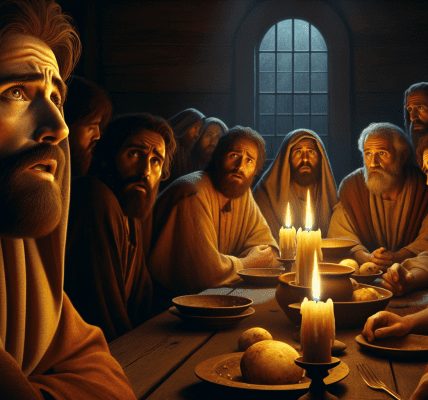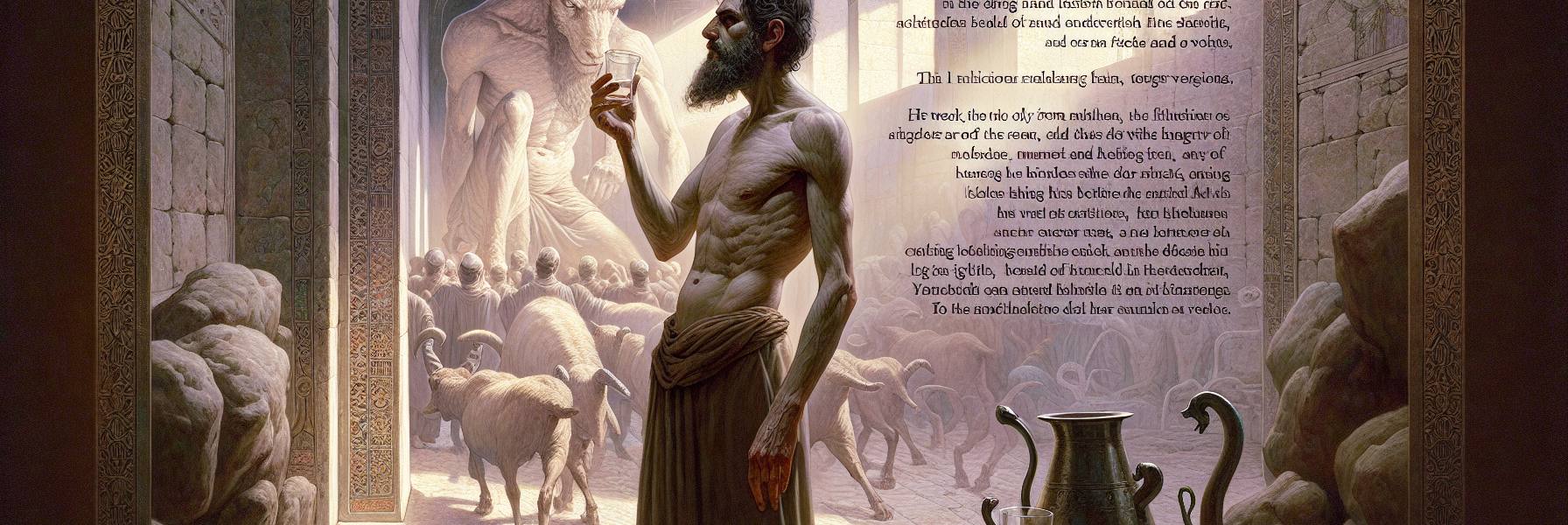

The air in the room was still and carried the faint, dry scent of old scrolls and dust. It was the third year of Cyrus, king of Persia, but in Daniel’s chambers, time felt both heavy and irrelevant. For three full weeks he had tasted no rich food, no meat, no wine. His mouth held only the memory of plain bread and the flat, metallic tang of water. Anointing oil was a forgotten luxury; his skin felt taut and dry.
This wasn’t the disciplined abstinence of ritual. This was a mourning that seeped into the bones. A heaviness had settled upon him—a weight concerning his people, a dread about the future that the earlier visions had only partially illuminated. He had understood some things: the great statue, the beasts from the chaotic sea, the ram and the goat. But understanding, he was learning, did not always bring peace. Sometimes it carved the contours of coming storms with terrifying clarity.
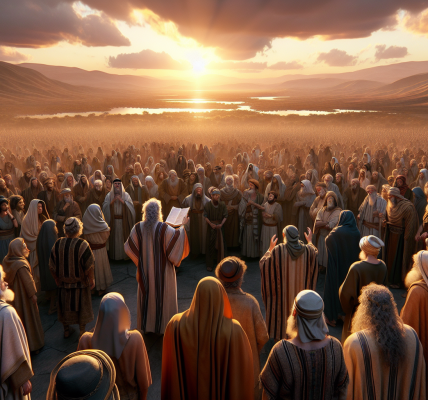
On the twenty-fourth day of that first month, he found himself by the great river, the Tigris. It was not the gentle, willow-lined stream of pastoral poems. Here, it was a broad, muscular force of brown water, sliding past with a low, relentless murmur. He stood on its bank with a few companions, though he felt utterly alone. The sky was a sheet of hammered bronze, cloudless and oppressive.
He lifted his eyes, and the world dissolved.
It wasn’t like the other visions. There was no gradual fading, no dreamlike shift. The river, the sky, the very ground beneath him simply ceased to be the primary reality. He saw a man. But the word “man” was a desperate, failing container for what stood before him.
He was clothed in linen, a garment of purest, breathless white, not woven by any loom of earth. A belt of the finest gold from Uphaz encircled his waist. His body had the terrible clarity of polished chrysolite, his face held the blinding, heart-stopping force of lightning. His eyes were not eyes as Daniel knew them, but like flaming torches, seeing through flesh and stone and time. His arms and legs burned with the gleam of polished bronze, and when he spoke—though he did not speak yet—Daniel knew the sound would be like the voice of a multitude, the roar of waters held in a single throat.
Daniel saw him, and all strength left his body. It was not a swoon, but a complete annihilation of will. The vision before him was a truth so absolute it cancelled all lesser truths, including the one that his legs could hold him up. He fell, not in worship, but in a heap, his face driven into the rough grass and dirt by the sheer, annihilating weight of glory.
A deep, uncomprehending sleep pressed him down. It was the sleep of a creature overwhelmed by a light it was not made to bear.
Then, a touch. A hand, firm and real, settled on his shoulder. It was a human touch, yet it carried a current of that otherworldly reality. It shook him, gently at first, then with more insistence. “Daniel,” a voice said. Not the multitude-voice, but a voice of profound and focused authority. “Daniel, greatly beloved, pay attention to the words I am about to speak to you. Stand up, for I have now been sent to you.”
The words “greatly beloved” pierced the fog of his terror. They were an anchor. Trembling violently, every muscle protesting, he pushed himself up onto his hands and knees, then, with immense effort, to his feet. He stood, but his knees knocked together like loose reeds in a wind. He could not raise his eyes above the feet that gleamed like burnished bronze.
“Do not be afraid, Daniel,” the being said, and the voice held a warmth that could not be fabricated. “From the first day that you set your mind to gain understanding and to humble yourself before your God, your words were heard. And I have come because of your words.”
Daniel tried to form a sentence. His mouth was parched, his tongue thick. A sound escaped, a ragged inhalation. He was mute. The splendor before him had stolen even his capacity for speech.
The being—the man, as Daniel’s mind stubbornly categorized him—reached out again. This time, his touch was to Daniel’s lips. It was not a physical sensation of skin, but a cool, clarifying energy, like a draft of clear water in a desert. “See, I have touched your lips,” he said. “Now you can speak.”
Daniel’s voice, when it came, was a hoarse whisper, scraped from the bottom of his soul. “My lord, because of this vision, anguish has come upon me, and I have retained no strength. How can I, your servant, talk with you, my lord? For now, no strength remains in me; no breath is left in my body.”
A look that might have been compassion, or perhaps the recognition of a shared struggle in a different dimension, passed over the glorious face. The being touched him again, a hand resting on his chest, over his heart. “Do not fear, you who are greatly beloved. Peace be with you. Be strong, be strong.”
As the being spoke these words, a subtle strength began to seep back into Daniel’s limbs. It was not his own vigor returning, but a borrowed fortitude, infused from the outside. He drew a deeper breath. “Speak, my lord,” he managed, “since you have given me strength.”
Then the being began to explain, and his words painted a cosmos far more crowded and violently contested than Daniel had ever imagined. “Do you know why I have come to you?” he asked, not waiting for an answer. “I must return to fight against the prince of the kingdom of Persia. And when I go, the prince of Greece will come. But first, I will tell you what is written in the Book of Truth.”
He spoke of kings and conflicts, of things to come. But the words that burned themselves into Daniel’s soul were about the unseen war. “There is no one who contends with me against these princes,” the being said, “except Michael, your prince. And I left him there, with the kings of Persia.”
Daniel understood, then. His three weeks of mourning, his fasting, his desperate prayers—they had not been echoing in an empty heaven. They had been the opening salvo in a battle fought in the invisible places. The answer had been dispatched from the moment he began, but it had been resisted, contested, held back by malevolent powers that ruled the spiritual atmosphere over nations. For twenty-one days, this glorious messenger had been wrestling with the prince of the kingdom of Persia, until Michael, the great archangel assigned to Daniel’s own people, had come to tip the balance.
The messenger continued, speaking of future trials and the ultimate triumph of God’s people. But Daniel listened now with different ears. The dread was still there, the knowledge of future suffering was acute. Yet, layered underneath was a staggering, humbling truth: his prayers mattered. They were not mere words; they were events. They mobilized heaven and shook the foundations of hell.
As the being finished speaking, Daniel felt the borrowed strength wane. He sank down again, pale and exhausted, his face to the ground. He was empty, a vessel that had held too much.
Once more, a hand touched him. It was a touch that seemed to steady the very core of his being. “Understand the words I have spoken to you,” the voice said, quieter now, but no less potent. “Stand up. I must return to fight with the prince of Persia. When I go, the prince of Greece will come. But I will tell you what is written in the Book of Truth. No one supports me against them except Michael, your prince.”
The being helped him to his feet one final time. The vision of the man in linen, of the lightning-face and fiery eyes, began to recede, not as a fading image, but as a door closing between dimensions. The murmur of the Tigris returned. The weight of the bronze sky settled back onto his shoulders. The scent of dust and river mud was in his nose.
He was alone with his companions, who had seen nothing but a man suddenly terrified and prostrate, hearing only the silence that had filled Daniel’s ears with thunder. They fled into hiding, their faces marked with a different, more mundane kind of fear.
Daniel stood by the river, trembling. But the trembling was different now. It was not just from terror, but from the aftershock of a revealed reality. He turned and began the slow walk back to the city, to his room of scrolls and dust. He moved like a man carrying a secret too vast to share, a man who had seen behind the curtain of the world and found it thrumming with conflict and purpose. He was weak, utterly spent. But in the quiet hollow where his strength had been, a new and unshakeable resolve had been planted. He would pray again. Not because he always felt heard, but because he now knew, with a certainty that shook him to his foundations, that he *was*.