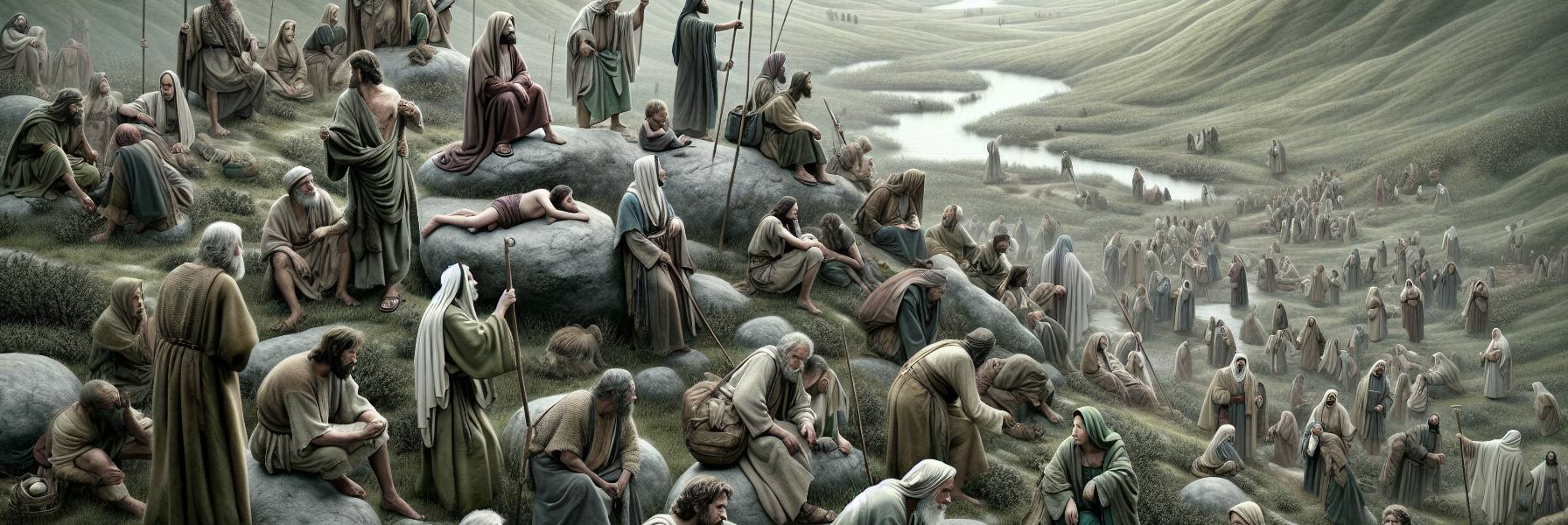

The grass on the hillside was more grey than green, brittle under the weight of so many feet. Thaddeus, a fisherman from Bethsaida who had been following the rabbi for only a few weeks, found a spot on a low, flat rock, his knees protesting. The crowd was a mosaic of desperation and curiosity: faces lined with Roman tax and poor harvests, merchants with shrewd eyes, mothers with children clinging to their legs, a few Pharisees in their distinctive robes standing at the periphery like disapproving statues. The air smelled of dust, sweat, and the faint, dry scent of wild thyme.
Jesus had climbed a little way up the slope, not to a pinnacle, but to a gentle rise where the land cradled him. He sat down. It was the posture of a teacher, but nothing felt academic. He didn’t clear his throat or offer a formal invocation. He simply looked at them, his gaze moving slowly across the sea of upturned faces as if he were counting each one.
When he spoke, his voice carried without strain, a clear, low current that ran beneath the whisper of the wind.
“Blessed,” he began, and the word hung in the air, strange and counter to everything. Thaddeus thought of blessings as things announced in the temple, tied to abundance, to victory, to clean hands. “Blessed are the poor in spirit, for theirs is the kingdom of heaven.”
A murmur, confused. The poor in spirit? The crushed, the ones whose hope was thin as morning mist? Theirs was a kingdom? Thaddeus glanced at a man nearby, his shoulders slumped, his eyes hollow. That man’s head lifted, just a fraction.
“Blessed are those who mourn, for they will be comforted.”
Thaddeus thought of his sister, gone in childbirth just a year before, the sound of her husband’s weeping against the courtyard wall. Comfort seemed a distant promise, a story for later. Yet here was this man saying the mourning itself was a blessed ground where comfort would take root.
The teaching unfolded, not like a legal scroll, but like a man turning over stones to show you the life hidden beneath. “Blessed are the meek…” Meekness was for donkeys and slaves, not for inheriting the earth. But Jesus said it with a certainty that made the Roman road at the valley’s bottom, a symbol of the earth’s current inheritors, seem suddenly fragile.
He spoke of hunger and thirst for righteousness, of mercy, of purity of heart. Each blessing was a dislocation, turning the world’s understanding upside down. The peacemakers were called God’s own children. Then, his tone deepened, touching something harder. “Blessed are those who are persecuted because of righteousness…”
Thaddeus felt a cold knot form in his stomach. He’d seen the sideways looks in the synagogues, heard the muttered questions about this Galilean and his unorthodox circle. Persecution wasn’t a blessing; it was a thing to be avoided. Yet Jesus spoke of it as a badge of honor, linking their potential suffering to that of the prophets their ancestors had scorned.
“You are the salt of the earth,” he said, and Thaddeus, who handled salt daily to preserve his catch, understood. Salt was no good if it lost its bite. It was just grey grit, fit for the path.
Then, “You are the light of the world.” His hand gestured to the small whitewashed houses of a village clinging to a distant hill. “A city on a hill cannot be hidden. People do not light a lamp and put it under a basket.” The image was absurd, and a few people smiled. They were *that* light? This grubby, anxious, hopeful crowd?
The teaching took a sharper turn. It was no longer just about who was blessed. It was about the fabric of the Law itself. “Do not think I have come to abolish the Law or the Prophets… I have come to fulfill them.” The Pharisees at the edge stood a little straighter. Here, perhaps, was something they could grasp.
But Jesus immediately stretched the Law until it became about the heart’s hidden crevices. Anger was a kind of murder. A lustful look was a kind of adultery. It was as if he was saying the commandment against murder wasn’t just about the final act, but about the simmering hatred that preceded it; the command against adultery wasn’t just about the body, but about the gaze that treated a person as a thing to be consumed. Thaddeus squirmed, his own thoughts feeling suddenly exposed in the harsh Galilean light.
“If your right eye causes you to stumble, gouge it out…” He spoke with terrible, surgical seriousness, but it wasn’t a call to literal mutilation. It was a statement of value. The cost of your whole self is worth more than the part that leads you to corruption. It was a shocking metaphor that left you breathless, contemplating the radical surgery of the spirit.
On oaths, he was dismissive in a way that felt almost scandalous. “Simply let your ‘Yes’ be ‘Yes,’ and your ‘No,’ ‘No’…” Truth, he implied, should be so woven into a person’s character that swearing by heaven or earth was a sign of its absence.
And then, the most impossible instruction of all. They all knew the law: *eye for eye, tooth for tooth*. It was a law of measured justice. But Jesus spoke of a different economy. “Do not resist an evil person. If anyone slaps you on the right cheek, turn to them the other also.” A gasp went through the crowd. A slap was the ultimate insult, a declaration of contempt. To offer the other cheek was not weakness; it was a defiant act of dignity, refusing to be drawn into the cycle of degrading violence. It exposed the bully’s cruelty for all to see.
He told them to give their cloak to the one who sued for their tunic, to go a second mile with the Roman soldier who forced them to carry his pack for one. These weren’t rules for slaves. They were the tactics of free men, subverting oppression by an excess of generosity, reclaiming agency by voluntarily going further than they were compelled.
The climax felt like a physical blow. “You have heard that it was said, ‘Love your neighbor and hate your enemy.’” The *hate your enemy* part wasn’t in scripture, but it was in the air they breathed, in the muttered prayers against Rome, in the sectarian feuds. “But I tell you,” Jesus said, his voice now quiet, yet it carried to the very back, “love your enemies and pray for those who persecute you.”
He pointed to the sky, where the sun, now past its zenith, shone on the fields of a Roman landowner and on the tiny plots of the Jewish peasants alike. He spoke of the rain falling on just and unjust. “If you love those who love you, what reward will you get? Even tax collectors do that.” The insult was deliberate, jolting. Their righteousness had to surpass that of the most scrupulous scribe; it had to partake of the very nature of God, who causes his sun to rise on the evil and the good.
“Be perfect, therefore, as your heavenly Father is perfect.”
Silence. Not the silence of boredom, but the silence of a deep, resonant bell that has just been struck, the sound vibrating in the bones long after the air grows still. The word ‘perfect’ – *teleios* – hung there. It didn’t mean flawless. It meant complete, mature, whole, functioning as intended. Like the sun giving its light wholly, without discrimination.
Jesus stopped. He didn’t summarize. He didn’t ask for questions. He simply sat there, looking out at them, his face weary but peaceful, as if he had just laid down a tremendous weight.
Thaddeus realized he hadn’t moved in over an hour. The sun was warmer. The brittle grass seemed less grey. The world had not changed—the Roman road was still there, the Pharisees still frowned, his back still ached—and yet everything was different. It was as if Jesus had drawn back a curtain on a reality that had always been present, a kingdom that existed within and among them, a way of being human that mirrored the generous, shocking, merciful heart of God.
He stood up slowly, his joints cracking. The crowd was beginning to stir, murmuring, some shaking their heads, others with faces alight with a kind of bewildered joy. Thaddeus didn’t join the discussions starting to bubble up around him. He just walked down the hill, the words echoing in the chambers of his mind: *Blessed are the poor in spirit… You are the light… Love your enemies…* It felt impossible. It felt like the only truth he had ever heard. He had come for signs and wonders. He was leaving with a map to a country he had never dreamed existed, etched not on parchment, but on the human heart.