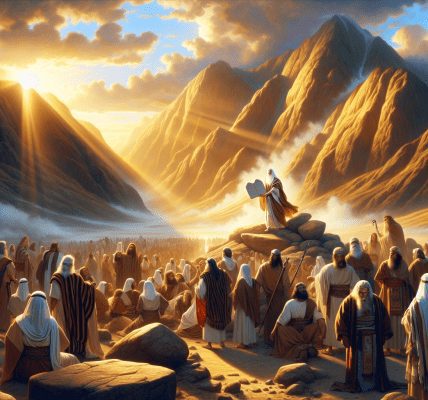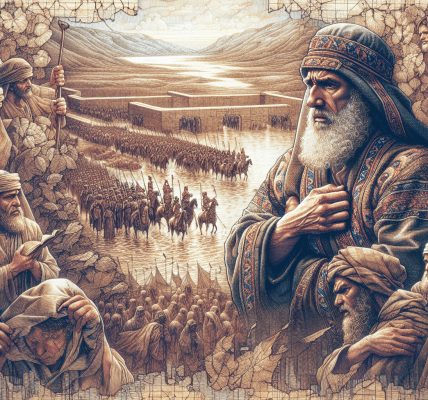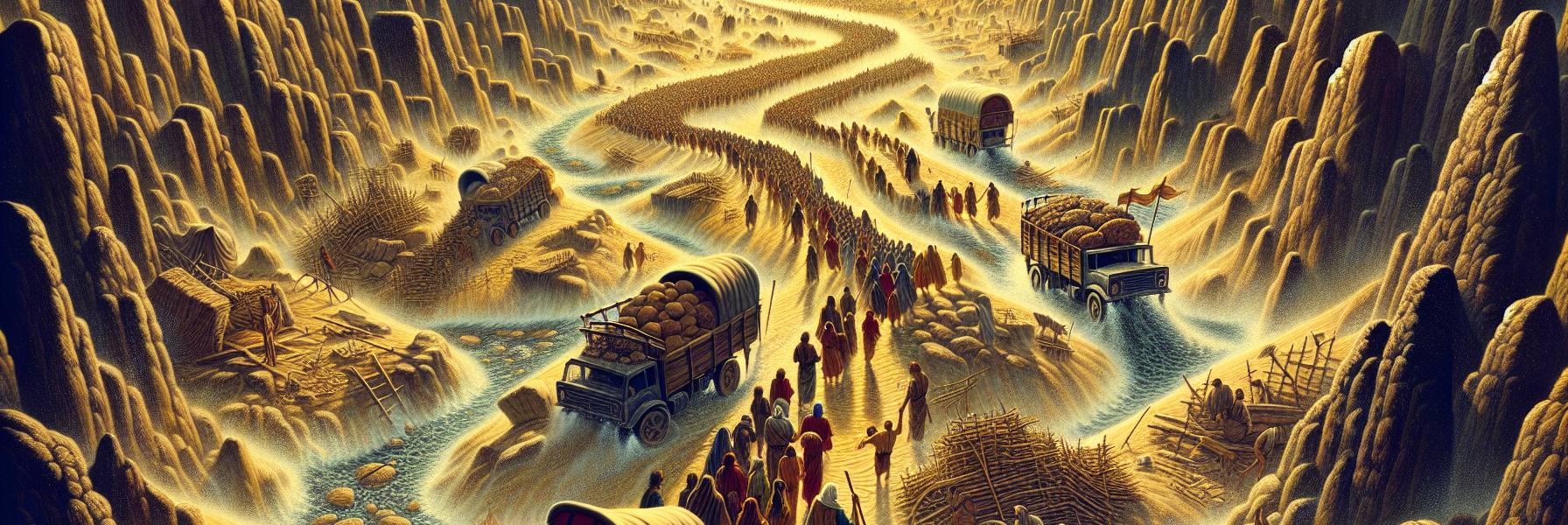

The memory of those years is a weight in my bones. Not the sharp ache of battle, but the dull, grinding press of sun-bleached rock and dust that finds its way into everything—your bread, your sleep, your spirit. We had turned our backs on Kadesh Barnea, on the terror of that report, and for a generation we moved in a wide, slow arc through the great and terrible wilderness. The land did not welcome us. It tolerated us. The Lord our God was with us, we lacked nothing, but His provision was the austere gift of manna, water from stone, and shoes that did not wear out. It was a schooling in dependence, a long lesson we were slow to learn.
Then, the word came. It was time to turn north.
The dust of many camps rose from the plain as we broke the long circle and set our faces toward the mountains of Seir. A different tension gripped the people. It was not the old fear, but a new, watchful alertness. We were moving toward borders now, toward lands with names and kings and standing armies. We were no longer a hidden multitude in a wasteland.
“You are to pass through the territory of your brothers, the descendants of Esau, who live in Seir,” the Lord said to me, and His instruction was precise, a map drawn in commandments. “They will be afraid of you, so be very careful. Do not provoke them, for I will not give you any of their land, not so much as a foot’s length, because I have given Mount Seir to Esau as a possession.”
I stood on a low rise, looking at the distant, hazy ridges that were the hills of Seir. Esau. My brother’s brother. A history of stew and tears and reconciliation centuries old, yet it dictated our path now. We were to buy food and water from them with silver. We were to pass through like merchants, not conquerors. The promise was not here.
So we did. We skirted the edges of their settlements, a sea of people flowing along the valleys. Their scouts watched from the heights, and I could see the glint of spear tips in the sun. Our own young men, their hands on their sword hilts, looked to me with questioning eyes. The urge to take, to prove our strength after so long wandering, was a palpable heat in the air. But the word of the Lord was a boundary firmer than any mountain. “Do not provoke them.” We traded, our silver for their grain and well-water. The transactions were tense, silent, but there was no violence. We moved on, leaving the land of our relatives untouched. It was a strange victory—a victory of restraint.
Then came the command concerning Moab. “Do not harass Moab or contend with them in battle, for I will not give you any of their land for a possession, because I have given Ar to the people of Lot for a possession.”
Another boundary. Another people protected not by their own strength, but by a divine decree rooted in a past we had no part in. The Lord spoke of a people He had destroyed before them, the Emim, tall and formidable as the Anakim. The Moabites called them *Rephaim*, terrors from an ancient time. Yet they lived in that land now, by God’s allowance. It was a humbling reminder: the earth is the Lord’s, and He apportions it to whom He wills. Our story was not the only story He was telling.
We crossed the Wadi Zered. The crossing of that streambed, dry and stony, was more than a geographical transition. The Lord said, “The time elapsed from our leaving Kadesh-barnea until we crossed the Wadi Zered was thirty-eight years, until the entire generation of men of war had perished from the camp, as the Lord had sworn to them.”
Thirty-eight years. I watched the people cross, the sons and daughters of those who had refused to go up. Their faces were not marked by the old rebellion. They carried only the stories of it, like a warning etched on their hearts. A solemn, quiet grief settled on me then, not sharp, but vast as the sky. The wilderness had consumed a generation. The sand of the wadi bed whispered under their feet, a dry echo of all those graves scattered behind us, from one horizon to the other. The hand of the Lord had been against them, and it was finished.
Now, a new land rose before us: the territory of Sihon the Amorite, king of Heshbon.
The instruction changed. The protective prohibitions fell away. “See, I have handed over to you Sihon the Amorite, king of Heshbon, and his land; begin to take possession, and contend with him in battle.”
A strange embassy was ordered. I sent messengers with words of peace, as we had done with Edom and Moab. “Let me pass through your land; we will stay on the king’s highway, turning aside neither to the right nor to the left. We will buy food for silver and water for silver. Let me only pass through on foot.” But the tenor was different. This was not a request guided by kinship or ancient promise. It was a test. A divinely appointed test.
Sihon’s answer was not born of fear, but of pride. He refused. More than that, he gathered his whole army and came out against us at Jahaz, confident, bristling with the arrogance of a king who had never known defeat.
I remember the line of his chariots in the plain, the sun flashing on bronze. I remember the stillness in our camp, a different stillness from the wary tension in Seir. This was a focused quiet. The Lord said to me, “See, I have begun to give Sihon and his land over to you; begin to take possession, so that you may occupy his land.”
We fought. And the battle was not like any I had seen since Egypt. It was the Lord’s doing. Sihon and all his people were utterly destroyed. We captured all his cities at that time—Heshbon and all its towns—and put every man, woman, and child to the vow of destruction. We left no survivor. But we took the livestock and the spoil of the cities as plunder for ourselves.
From Aroer on the edge of the Arnon Gorge, northward, the land was now empty of the Amorite. It was ours. A foothold. A first portion of the promise made tangible.
I walked through the ruins of Heshbon after the smoke had cleared. The silence was heavy, filled with the ghost of a kingdom that had stood in the way of the purpose of God. There was no triumph in my heart, only a solemn awe. The Lord had hardened his spirit and made his heart obstinate, that He might give him into our hand. We had moved from the patient, circuitous wandering, through the disciplined restraint with brothers, to the sudden, total warfare of His judgment.
It began here, on this side of the Jordan. Not with a fanfare, but with the dust of a refused peace settling on the road to Jahaz. The long turn was over. We were facing the land, and the land would now begin to feel our tread.