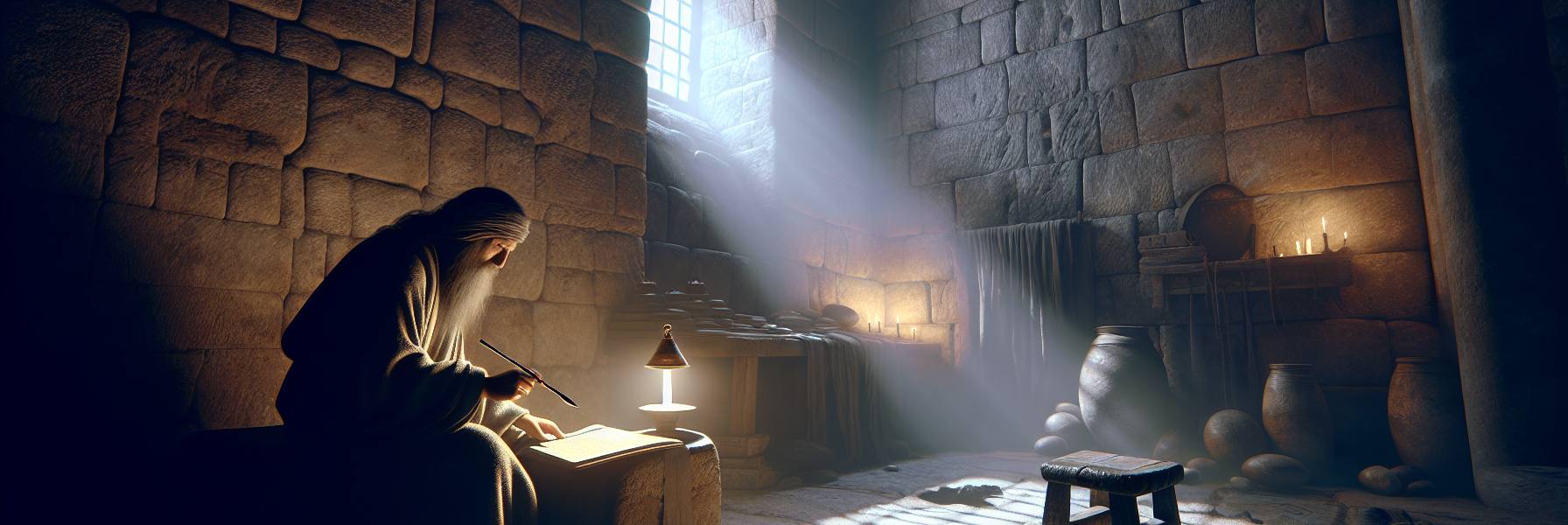

The heat in the room was a physical weight. It wasn’t the dry, clean heat of the desert, but the stifling, woolen heat of a closed upper chamber in Jerusalem’s oldest quarter, where the stone walls drank the sun all day and breathed it back at night. I sat on a low stool, a blank parchment before me, a sharpened reed in my hand that felt as heavy as a spear. The lamp guttered, throwing frantic shadows that seemed to mock my stillness.
For months, it had been like this. A dryness in the soul. A silence where there used to be a stream.
It wasn’t that the Lord was distant. I knew, in my bones, the terrible, wonderful truth: He was *right here*. That was the problem. His presence, which had once been my citadel, had become a crushing weight. I could feel Him in the stillness, a silent witness to the rot inside me. My own bones, as the old words say, began to waste away. It was no metaphor. A dull ache had taken residence in my joints, a weariness that sleep could not touch. My vitality, the very force that had carried me through wilderness and war, was being sapped, drop by drop, as if by the relentless summer sun.
It was the silence that did it. My silence.
The thing I carried—a wrong turn, a moment of profound failing, the kind that reshapes the landscape of a life—I had wrapped it in layers of justification and locked it away in a vault of my own making. I told myself it was for the good of the kingdom. For stability. I told myself it was buried. But the dead do not always stay buried. They groan, and their groaning echoes in the hollow places of the spirit.
I would go through the motions. Offer the sacrifices, speak the prayers, give the judgments. The courtiers saw a king, perhaps a tired one. But I moved through those days like a man wrapped in sodden wool, every step an effort. The music had left me. The harp in the corner gathered a fine layer of dust, its strings slack. To sing would be a lie, and my spirit, for all its sickness, revolted against the hypocrisy. Joy was a memory, a story told about someone else.
And then, the breaking point. It wasn’t a voice from heaven. It was a simple, physical thing. I reached for a cup of water, and my hand trembled so violently the water spilled, a dark stain spreading on the cedar table like an accusation. In that moment, I saw it clearly: I was not being punished by a capricious god. I was being consumed by my own unacknowledged poison.
The decision was not a grand one. It was a collapse. A giving up.
I did not go to the Tabernacle. I did not summon the High Priest. I turned my face toward the wall, away from the guttering lamp, and into a deeper darkness I knew I must enter. And I spoke. Not a crafted prayer, not a royal petition. A raw, unvarnished truth, whispered into the woolen heat.
“I have sinned.”
The words hung in the air, ugly and small. And with them, the floodgates opened. Not of excuses, but of confession. I named the thing. I laid out its shape, its consequences, the petty pride and the gross failure that spawned it. I did not parcel it out or soften its edges. I dumped the whole festering mass of it out before the One whose gaze I could no longer bear, yet could no longer escape.
And a strange thing happened. As the words left me—the last of them a spent whisper—the crushing weight in the room… shifted. It didn’t vanish. It *lifted*. It was as if a hand, cool and immense, had been placed upon my fevered brow. The silence that followed was not the accusing silence of before. It was a deep, clean, quiet silence. The silence of a debt cancelled. The silence after a storm has passed, when the air is washed new.
The ache in my bones did not miraculously disappear that night. But its nature changed. It was no longer the ache of corruption, but the ache of healing, like a wound being knit together, tender and sore, but clean.
I picked up the reed. My hand was steady. The words that began to flow onto the parchment were not the ones I had planned. They came from a place deeper than poetry, a well that had been unblocked.
*Blessed is the one whose transgression is forgiven, whose sin is covered over…*
I wrote of the misery of keeping silent. I wrote of the Lord’s hand being heavy upon me, a truth I had lived. Then, the turning point: *I acknowledged my sin to you, and I did not cover my iniquity. I said, “I will confess my transgressions to the Lord.”*
The next line wrote itself with a certainty that tasted like cool water: *And you forgave the iniquity of my sin.*
Forgiveness. It is not a feeling. It is a state of being. A judicial act of the cosmos, decreed by the only Judge who matters. It is the dismantling of a wall I had built with my own two hands. The room was no longer a prison. It was simply a room, holding the quiet night and the soft light of a single lamp.
The psalm unfolded, becoming a warning, a shout of joy, an instruction. *Therefore let everyone who is faithful pray to you at a time of finding.* A time of finding! That was it. Not when you have it all together, but when you find yourself lost, when you find the courage to stop hiding.
I wrote of the Lord being a hiding place, and the irony made me smile, a real smile that felt strange on my face. He who had been my unwanted witness had become my only shelter. The surrounding shouts of deliverance were not yet in the air, but they were in my heart, a future promise I now trusted.
I ended with a contrast, the stark choice laid bare: the sorrows of the wicked, and the steadfast love surrounding the one who trusts.
The scribe found me in the morning, asleep at the table, my head resting on my arms beside the finished psalm. He later told me I looked peaceful, younger somehow. He took the parchment with care, seeing the smudges where tiredness had met ink.
He didn’t know the half of it. He saw a poem. I had lived a rescue. The joy I wrote of—*Be glad in the Lord, and rejoice, O righteous!*—was no longer a command to be obeyed. It was the only possible response to a weight that was gone, a silence that had been broken, and a love that had waited, unwavering, for me to stop talking and start listening to my own crumbling bones.